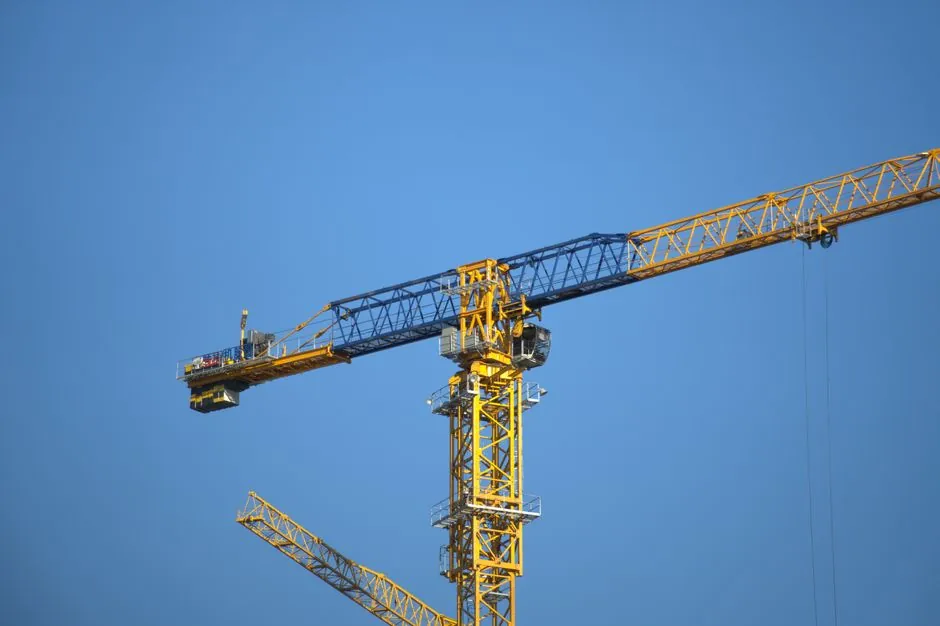
The grade defines a minimum yield strength of 700 N/mm², allowing thinner plate than S355 for the same load, while moving the critical design work to welding, heat management, bend radius and section stability [S3][S5].
What S700 Changes in a Boom Section
S700 belongs to the high-strength structural steel range used in lifting equipment, where 700 MPa yield strength allows engineers to reduce material thickness instead of enlarging the section [S1][S5]. The number in the grade is a strength parameter, not permission to assume that every component can be made 700/355 thinner.
That 700/355 relationship is about 1.97 times the nominal yield-strength ratio, but actual mass saving depends on buckling, deflection, fatigue, weld size, local geometry and the fraction of the boom that is actually strength-governed [S2][S5]. High-strength plate for fabricated booms can be treated in the broader context of steel plate, with the weld heat-affected zone acting as a separate metallurgical limit.
High-strength grades are not limited to S700. Mobile crane booms commonly use S355, S690, S960 and S1100, with the grade number representing minimum yield strength in N/mm². S960 and S1100 are used for modern high-capacity telescopic booms, while S690 occupies a higher-strength middle range [S3].
Where the 20–40% Saving Comes From
A reach-stacker study reported a boom weighing 2,974 kg, representing a 26% weight reduction compared with the current design.
Material substitution provides the first saving, but section geometry can provide a second. For boom members subjected to torsion, a closed box section has much higher torsional stiffness than an open U or I section at the same mass. Variable-thickness fabricated girders place material where the load path requires it rather than maintaining one plate thickness over the full length [S5].
Comparison by governing criterion makes the engineering choice clearer:
<table><thead><tr><th>Criterion</th><th>S700 welded box option</th><th>S355 conventional option</th></tr></thead><tbody><tr><td>Static strength</td><td>700 MPa nominal yield strength, permitting reduced thickness</td><td>355 MPa nominal yield strength, generally requiring more material</td></tr><tr><td>Fatigue</td><td>No automatic increase at welds; weld detail remains decisive</td><td>Weld detail also remains decisive</td></tr><tr><td>Buckling and stiffness</td><td>May govern once plate thickness is reduced</td><td>Less exposed to thickness-driven stiffness loss</td></tr><tr><td>Fabrication</td><td>Requires tighter heat-input, cooling and bend-radius control</td><td>More tolerant welding and forming process</td></tr></tbody></table> <p>The comparison shows why S700 is not a universal substitution. It is strongest when static strength governs, while S355 may remain simpler to fabricate and repair. For torsion, a closed section can be more effective than simply changing steel grade.
Welding Is the Main Process Constraint
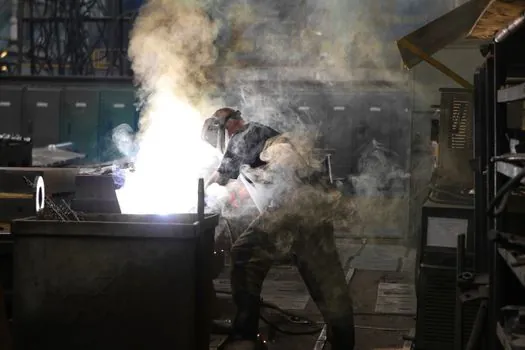
Welding S700 or S960 introduces localized heat that changes the steel microstructure, and excessive heat input or an unsuitable cooling time can soften the heat-affected zone [S5]. The fabrication plan therefore needs controlled heat input, specified cooling time t8/5, compatible filler selection and adequate preheat and interpass control where required [S3][S5].
Higher grades narrow the repair margin. Fatigue strength at a welded joint does not automatically rise with the nominal steel grade, so lighter weld geometry can even expose a weak fatigue detail [S5].
Thinner plate also changes distortion, fixture requirements and weld sequencing. These are fabrication consequences of the lightweighting proposal, while final structural approval remains with the design owner [S5].
Section Shape Can Beat a Simple Steel Upgrade
For members in torsion, closed box sections provide far higher torsional stiffness than open U or I sections at the same weight. For a crane boom, this can raise stiffness without changing the steel grade, but it increases weld count and creates closed-corner quality requirements that fabrication must control.
Other section options can remove weight from low-stress regions.
For buyers comparing forms, steel hollow sections provide the broader product family for welded box or tubular boom members. The decision should rank the actual section by mass, torsional stiffness, local buckling, weld access and inspectability rather than by grade alone [S1][S5].
Static Strength, Fatigue and Deflection Must Be Checked Separately
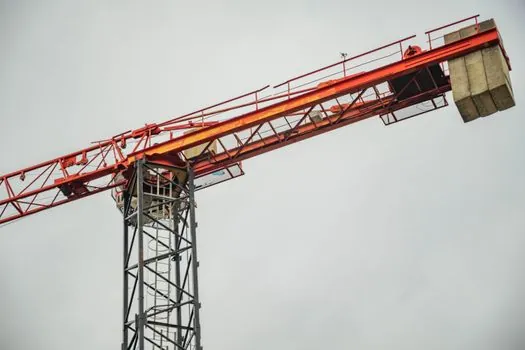
Moving from S355 to S700 or S960 permits thinner plate for the same load, but that statement applies only when the load is controlled by material yield strength [S5]. Under fatigue loading, a higher grade does not raise the fatigue strength of the weld unless the connection detail improves, and under a stiffness requirement, reducing thickness can increase deflection even when yield checks pass [S5].
A design review should therefore record at least 4 checks: the governing load case, the selected plate thickness, the weld detail and heat-affected zone, and the deflection or buckling result. S700 can reduce section mass when these checks pass, but the weight-saving claim is not transferable from static design to fatigue-limited or stiffness-limited structures without recalculation or testing [S2][S5].
For lattice booms, the material grade of each member also interacts with pin or welded connection details, local opening geometry and load distribution. SSAB identifies high-strength plate, tubes and hollow sections as materials for lattice booms, jibs and frames, where higher strength can support thinner structural dimensions [S1].
Repairability and Service Life Become Design Constraints
S700, S960 and S1100 boom steel require more demanding repair procedures than S355 because welding can reduce local toughness or create residual stress if the procedure is incorrect [S3]. A boom design that saves mass but cannot be repaired economically may create a higher lifecycle cost than a heavier baseline section.
High-capacity telescopic boom programs face an especially narrow repair market because qualified procedures, suitable consumables and controlled workshop conditions are required for 960 and 1,100 N/mm² material [S3]. The grade affects certification, repair method and damage cost, so repairability should be evaluated alongside transport mass, setup speed and lifting capacity [S3].
Strenx lifting steels span 700–1,300 MPa yield strengths for aerial work platforms and mobile cranes, illustrating the broader design ladder available to lifting-equipment engineers [S1]. The relevant choice is not the highest grade available, but the lowest grade that satisfies strength, fatigue, stiffness, welding and repair constraints for the specific boom configuration.
Procurement Check Before Ordering S700 Material
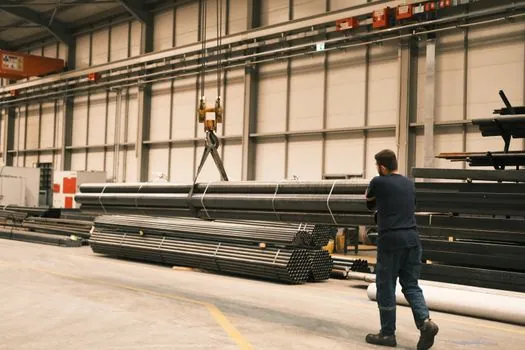
Specify the full material and fabrication package rather than ordering only a grade designation. The supplier needs to confirm thickness tolerances, flatness, bending properties, weldability and available section dimensions because production performance is as important as nominal yield strength for thin, high-strength boom fabrication [S1].
For a welded boom, require a grade-specific WPS, compatible filler selection, heat-input and t8/5 controls, preheat and interpass limits, bend-radius requirements, weld sequencing and a defined distortion-control plan [S3][S5]. Then verify the mass target against three baselines: the original boom, an equivalent S355 box design and an optimized S700 box design.
The trackable engineering result is not simply “S700 saves weight.” It is a signed-off section schedule showing kilograms removed, governing failure mode, calculated margin, weld procedure and repair method. The 20–40% range is credible for an optimized structure, while the 26% reach-stacker calculation demonstrates a specific boom case rather than a universal S700 outcome [S2][S4].