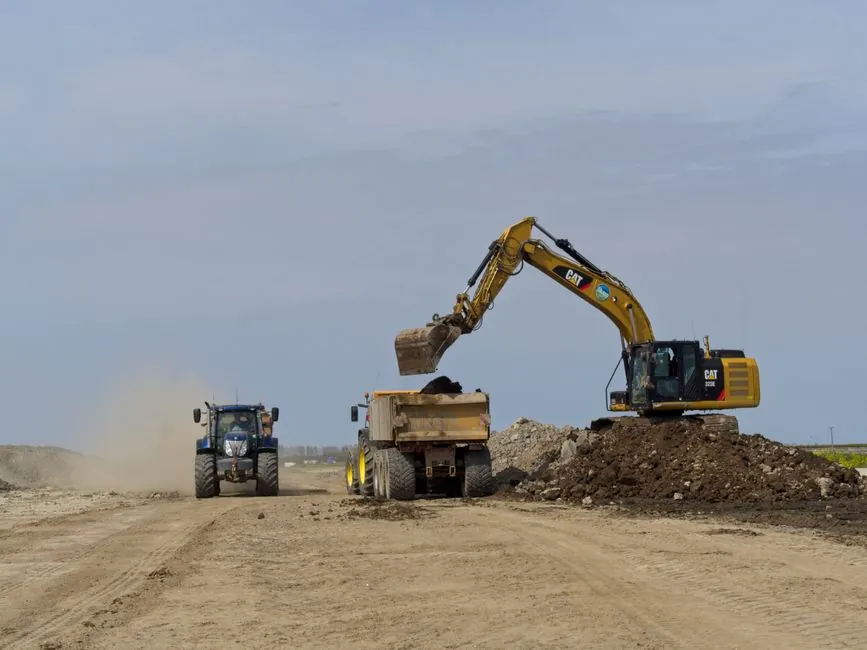
Agricultural buyers should match the machine to slope, hydraulic capacity, and load density: 1.5–2 t rubber-tracked carriers from suppliers such as GlobalMachEx climb 45° grades on muddy orchard and field roads, while tractor-pulled off-road dump trailers in the 10–20 gauge steel class serve most row-crop and livestock farms within the 20% loaded-weight-to-tractor rule of thumb [S1][S2].
Articulated dump trucks (ADTs) from John Deere, Hyundai, and others start at 25 t payload, so they fit only the largest grain, silage, or estate-scale operations; typical mid-size farms have no business running a 359 kW (481 hp) 460E that weighs 74,036 kg loaded [S5]. Knowing where each class breaks is the first selection step.
Three platform classes, three farm profiles
Tracked mini-dumpers (1.5–2 t payload, hydraulic tipping bed, ~45° slope capability) target orchards, vineyards, and smallholder plots where ground pressure, not tonnage, is the binding constraint; these units often replace wheelbarrows and small trailers on steep, wet terrain and run on modest diesel or petrol engines in the 10–20 kW band [S1]. Tractor-pulled off-road dump trailers in the 1,500–6,000 kg loaded range remain the workhorse for mixed farms, pairing with compact and utility tractors already on the property [S2]. Full-size ADTs in the 250D–460E bracket (25–46 t rated payload) are over-specified for crop production but appear on large ranches, contract forage operations, and farm-to-quarry aggregate haulage where a single owner moves tens of thousands of tons per season [S5][S7][S10].
Selection criteria that actually fail in the field
Dump angle and lift height are the two most commonly mis-specified parameters: a proper dump angle starts at 45°, with 50°+ optimal for shedding sticky clay and wet manure, and lift height must clear the receiving spreader, hopper, or trailer sidewall [S2]. For tracked carriers, slope rating (commonly published at 45°) and ground clearance matter more than engine power, because the limiting factor on hilly orchards is traction, not speed [S1]. For tractor-pulled trailers, the binding metric is hydraulic flow: an undersized GPM/PSI combination on the tractor will lift a loaded bed too slowly and overheat the remote valve, so buyers must consult their tractor operator manual before sizing the cylinder [S2]. The 20% rule, that a tractor's curb weight should sit within 20% of the loaded trailer weight, is the single most cited stability guideline in the off-road trailer segment [S2].
Comparison: tracked mini-dumper vs off-road trailer vs ADT
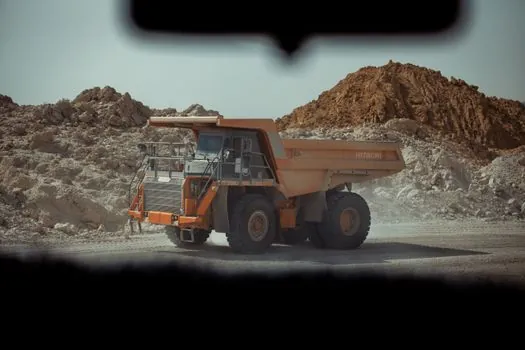
On payload, slope rating, and capital cost, the three classes split cleanly. A 2 t tracked carrier hauls about 2,000 kg per load, climbs 45° slopes, and lists at a fraction of the price of a self-propelled ADT, but its top speed is single-digit km/h and it cannot legally enter public roads in most jurisdictions [S1]. An off-road dump trailer sized to a 75–100 hp compact tractor typically carries 2,500–5,000 kg, requires the tractor's existing hydraulics, and shares the tractor's road-legal status, which makes it the most flexible option for mixed farms [S2]. A 25 t ADT (e.g., John Deere 300D) carries roughly 27,000 kg heaped and runs at 30+ km/h on private haul roads, but consumes 20–30 L/h of diesel and needs a trained operator; a 46 t 460E escalates to 41,820 kg rated payload with a 25.5 m³ heaped body and a 359 kW (422–481 hp) engine [S5][S7]. For typical row-crop and livestock farms, the tractor-trailer pair is the right economic answer; for steep, soft, or terraced terrain, the tracked carrier wins; for estate or contract-scale bulk haulage, an ADT is justified only with steady high-volume tonnage.
Frame, bed, and hydraulics: where low-cost units fail
Off-road trailer and dumper durability lives or dies in three places: frame steel grade, bed gauge, and dump cylinder sizing. Industry guidance for off-road dump trailers calls for a minimum 10-gauge steel bed, with 7-gauge or 3/16" steel preferred for rocky, log-strewn sites; frames should be high-tensile or reinforced channel steel with continuous, even welds free of spatter [S2]. Tracked mini-dumpers invert the priorities: a hydraulic dump bed with positive cylinder lock and a fabricated high-alloy steel body matters more than bed thickness, because the limiting wear mode is abrasion from sand, gravel, and fertilizer, not impact [S1]. For ADT-class machines, John Deere specifies high-alloy-steel dump bodies, fabricated heavy-duty frames, and purpose-built 8F/4R transmissions on the E-Series (370E/410E/460E), with wet-disc brakes and full-time six-wheel drive; an available dump body heater prevents carry-back in cold-weather silage or clay conditions [S5]. The D-Series 250D–400D shares the same design language in the 25–40 t class, with operating weights between roughly 30,000 kg and 60,000 kg loaded [S7].
Power, weight, and the ADT reference data point
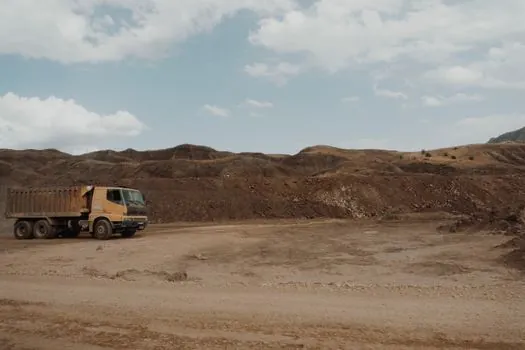
Buyers who do move into the ADT class should anchor their decision on published, verifiable specs. The John Deere 370E delivers 315 kW (422 hp), 20.5 m³ (26.8 cu yd) heaped capacity, and a 33,630 kg rated payload; the 410E steps to 330 kW (443 hp) and 37,266 kg; the 460E reaches 359 kW (481 hp) and 41,820 kg, the largest ADT John Deere has produced as of the E-Series publication [S5]. Hyundai's HA45 ADT, a competing 45 t-class unit, lists a Scania DC13 engine at 489 hp @ 2,100 rpm, 1,750 ft-lb torque @ 1,130 rpm, and 66,359 lb (30,100 kg) operating weight, which puts it in the same payload band as Deere's 410E/460E [S10]. For agricultural buyers, the practical takeaway is that any ADT under 30 t operating weight is rare, and most farm-scale ADT purchases sit in the 25–40 t payload range (D-Series 250D–400D), not the 46 t flagship [S7][S9].
Operating environment and standards notes
For tractor-pulled off-road dump trailers, the dominant failure modes are bent tongues from overloading, cracked welds at the gooseneck, and hydraulic cylinder seizure from contamination, all of which trace back to the buyer ignoring the tractor's hydraulic GPM and the 20% weight rule [S2]. For tracked mini-dumpers, the failure mode is underframe flex on operators who exceed the 45° slope rating or use the machine on hard, abrasive surfaces that wear rubber tracks prematurely; suppliers therefore recommend staying on muddy, soft, or orchard-floor surfaces [S1]. For ADT-class machines, on-farm operation typically requires compliance with local on-road rules for crossing public highways, plus operator certification that varies by jurisdiction; the John Deere E-Series documentation flags EPA IT4/EU Stage IIIB emissions as the standard configuration, with cooled EGR, a DPF, and a DOC aftertreatment package [S5]. Buyers should match the machine's emission tier to the region of operation rather than assume a single global spec.
Where the small-tracked-carrier segment is heading
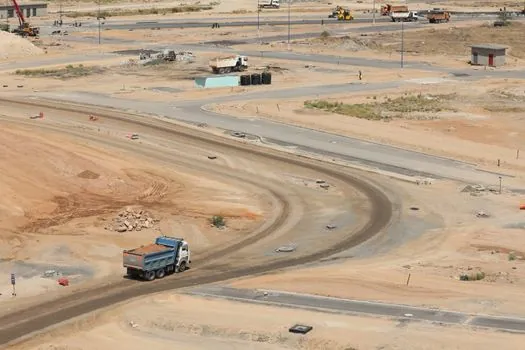
Within the past 6 months, tracked mini-dumper offerings for agriculture have consolidated around two payloads (1.5 t and 2 t), rubber-track undercarriages, and hydraulic tipping beds with a 45° slope rating; suppliers such as GlobalMachEx now market these as multi-purpose carriers for fruit, fertilizer, sand, and gravel rather than purely construction tools, a sign that the orchard and small-farm segment is large enough to be a primary sales channel [S1]. Off-road dump trailer guidance published 2026-01-05 emphasizes the 20% tractor-to-trailer weight rule and the 45°–50°+ dump-angle window as non-negotiable, which is a slight tightening of older 30° recommendations and reflects the heavier clay and manure loads on modern livestock operations [S2]. Reference platforms to weigh against any new quote: the John Deere 370E–460E ADT range for bulk haulage, the Hyundai HA45 class for the 45 t comparison point, and a compact off-road dump trailer pairing for typical mid-size farms. For a demolition-style body spec that also informs farm aggregate use, the dump-truck selection guide for demolition carries a useful steel-body and axle-count comparison. Trackable signals over the next 6–12 months: whether 2 t tracked carriers add factory-fitted ROPS and diesel Stage V options, and whether mid-size ADT makers (250D–400D class) release a lower-emissions Tier 4 Final / Stage V variant targeted at on-farm, not just quarry, buyers [S5][S7].