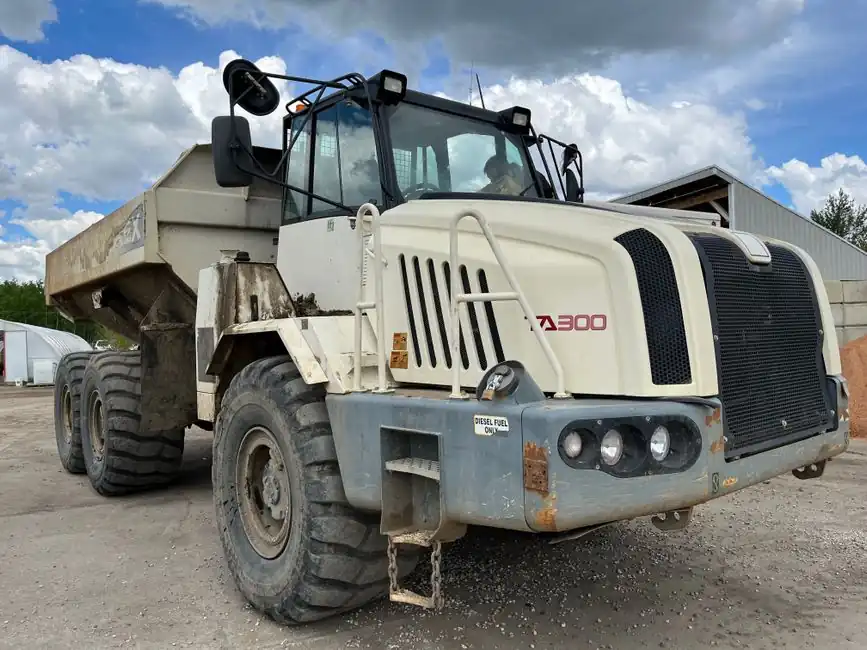
The DirectIndustry industrial index, as of 2026-07-09, lists 20 manufacturers offering 68 distinct mining-and-quarrying dump-truck models, with Bell Equipment, Caterpillar Global Mining, Hitachi, Hyundai, Komatsu and XCMG dominating the named-OEM shortlist [S1].
Payload bands inside that index run from roughly 30 t utility-class units to 363 t mechanical-drive mining trucks, and the correct selection is decided first by mine tonnage and haul-road profile, not by engine horsepower or tyre size [S1]. A 50-tonne-class rigid frame unit such as the HOWO 50T posts a 22,090 kg curb weight, 50,000 kg maximum permissible total mass, 8,700 mm overall length, 75 km/h maximum driving speed, and 43% maximum gradability on the Okorder published spec sheet [S2].
Payload Class and Rigid-Frame versus Articulated Split
Payload class is the first spec gate, not the last: 30-50 t covers construction-quarry and small open-pit work, 70-100 t is the mid-range rigid-frame (mechanical-drive) mining truck, 150-240 t covers the 793/797/Cat 793F class, and 290-363 t covers the 980E/MT5500 ultra-class [S1][S2]. The HOWO 70-ton mining dump truck (ZZ5707S3840AJ family) sits at the lower edge of the off-road mining class, with a 6x4 drive layout, manual transmission, and Euro 2 emission rating [S1].
Articulated dump trucks (ADTs), typically 25-45 t payload with 6x6 drive and oscillating articulation, suit soft-ground, muddy or steep-gradient haul roads below roughly 2 km one-way, where a rigid-frame mechanical-drive truck would bottom-frame or lose traction [S1]. Rigid mechanical-drive haulers suit hard-rock, long-cycle, high-tonnage pits with crushed-stone or blasted bench roads. A working mining dump truck reference page catalogues the truck class and separates it from the broader dump truck taxonomy that includes on-highway tippers.
Drive Layout, Engine Power and Transmission
Common drive configurations on the 2026 OEM shortlist are 4x2, 6x4, 8x4 and 6x6, with 6x4 dominating the 30-50 t class and 6x6 standard on ADTs [S1][S5]. For daily loads at or above 50 tonnes, 8x4 or 6x6 heavy-duty configurations are specified; for general construction and short-haul transport, 6x4 standard models remain the value choice [S5]. For the HOWO 6x4 41-50 t mining dumper the OEM specifies a diesel engine with manual transmission, 41-50 t payload, and Euro 2 emission standard, figures that matter for any pit where Tier 4 Final / Stage V is contractually required [S1].
Western OEM mechanical-drive rigid haulers scale gross engine power at roughly 1,500 kW in the 100 t class, 2,000-2,500 kW in the 240 t class, and 2,600-3,000 kW in the 363 t class, paired with AC-drive or DC-drive electric-wheel traction and retarder braking rated in the megawatt range [S1]. For sites above 200 km one-way haul or with trolley-assist infrastructure, mechanical-electric drive (AC drive alternator plus wheel motors) raises the efficiency curve but adds roughly 12-18% to capital cost and requires a defined site voltage, typically 3 kV DC or 6 kV DC for trolley assist and 690 V AC on-board for the wheel motors [S2]. The wrong powertrain choice, such as diesel-mechanical on a long down-gradient haul, wastes fuel and overheats service brakes; electric-drive with retarder is the standard answer for sustained down-haul cycles [S1][S2].
Body Volume, Liner Selection and Loading-Tool Match
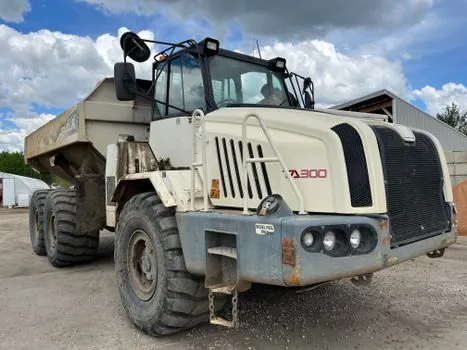
Body volume (heaped m³) and payload must reconcile to within roughly 10% of the loading tool's pass count, or the truck either short-loads (wasted cycle cost) or spillage-loads (struck-pan damage) [S1]. A 16 m³ body suits 5-6 m³ shovel passes (3-pass loading); a 25 m³ body steps up to larger hydraulic faces. Common Chinese OEM body capacities for general engineering sit in the 15-25 m³ range, with larger volumes reserved for bulk material transport [S5].
For highly abrasive cargo such as large ore blocks, HARDOX wear-resistant steel is the recommended body material; rubber mat suits coal where impact is light and hang-up is the dominant failure mode [S1][S6]. A fleet sizing rule used by Chinese OEM buyers pairs a 4 m³ shovel or 100 t excavator with a 45-50 t rigid, and a 6-8 m³ hydraulic shovel with a 70-90 t rigid [S2]. Aerodynamic studies on mining dump trucks, including head-shape rounding and splitter-plane additions, show measurable drag reduction at sustained haul speeds, though for typical 30-40 km/h cycle speeds the fuel saving is marginal versus the liner/tyre cost [S1].
Braking, Grade Performance and Tyre Selection
For pit ramps at 8-12% sustained grade, retarder braking and engine brake capability are non-negotiable on any truck above 50 t payload; the service brake alone will fade inside one loaded down-haul cycle [S1]. Buyers running at 110-115% of nominal payload to hit production targets accelerate frame fatigue cracking and bed cracking on the second overhaul cycle, which is the most common reason fleets cycle trucks inside five years instead of ten [S2]. Two payload numbers on a spec sheet need verification before sign-off: rated payload (the OEM warranty basis) and maximum permissible total mass (the legal/road limit). On the HOWO 50T, curb weight is 22,090 kg and maximum permissible total mass is 50,000 kg, leaving roughly 27.9 t of legal payload once fuel, operator, options and 5% overload tolerance are netted [S2].
Tyre selection follows the payload and haul-road profile, not the brand shortlist: for a 30-50 t rigid on blasted rock, 24.00R35 or larger radial off-road tyres are typical; for a 70 t unit the step is 27.00R49 or 30.00R51; ultra-class 363 t haulers run 40.00R57 or 59/80R63 [S1][S5].
Use-Case Match: Open-Pit, Quarry, Underground and Cross-Country Haul
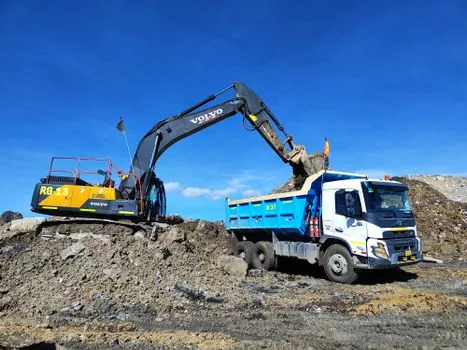
Open-pit coal and mid-scale iron-ore haul roads with one-way distances under 5 km and ramp grades below 10% are the natural fit for 50-tonne HOWO-class rigid haulers, while 30-tonne units target quarry face-to-crusher loops and 90-100 tonne rigid frames handle overburden stripping on iron-ore and copper operations [S2]. In Liberia's Yekepa-to-Buchanan corridor, 430-460 hp 6x4 dump trucks paired with 3-axle dump semi-trailers raise single-trip payload from 30 t to 55 t while cutting fuel consumption by 15-20% versus a single-unit rigid on the same route [S3].
Underground operations require a separate dumper class with tighter turning radius, lower overall height, and diesel particulate-filter or engine package certified for confined-space ventilation, as set out in the underground dumper selection guide [S7]. Above-ground cross-country haul (mining area to railhead or port) frequently shifts to tractor-trailer combinations because of bridge load limits and tyre-road-wear cost, which is why route analysis matters as much as truck spec [S3]. Buyers evaluating trailer-mounted or chassis-mounted options can cross-reference the broader concrete mixer truck class for chassis-platform commonality, and the reach truck entry for warehouse-scale material-handling contrast.
Compliance, Sourcing and Cost-per-Tonne
Chinese OEM 50 t mining dump trucks are typically offered with WD615 series diesel engines in the 336-420 hp bracket, paired with 7-9 speed manual or fully automatic transmissions, a 5-tonne front and 10-tonne rear axle rating split, and a 6x4 drive configuration [S2]. Entry 6X4/8X4 construction-grade mining dump trucks list on Made-in-China at US$9,000-13,000 per unit with 1-piece MOQ, while 4X2 mini tippers drop into a lower price band; Sinotruk HOWO Tx 380/400/430 hp 8x4 25 m³ units list at US$19,800-26,900 per unit FOB [S1][S8]. Compliance with local emission standards and traffic regulations in the destination country is a hard gate; Tier 4 Final / Stage V is contractually required in many jurisdictions and excludes Euro 2 Chinese stock [S1][S2][S5].
The mechanical-spec Chinese 30-50 t class remains the dominant choice for new Chinese coal and quarry buyers in 2026 because it interfaces with no fixed infrastructure, while Western OEM ultra-class trucks are reserved for the world's largest open pits where 200-400 t payloads rewrite the cost-per-tonne economics [S1][S2]. One way to keep the cost-per-tonne-haued number honest is to lock the on-site voltage, the sub-station location and the truck pantograph spec at the gate stage when trolley-assist is even a remote possibility, because retrofit after delivery is a stranded-capital event [S2]. Useful adjacent reading for fleet planners evaluating related heavy equipment classes sits in this boom-and-chassis agricultural concrete pump truck selection map, which addresses similar chassis-and-engine trade-offs in a different duty cycle.
Limitations, Failure Modes and Standards Discipline
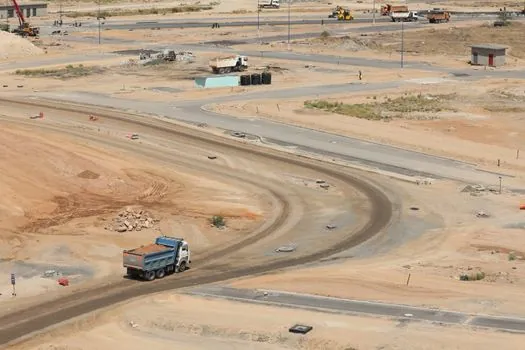
The most common procurement failure modes are: mismatched payload class versus site conditions, over-spec on engine power, under-spec on frame and bed hardness, and running above nominal payload to recover a margin gap, all of which shorten structural warranty life [S2][S4]. Haulage cost can dominate total mining operating cost in large open-pit operations, so a wrong truck class compounds the financial loss across every cycle, not just the purchase line [S4].
Procurement discipline requires two written verifications before any supplier quote is accepted: rated payload versus maximum permissible total mass, and emission standard versus destination-country requirement, with the engine model, transmission type, axle split and drive configuration named on the order sheet rather than implied by marketing literature [S1][S2][S5]. Frame, bed and body hardness should be specified by steel grade (HARDOX-class wear plate for ore, high-tensile structural for frame rails), not by generic "heavy-duty" descriptors [S1][S5][S6].
Track the next signal: 2026 export-volume data for Chinese OEM mining dumpers (Made-in-China and GoldSupplier transaction counts) and any 2026 Tier 4 Final / Stage V compliance filings for the 50 t rigid class, both of which will redraw the 30-50 t versus 70-100 t crossover for new coal and iron-ore buyers in 2027.