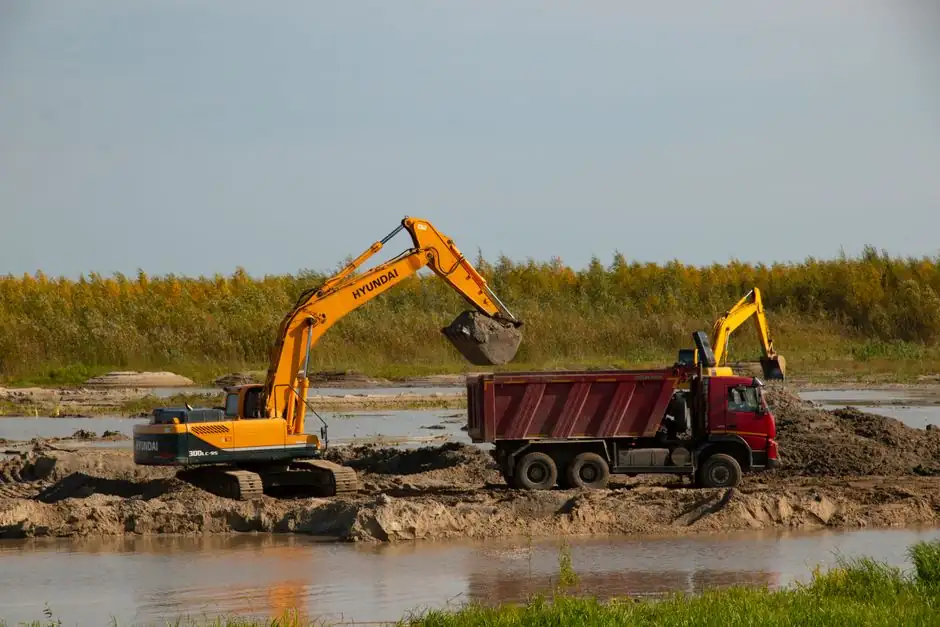
A 6×4 dump truck running a 300–380 hp engine remains the workhorse configuration for most road construction fleets in 2026, balancing 15–25 m³ body volume against maneuverability on partially completed pavement [S3]. On greenfield earthworks where haul cycles stretch past 2 km and gradients hold below 8–10%, an 8×4 rigid chassis at 400–550 hp shifts lower cost-per-tonne, while soft-ground or steep-grade sites above roughly 10–15% push buyers toward articulated dump trucks in the 20–60 tonne payload class [S2][S4].
Selection is not a single-decision problem. Engine torque curve, body steel grade, axle count, turning radius, emission tier, and dump-box volume interact with material density and route geometry, so a truck that excels on a crushed-stone motorway subbase can be the wrong tool for a residential base-layer job. The remainder of this article maps the dominant configurations, dimensional envelopes, and decision filters that procurement engineers and site managers are applying to dump-truck tenders dated 2026-08.
Axle Configuration vs Haul Profile: The Core Decision
For road construction, the most decision-critical axle layouts are 4×2, 6×4, and 8×4, with 6×6 reserved for extreme terrain [S3]. A 4×2 single-axle unit suits light residential and small-scale projects, where daily payloads stay well under the heavier classes and short-distance moves dominate. The 6×4 layout is widely used in construction and road haulage because it offers the best value-for-money balance between payload, parts availability, and tire wear [S3]. When daily loads push ≥50 tonnes, the 8×4 layout delivers higher payload capacity and better stability under sustained heavy hauls, which is why mining and quarry operators default to it [S2][S3].
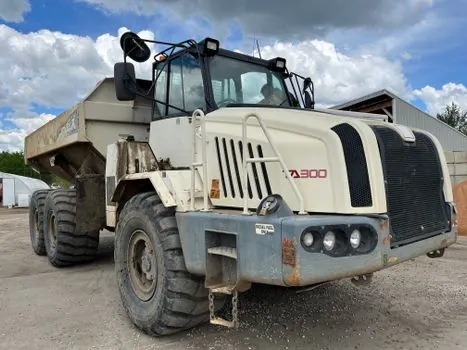
For projects where haul-road engineering is the binding constraint, the off-highway decision shifts to ADT versus RDT. Articulated dump trucks (ADTs) hold a mobility edge on soft ground and on sustained grades above approximately 10–15%, with payload ranges of roughly 20–60 tonnes and typical haul distances under 2 km. Rigid dump trucks (RDTs) are engineered for hard, stable haul roads and push payloads of roughly 40–700+ tonnes, with typical haul distances from 1–5+ km, delivering better cycle times and lower fuel per tonne on engineered surfaces [S4]. Site managers should validate any gradient assumption against OEM grade-ability data for the specific model class under evaluation.
Engine, Gearbox, and Powertrain Spec Bands
Engine power alone is a poor selection filter. Procurement teams in 2026 weigh torque profile, fuel consumption, engine reliability, and the regional density of maintenance support alongside peak horsepower [S2]. For urban short-haul and last-mile base-layer work, 300–380 hp is the prevailing band, while mining and long-haul heavy-duty applications call for 400–550 hp [S3]. Established engine families from Weichai and Cummins dominate the Chinese-OEM supply chain for these bands, and buyers should check spare-parts lead time for the specific engine before locking the configuration [S3].
Gearbox choice follows the duty cycle. A fuel-efficient manual quick-shift transmission is sufficient for general construction roading, while mining-bound and steep-grade fleets should specify a reinforced heavy-duty gearbox to absorb the higher mean effective torque [S3]. For off-highway ADTs and RDTs in the 20–100 tonne payload class, OEM driveline ratings and tire-size availability typically govern the powertrain package, so the gearbox spec should be cross-checked against gross vehicle weight and intended haul distance rather than peak engine output.
Dump Body Volume, Steel Grade, and Material Density

Dump body volume is meaningless unless it is paired with the density of the carried material. A larger body suits lighter aggregates and overburden, but heavy materials demand a stronger structural support and a high-strength wear-resistant steel body to extend service life in mining and high-abrasion road-base applications [S2][S3]. For general engineering, 15–25 m³ is the typical envelope; larger capacities are reserved for bulk-material transport where loading equipment can fill them in a single pass [S3].
Specific commercial models illustrate the spread. The SANY SYZ320C-8S(V) carries a 20 m³ dump box, the SYZ432C-8LRBEVSD scales to 32 m³ in an electric configuration, and the SYZ438C-8S(V) reaches 38 m³ for high-volume aggregate haul [S5]. Body height sits in a 3.0–3.8 m band, where excessive height increases rollover risk on rough terrain and limits clearance under low crossbeams and overhead pipe racks on urban jobs [S5]. Hydraulic lifting systems should be specified for stable, leak-free, rapid unloading, since cylinder failure is a common cause of mid-shift downtime on tight construction windows.
Dimensional Envelope: Length, Width, Wheelbase
Total length for road-construction dump trucks typically falls in a 7–11 m band, with overall width between 2.3 and 2.55 m, and wheelbase between 3.2 and 4.5 m [S5]. The width band is tighter than most buyers expect: a 10-centimeter difference is operationally noticeable when reversing into loading bays on confined urban sites [S5]. In narrow-lane and sharp-curve work areas, the practical ceiling is an overall length no more than 8.5 m, a wheelbase ≤ 3.8 m, and an overall width of 2.3–2.4 m, paired with a compact dump box capacity matched to the excavator or loader on site [S5].
For first-time buyers reading the dump truck overview entry alongside this article, the practical takeaway is to size the truck to the loading equipment and the tightest turning radius on the haul route, not to a generic class maximum. A truck that physically cannot complete a U-turn at the borrow pit will lose more cycle time than a heavier truck gains in payload per pass. Procurement teams should map every pinch point on the planned haul route against the candidate truck's turning circle before issuing the purchase order.
Emissions, Compliance, and After-Sales Coverage

Compliance with the destination country's emission standard and traffic regulations is non-negotiable for cross-border tenders, and Chinese-brand tipper trucks have built a value-for-money position by packaging complete export certification with a global aftermarket footprint [S3]. For European Union road projects, Euro 5 / Euro 6 engine tiers are typically required; for African and South-American tenders, Euro 2 platforms are still in active supply, as seen in the F2000 6×4 offerings currently in the export catalog [S1].
Spare-parts lead time and dealer density drive total cost of ownership more than sticker price on multi-year road programs. Buyers should confirm regional parts depots, common service intervals, and warranty coverage for the chassis, engine, and hydraulic tipping system as a single package. The mining dump truck reference page is useful when comparing 8×4 and 6×6 heavy-duty chassis against the same compliance checklist.
Cost Bands Observed in 2026 Export Catalogs
List prices in the 2026 export market span a wide range by configuration and origin. Crawler-mounted compact dumpers for mountain-road construction sit at roughly $1,500–1,800 per unit, while 8×4 HOWO 12-wheel tippers in the 25 m³ class trade in a $1,900–3,900 band for the entry-level SKUs [S1]. Mid-tier 8×4 chassis from SHACMAN, HOWO, and SITRAK cluster between $13,900 and $20,000, and top-tier heavy haulers such as the ISUZU GIGA 8×4 460 hp 12-wheeler list at $69,800–71,360 [S1].
Reorder rates on B2B platforms, where reported, give a rough signal of buyer satisfaction: HOWO export lines run at 50% reorder rate with hundreds of interested buyers, while some niche configurations show 100% reorder rates on very thin order books of two units, so reorder rate alone should not be used as a quality proxy [S1]. For project budgeting, treat catalog list prices as a starting band and validate against OEM factory quotes, since freight, duties, and emission-certification surcharges routinely add 10–25% to the landed cost.
Selection Checklist for a 2026 Road-Construction Tender
The minimum viable spec for a road-construction dump-truck purchase, applied by procurement teams in 2026, looks like this. First, match the chassis to the daily tonnage and material density: 4×2 light-duty for small jobs, 6×4 standard for the workhorse role, 8×4 for ≥50 tonnes/day, and 6×6 only for extreme terrain [S3]. Second, lock the engine to 300–380 hp for urban short-haul or 400–550 hp for mining and long-haul heavy duty, and confirm regional service coverage for the engine brand [S3]. Third, set the body volume to 15–25 m³ for general engineering and validate steel grade against the abrasiveness of the carried aggregate [S2][S3].
Fourth, dimension the truck to the site: ≤8.5 m length, ≤3.8 m wheelbase, 2.3–2.4 m width in narrow-lane work, and a height within the 3.0–3.8 m band that clears local overhead obstacles [S5]. Fifth, confirm compliance with destination emission tier and export certification, and secure spare-parts lead-time commitments in writing [S3]. For pipelaying and port-adjacent road programs, cross-reference the dump-truck spec against the concrete pump truck selection map for pipeline construction so that the concrete-placement fleet and the aggregate-haul fleet share a common parts and service backbone. Buyers sourcing through B2B platforms should also compare their shortlist against adjacent construction machinery and equipment categories to ensure operator cross-training is feasible across the fleet.
Trackable signals for the next procurement cycle include OEM announcements of Euro 6 / Stage V compliant 8×4 chassis for 2027 delivery, any tightening of axle-load enforcement in major export markets, and benchmark fuel-per-tonne data from completed motorway subbase projects published in late 2026. Watch the construction tools reference for matched hand-tool and compaction-equipment specs that usually accompany a new dump-truck purchase order.