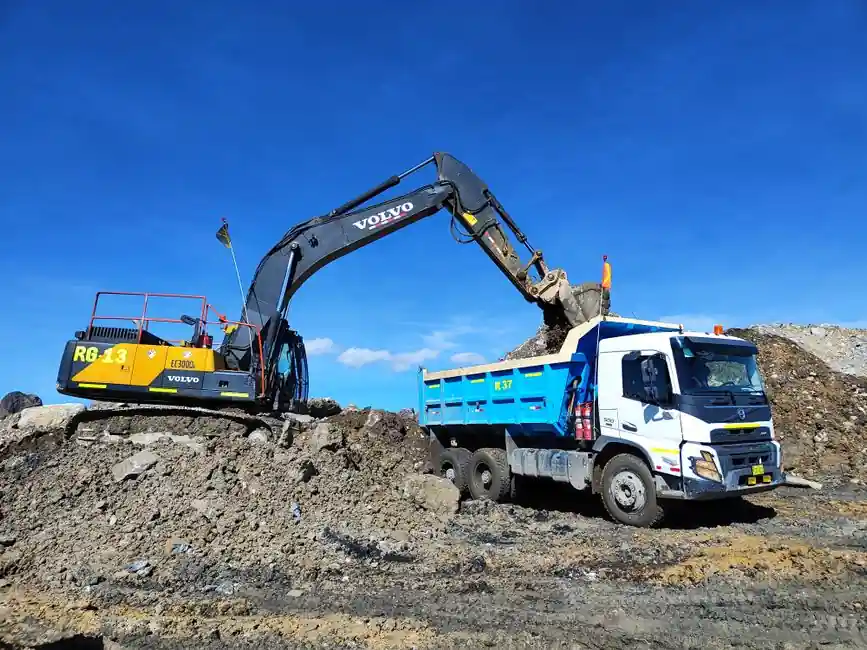
For 2026 quarry procurement, the 30-40 tonne rigid dump truck segment clusters around a 336-420 hp diesel engine, a 9-speed or 10-speed manual gearbox, and a double-reduction drive axle with differential lock [S1][S3]. The frame is short-wheelbase to lift torsional rigidity on rough haul profiles, and the body is built to 12mm floor / 10mm side and back plate to absorb rock impact [S1].
Chinese-engineered rigs in this band (HOWO 8x4, SHACMAN F3000 6x4, XCMG XDR) dominate Africa, Russia and Southeast Asia because simplified electronics, galvanized chassis, and locally serviceable components cut Tier-2/3 fleet downtime by 40% versus aftermarket assemblies [S2]. Ground clearance of 320mm or higher is the practical floor for abrasive, unimproved quarry roads, per the same export guide.
Quarry Duty Cycle and the 30-40 T Payload Envelope
Quarry-to-crusher haul roads typically run at 12-15% grade, and a fully loaded 30 t tipper at 336 hp is sized to climb that gradient at 25-35 km/h, which is the realistic working envelope rather than the brochure top speed [S3]. For deeper pits or aggregate volumes above 90 t per load, the chassis shifts away from a road tipper to a rigid-frame mining dump truck, where diesel-mechanical and diesel-electric (AC drive) drivelines remain the only credible options for ultra-class surface mining [S6]. Buyers running lighter 21-30 t quarry cycles can drop to a 6x4 with a 336 hp diesel and Euro 2 emission standard for non-regulated markets, with Euro 3 through Euro 6 available as 4-8% upcharges on the surveyed Chinese wholesale band [S3].
Quarry application is mechanically distinct from open-pit mining because the haul distance is shorter, the cycle count per shift is higher, and the abrasive wear on body liners is severe. A typical quarry dump truck supports three primary movements: overburden transfer, distribution to crushers or stockpiles, and inter-pit redistribution; selecting a unit that does not match the terrain and volume profile inflates downtime risk and fuel waste per ton hauled [S5]. For a working definition of the broader mining rigid class, the mining dump truck encyclopedia page lays out the chassis and driveline differences from on-highway tippers.
Driveline Bands: 6x4, 8x4 and Mining Rigid Side-by-Side
The 6x4 layout with one steering front axle and two driven rear axles is the default for 21-30 t quarry duty, paired to a 9-speed or 10-speed manual box and a 336-380 hp diesel on the surveyed Howo-spec listings [S3]. The 8x4 configuration adds a second steering or second drive axle to push legal payload into the 30-40 t band that quarry operators actually need for aggregate and coal haulage; on mining dump truck duty above 90 t per load, the chassis shifts to a rigid-frame electric or mechanical-drive design rather than the tipper format used on road-haul construction [S3]. Buyers moving less than 20 t per cycle are usually better served by a 4x2 or 6x2 short-wheelbase tipper, which keeps the unladen weight lower and tyre wear inside single-axle load limits.
The criteria-based comparison below lines up the three formats a quarry fleet will actually be choosing between:
- 6x4 diesel tipper: 21-30 t payload, 336-380 hp, 9 or 10-speed manual, Euro 2 baseline. Best for short-cycle quarry-to-crusher runs and operators buying on FOB China wholesale between roughly US$ 7,000 and US$ 22,000 per unit, with Howo-spec builds reaching US$ 32,000 at the top of the surveyed band [S3].
- 8x4 rigid chassis: 30-40 t payload, 380-420 hp, 10 or 12-speed manual or AMT, double-reduction drive axle with ratio 4.42 to 5.73, body length 6200-8500mm. Best for high-cycle aggregate and coal haulage on grades above 10% [S1][S2].
- Mining rigid (mechanical or diesel-electric AC drive): above 90 t per load, ultra-class surface mining only. Not a quarry unit in the 30-40 t class; needs separate evaluation against dump truck total-cost-of-ownership models.
Engine, Transmission and Emission Matching for Quarry Duty
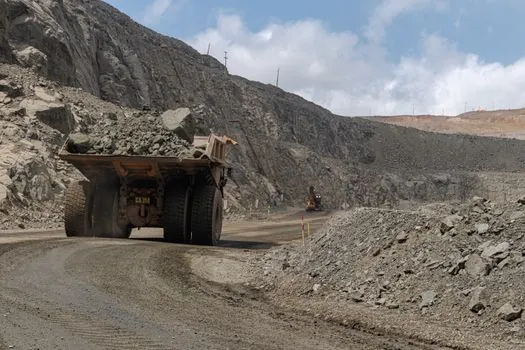
Engine power on a 6x4 quarry tipper clusters in a 336 hp band for 21-30 t, with 380 hp and 420 hp appearing on heavier 8x4 builds and on export units sold into Africa, Southeast Asia and the CIS where fuel quality and altitude derate the standard rating [S3]. The 336 hp figure corresponds to a torque envelope sized for a fully loaded 30 t tipper climbing a 12-15% grade at 25-35 km/h, which is the realistic working envelope for quarry-to-crusher haul roads rather than the highway fuel-economy map [S3]. Buyers comparing engines should pull fuel curves at rated payload, not brochure peak power; the right comparison is kW per tonne at the working grade, since chassis derating, not peak horsepower, sets cycle time [S6].
Manual transmissions still dominate the surveyed listings, with the 9-speed and 10-speed manual box paired to a single-disc dry clutch as the default for the 336 hp class; automated manual transmissions (AMT) and torque-converter automatics appear on higher-horsepower 8x4 and electric builds because they protect the driveline from shock loads on rocky haul profiles [S3]. A buyer specifying an AMT for an off-road quarry cycle should confirm the torque-interrupt calibration, because a unit tuned for highway fuel economy will cycle the clutch 3-5x more than a mining-tuned unit and burn through the clutch plate in under 20,000 hours. For mixed on-road and off-road duty the manual gearbox remains the lower-cost, easier-to-repair choice; the AMT premium is recovered only on long uphill hauls with a trained operator pool.
Body, Tipper System and Chassis Reinforcement for Abrasive Loads
For quarry use, the dumping body floor should be specified at 12mm and the sides and back at 10mm, and the rear door should be removable when the truck is dedicated to carrying large stone [S1]. Bucket capacity maps cleanly to tipper system: 15-18 m3 to middle or front tipping, 20-25 m3 to front tipping only, and above 25 m3 to front tipping with a HYVA front-tip cylinder for stability under a 30-40 t impact load [S1]. The HYVA front-tipping configuration is the standard recommendation for quarry duty because the geometry keeps the load centre low during the dump stroke and reduces tip-over risk on side slopes.
Ground clearance of 320mm or more is the published floor for quarry export builds, paired to deep-tread tyres and a self-cleaning body geometry that ejects mud and rock before it adds dead weight [S2]. Tipping system sizing is not a marketing choice: a 30-40 t quarry truck with a 20-25 m3 body needs a front-tipping cylinder matched to a higher pump flow than a road tipper of the same capacity, because the abrasive load does not flow off the body the way aggregate or coal does. For buyers evaluating total payload and body geometry against the concrete mixer truck class, the chassis and hydraulics are similar in mass but radically different in duty cycle.
Regional Sourcing, TCO and Logistics Levers for 2026

Quarry operators in Africa, Russia and Southeast Asia should size for the regional environment first: Arctic-grade lubricants and a -45°C cold-start system for Russian permafrost sites; galvanized chassis, sealed electrical connectors, and anti-corrosion body liners for tropical monsoon conditions; high ground clearance and simplified electronics for African dust where sensor failures drive the bulk of downtime [S2]. Original spare parts supply through an authorized SINOTRUK/SHACMAN/XCMG channel is reported by the same export database to cut downtime by 40% versus aftermarket alternatives in Tier-2/3 regions.
Sourcing cost is not just FOB unit price. A 6x4 diesel dump tipper in the 21-30 t payload class with a 336 hp manual transmission lists from roughly US$ 7,000 to US$ 22,000 per unit on Chinese wholesale portals, while Shandong-based Howo-spec builds reach US$ 32,000 at the top of the surveyed band [S3]. Buyers should price in a 4-6% marine-freight and insurance delta for RORO (roll-on/roll-off) shipment, plus a 2-3% customs-duty band depending on the destination HS code for dump-truck chassis [S3]. Electric and mining dump truck configurations run 90-150 days longer lead time than the equivalent diesel because the battery pack or AC drive system is sourced to order, and the spec band above 90 t per load is a different purchasing process than the 30-40 t quarry segment. For a related driveline and TCO comparison beyond the 30-40 t class, the Mining Dump Truck Selection: Payload, Powertrain and Sourcing Specs for 2026 article covers the mining-rigid segment in detail.
Selection Failure Modes and the Quarry Buyer's Checklist
The recurring failure modes on quarry-spec dump trucks are predictable: clutch burn from highway-tuned AMT calibrations, body liner wear from under-spec steel (less than 12mm floor plate), driveline shock from a single-reduction axle on rocky grades, and downtime from non-authorized electronics on Tier-2/3 sites. The mitigation is equally mechanical: specify a mining-tuned torque calibration on any AMT, hold the body plate thickness to 12mm floor / 10mm side, require a double-reduction drive axle with differential lock and inter-axle differential for any haul above 30 t [S1], and route the spare-parts chain through an authorized distributor [S2].
Buyers comparing electric and mining dump truck options against the diesel 30-40 t quarry class should note that electrification is being trialed in underground and short-haul pit duty, but ultra-class surface mining remains diesel-mechanical or diesel-electric (AC drive), and the on-highway 8x4 version of the same engine block is typically de-rated and matched to an automated manual or torque-converter automatic rather than the rigid-frame AC drive used at mining scale [S6]. For sites with narrow lanes and sharp curves, the dimensional rule is overall length no more than 8.5 m, wheelbase 3.8 m or less, and overall width 2.3-2.4 m paired with a compact dump box [S8]. Where reach into a stockpile face or crusher hopper is the limit, the aerial work truck and reach truck classes are not substitutes for a haul truck but are worth flagging when a quarry yard also runs a fixed conveyor feed. Verify the 320mm ground-clearance number on the export spec sheet, confirm the HYVA front-tipping cylinder is matched to the body capacity, and check that the driveline ratio sits between 4.42 and 5.73 for quarry grades before signing the purchase order.