Choose continuous inkjet when annual print volume is high and inkjet-compatible surfaces dominate, because one modeled 250-package-per-minute line produced €0.008 per print with CIJ versus €0.009 with laser, a €616 annual difference [S4].
Choose laser for permanent marking on compatible metal or other laser-markable surfaces when downtime, surface durability, and low consumable use outweigh the higher equipment cost [S1][S2][S3].
Cost Per Print: The Core Decision
CIJ generally has the lower purchase price, while laser generally has higher equipment cost but substantially lower ink and solvent consumption [S1][S2][S3]. The total-cost calculation must include depreciation, financing, service, maintenance, ventilation, eyewear, and lost line time rather than purchase price alone.
In the cited soup-packaging example, the line ran at 250 packages per minute, operated 2 shifts of 8 hours for 250 days per year, and applied a 2-line expiry date and batch number. CIJ ink and solvent cost €1,737 per year, but laser equipment depreciation and interest more than offset its consumable saving [S4].
The resulting comparison was €0.008 per print for a LEIBINGER JET3up CIJ system and €0.009 for the laser alternative. The €0.001 per-print difference implies €6,000 across 6,000,000 prints [S4]. The source describes these values in a high-volume packet-soup scenario [S4].
Cost Model: Five Variables to Calculate
A valid cost-per-print model uses annual prints, not output per minute alone. For this CIJ example, 250 packages/min × 60 min/h × 16 h/day × 250 days/year equals 6,000,000 prints annually. At the modeled rates, 6,000,000 × €0.008 gives €48,000 for CIJ and 6,000,000 × €0.009 gives €54,000 for laser [S4].
The largest uncertainty is not usually the click of a printer setting, but the annual print count, content length, number of changeovers, service frequency, ink utilization, and whether the quoted laser includes fume extraction [S2][S3][S4]. A two-line code also consumes more ink or marking time than a one-line code, so unit pricing should be based on the actual code configuration.
Compare capital recovery over the planned operating period rather than comparing list price with annual consumables. Include the laser extraction system, installation, interlock design where applicable, and protective eyewear requirements; laser coding can create irritating or toxic fumes depending on the substrate [S3]. CIJ requires ink, solvent or make-up fluids and routine servicing, while laser systems generally use very few consumables and require less frequent maintenance [S1][S3].
CIJ Versus Laser: Decision Criteria
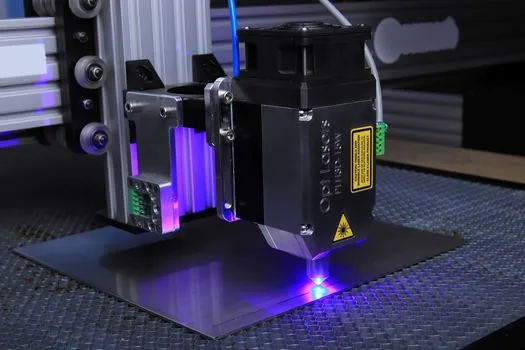
CIJ wins on lower equipment cost, broad ink compatibility, and economical high-volume variable coding, but it carries recurring ink, solvent, make-up, and maintenance costs [S1][S2][S3]. Laser wins on permanent marks, low consumable use, lower routine maintenance, and operation at variable line speeds where its speed-sensing system is provided, but it carries higher capital, integration, and fume-control costs [S2][S3].
Surface compatibility often decides the comparison. CIJ deposits ink without contacting the package and can work well on clear plastic and glass, where contrast may be stronger than a laser mark. Laser can burn or melt fabrics such as cotton, nylon, and polyester, while CIJ ink applied to metal in severe environments may fade or wear away [S3].
For permanent, wear-resistant identification on compatible metal, laser is usually more robust because the mark is altered into or onto the surface rather than sitting on top as ink [S3].
CIJ suits packaging lines with a continuous, fixed product speed and frequent product or code variation. Laser suits compatible industrial components, serial-number marking, and production environments where a durable mark and less frequent service outweigh capital cost [S3][S5]. The choice is not equivalent to a simple inkjet-versus-laser purchase decision: substrate, code content, volume, line speed, and environmental controls determine the defensible cost per print.
Production Use Cases and Operating Constraints
A high-volume packaging line is the clearest CIJ case. The 250-package-per-minute, two-shift, 250-day model produced an annual CIJ cost advantage of €6,000 over the modeled laser system when 6,000,000 prints were compared [S4]. CIJ also handles expiry dates, batch numbers, barcodes, QR codes, logos, serial numbers, and variable data used across food, pharmaceutical, cosmetics, automotive, electronics, and packaging operations [S5].
Lasers require a more controlled operating environment. Laser marking systems can generate irritating or toxic smoke or fumes, so the installation should include an industrial fume extractor; the cited comparison also identifies special eye protection for operators [S3][S4]. The ventilation and personal-protection costs belong in the laser ownership calculation rather than being treated as exceptions.
CIJ has a separate environmental burden because it consumes industrial inks and solvents. Some formulations have adverse environmental properties, while laser avoids liquid ink and solvent consumption but transfers the burden to fume extraction and substrate-specific process safety [S3]. Neither technology can be declared universally cleaner without the selected chemistry, substrate, and controls.
Environmental enclosure should also influence model selection. The JET3up PRO is identified as IP65-compliant for regular wash-down environments, while the JET2neoD uses pressurized print-head technology intended to reduce interference from small airborne particles in dusty applications such as cement or baked-goods production [S4]. These are model-level facts, not universal CIJ ratings.
Failure Modes That Shift the True Cost

The most consequential CIJ failure mode is degraded readability caused by ink fade or wear on exposed or harsh surfaces. On metal, a laser mark is generally preferable where a clear, dark, permanent code is required, but laser heat damage on plastics, glass, paper, or textiles can restrict or prevent use [S3].
Laser failure modes include fume extraction failure, an unsuitable marking window, or material damage. Reduced contrast on clear plastic and glass is also a practical constraint because the mark may be less legible than an inkjet code [S3]. CIJ introduces fluid management, nozzle condition, ink selection, print-height setup, and solvent-handling requirements; laser introduces source, optics, focusing, extraction, and application-specific mark-content requirements [S1][S2].
Maintenance frequency is part of availability, not merely a service expense. CIJ generally needs more routine attention because liquid consumables and a nozzle-based print system can require cleaning and replenishment. Laser generally needs fewer consumables and less frequent maintenance, which can reduce downtime on stable production [S3]. Line-speed changes, however, favor laser when speed-sensing control is fitted, while CIJ performs well on continuous, fixed-speed lines [S3].
Procurement Method and Break-Even Test
Request at least 3 supplier quotations for each option on identical code content, annual volume, line speed, substrate, and environmental conditions. A machine quote without ink, solvent, make-up, parts, service, ventilation, and depreciation assumptions is not comparable. For laser, also price extraction, filters, installation, and required protective measures [S2][S3].
Run 12-month and 3-year totals. Subtract CIJ consumables and maintenance from laser’s higher capital requirement, then include CIJ downtime for service against laser’s lower service burden and potentially longer service life. The modeled 6,000,000-print case compares CIJ at €0.008 per print with laser at €0.009 per print, and this comparison is specific to the modeled scenario rather than a universal benchmark [S4].
Use a break-even print count where the extra laser capital is recovered by CIJ recurring costs. If the quoted laser premium is €18,000 and CIJ consumes €0.002 more per print, the simple break-even is 9,000,000 prints, excluding downtime and residual-value differences. This calculation must use supplier-quoted inputs, because the research establishes the direction of the cost trade-off but does not provide a universal machine price or print price [S1][S3][S4].
Applicable Standards and Supplier Records
Record the ink type, solvent or make-up fluid, safety data sheet, service interval, nozzle or laser-source specification, and disposal route in the comparison file. The research identifies safety data sheets, ink specification sheets, operator manuals, coding standards, and regulatory guidance as supplier document categories, but it does not establish that one specific product or regulatory standard applies to every installation [S2].
For laser installations, document substrate compatibility and the extraction design rather than treating ventilation as optional. For CIJ installations, verify fluid-handling, ventilation, cleaning, and wash-down requirements against the selected model and site conditions. The JET3up PRO’s IP65 designation applies to that named configuration, not to every continuous inkjet printer [S4].
Validate cost per print with a controlled trial on the real substrate at the real line speed. Record ink consumption, make-up consumption, service time, laser cycle time, extraction requirements, and code legibility over the planned maintenance interval. A trial exposes substrate, contrast, throughput, and durability effects that a spreadsheet based only on consumable prices will miss.
The defensible choice is CIJ for high-volume packaging with variable data and low equipment cost, or laser for permanent compatible marking where low consumables, reduced maintenance, and longer service life offset the capital and ventilation burden. Track annual prints, recurring-cost variance, service downtime, and the modeled break-even point before issuing the purchase order.