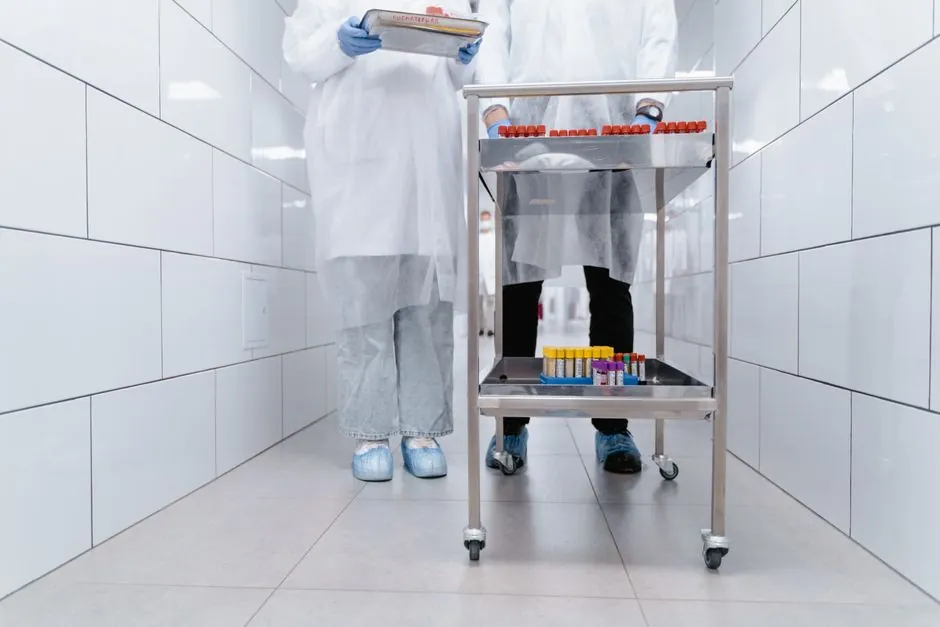
Heat-welded vinyl with 4 inch integral cove is the most commonly specified cleanroom floor for cGMP pharmaceutical and medical-device suites, with epoxy coating as the lower-cost alternative for less aggressive industrial spaces, and VCT reserved for ISO-8 / class 100,000 areas [S1].
Selection reduces to four decision gates: target ISO 14644 class, contamination-control requirement (particulate, microbial, ESD), chemical/sterilant exposure, and load regime. Concrete is unsuitable in any form because it is porous and a continuous particulate source, so every cleanroom floor is a coating, sheet, tile, or raised system laid over a prepared slab [S2].
Heat-Welded Vinyl: cGMP Pharmaceutical and Medical Device Default
Heat-welded vinyl sheet is the dominant pharmaceutical cleanroom floor because heat-welded seams create a monolithic, non-porous surface that meets ISO contamination control targets, and a 3 to 6 inch cove base eliminates the 90 degree floor-to-wall corner where bioburden accumulates [S2][S4].
Vinyl is softer underfoot than poured resin (reducing fatigue during long standing shifts), tolerates aggressive disinfectants such as peracetic acid and quaternary ammonium blends, and is faster to replace in patches than full-pour systems [S2]. Static-dissipative grades in the 10^6 to 10^9 ohm range are stocked as catalog items, e.g. the U78010 ESD vinyl tile listed at $5.67 per unit, so ESD control does not force a switch to epoxy [S5]. The documented weakness is mechanical: heat-welded vinyl wears fast under heavy rolling loads, so facilities with pallet jacks, autoclaves, or kettles should validate the load path before specifying it [S4]. For broader context on how sheet vinyl compares with tile and poured systems in commercial buildings, the commercial flooring spec map lines up cost, lead time, and maintenance trade-offs.
Epoxy and Urethane Resin Systems: ISO-7/8 Industrial Workhorse
Poured epoxy produces a fully seamless surface with superior chemical resistance, high compressive strength for rolling equipment, and optional ESD formulations, making it the most common ISO-7 and ISO-8 cleanroom floor in industrial and electronics plants [S2].
A three-part installation is standard: mechanical substrate prep (grinding, scarifying, shot-blast) to a defined surface profile, primer/body coat, and a urethane top coat that lifts chemical and scratch resistance [S1][S4]. Urethane-cement and polyurethane mortar systems (e.g. cementitious urethane, methyl methacrylate, polyaspartic chemistries) extend the same seamless logic into wet process areas with thermal cycling or hot-water washdown, where standard epoxy would amber or delaminate. Static-dissipative and conductive resin systems meet ANSI/ESD S20.20 and IEC 61340-5-1 for electronics and industrial flooring zones handling ESD-sensitive components [S2].
VCT, Polished Concrete, and Interlocking Tile: ISO-8 / Class 100,000 Budget Tier

Industrial vinyl composition tile (VCT) is the lowest-cost cleanroom floor, factory-precut and adhesive-bonded to a prepared slab, and is acceptable for ISO-8 / class 100,000 cleanrooms where the budget outweighs lifecycle concerns [S1].
Polished concrete with a penetrating chemical densifier/hardener sealer is also acceptable at ISO-8 once the slab is sealed, because the densifier closes the pore structure that otherwise sheds dust [S1]. Interlocking vinyl tile is the newer budget option, with puzzle-edge joints that close the seam gap and a thickness that can be laid over worn subfloors, cutting install downtime for retrofit projects [S4]. None of the three meets the seamless requirement of cGMP pharmaceutical or medical-device suites, so the cost saving has to be weighed against audit risk in FDA-regulated spaces.
ESD / Static-Dissipative Floors: Required for ISO-5/6 Electronics
Static-dissipative flooring is not a separate material but a property that can be built into vinyl tile, vinyl sheet, or epoxy, with surface resistance typically targeted at 10^6 to 10^9 ohms to safely bleed charge away from components [S2][S5].
Semiconductor and backplane-assembly cleanrooms at ISO-5 and ISO-6 almost always pair static-dissipative surfaces with conductive ESD footwear and wrist straps, because a single 100 volt event can rupture sub-micron gate oxide. Conductive vinyl tile in the 10^4 to 10^6 ohm range is the most common catalog option; conductive epoxy is specified where chemical or abrasion resistance dominates. Where both ESD and heavy loads intersect, raised access floors with aluminum or steel perforated panels deliver air return from below while allowing underfloor routing of process utility, the same logic that applies to large-scale industrial flooring retrofits with high service density.
Raised Access Floors: ISO-5/6 Semiconductor and High-Density Service Buildings
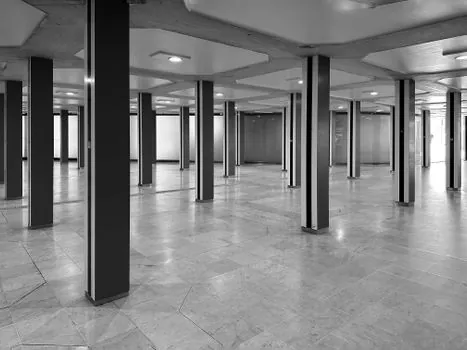
Raised access flooring with perforated aluminum panels on approximately 600 mm (two foot) pedestals is the most expensive cleanroom floor, reserved for class 10 / ISO-4 and class 100 / ISO-5 semiconductor fabs where underfloor air return and process utility routing outweigh first cost [S1].
Perforated panels typically carry 15 to 25 percent open area for return air, and the plenum below also carries deionized water, specialty gas, and signal conduit, which removes those services from the work envelope and reduces particulate shedding in the clean zone. Because the system is engineered (panels, pedestals, stringers, ramps) and not just a finish, retrofit is disruptive and lead time runs 8 to 16 weeks for a typical fab bay, so it is rarely a brownfield fix.
Selection Criteria and Comparison
Specifying a cleanroom floor is a four-axis decision: target ISO class (drives seam and outgassing limits), contamination profile (particulate only, microbial, or ESD), chemical and thermal exposure, and rolling/static load. [S2]
The practical matrix: heat-welded vinyl wins ISO-7 cGMP pharma and medical-device suites; poured epoxy or urethane cement wins ISO-7/8 industrial, electronics, and biotech process rooms with chemical and load demands; VCT or polished concrete wins ISO-8 back-of-house and warehouse-classified space; ESD vinyl or epoxy is mandatory for ISO-6 and tighter electronics work; raised access flooring is reserved for ISO-4/5 semiconductor fabs and command-and-control rooms with heavy underfloor services. For a structured side-by-side at the catalog level, the SPC flooring and industrial adhesive reference pages document the backing and bonding limits that drive tile-vs-sheet choice in retrofit builds. For broader adjacent selection work, the commercial flooring spec map frames the cost-vs-lifecycle comparison outside the cleanroom envelope.
Limitations, Failure Modes, and What to Avoid
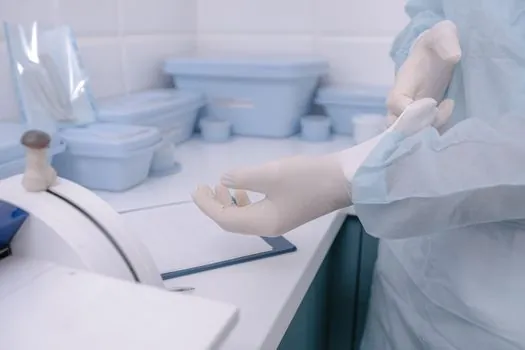
Carpet within or adjacent to the cleanroom envelope is disqualified because it traps and re-releases particulates, and tacky mats plus cleanroom booties are the minimum particulate-control measures at every gowning room threshold [S1].
Common failure modes: epoxy without a urethane top coat turns yellow and loses chemical resistance within 12 to 24 months under aggressive disinfectants; heat-welded vinyl de-bonds at the cove when the adhesive is incompatible with the slab moisture-vapour emission rate (verify MVER below 3 lb/1000 sq ft/24 h before install); VCT seams open under rolling traffic and become particle traps; raised access floor panels lose their seal when stringers are omitted on a high-traffic bay. Skip polished concrete in any space with hot-tire or solvent traffic, because the densifier will soften and the slab will shed again.
Standards and Sourcing Reference
Floor selection should be cross-checked against ISO 14644-1 for airborne particulate class, ISO 14698 for microbial contamination control, ANSI/ESD S20.20 and IEC 61340-5-1 for static-dissipative zones, and FDA cGMP / EU GMP Annex 1 for the seam and cove requirements in aseptic processing [S2].
Closing node: confirm MVER, surface profile (CSP), and slab moisture before locking the floor chemistry, then validate the chosen system against the room's ISO class and chemical register in a mock-up bay before full release. The next trackable signal is the 2026 revision cycle for EU GMP Annex 1 sterile-fabric guidance, which is expected to tighten expectations around cove height and seamless-surface documentation in compounding aseptic isolator suites.