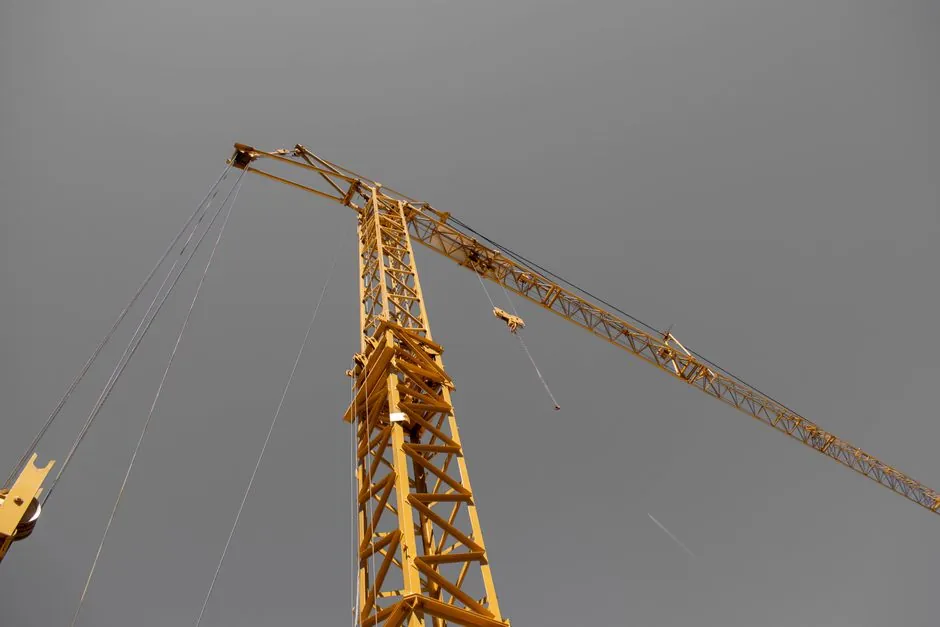
Climbing tower cranes are erected inside or against the host structure and jack themselves up floor by floor, so the host building (not a ground pad) carries the crane's vertical load, overturning moment, and horizontal reactions through collars or bracing frames inserted into the floor slab [S3][S5].
Static (freestanding, fixed-base) tower cranes are mounted on a ground foundation or structural support without braces or guys, meaning the foundation block, anchor cage, and surrounding soil or pile cap must be designed to resist the full in-service overturning moment and the vertical load of the mast, jib, counter-jib, and ballast [S4][S2].
Load Path and What the Foundation Has to Resist
Climbing cranes place a small temporary base on the ground only during the first erection phase, then the entire vertical load, slewing torque, and wind overturning moment travel through the climbing collars and tie beams into the host structure's floor diaphragms; OSHA 1926.1435(b)(7)(ii) requires a registered professional engineer to verify that the host structure is strong enough to sustain the forces imposed through the braces, brace anchorages, and supporting floors [S1].
Static freestanding cranes rely on a single gravity-and-tension foundation block, typically a reinforced concrete pad tied into a steel anchor cage, that must resist the maximum in-service overturning moment (M), vertical load (V), and horizontal torsion (T) published by the manufacturer for the chosen free-standing height; OSHA 1926.1435(b)(3) requires the foundation itself to be designed by the manufacturer or a registered professional engineer [S1][S4].
Plumb Tolerance, Plumb Verification, and Erection Geometry
Both crane categories must be erected to a plumb tolerance of 1:500 (approximately 1 inch in 40 feet) where the manufacturer does not specify otherwise, with verification by a qualified person before and after every climb under OSHA 1926.1435(b)(5) [S1].
For climbing units this check is repeated at every floor jack, because out-of-plumb build-up compounds across climbs and feeds directly into the horizontal reaction the host structure must absorb at the upper tie level; for static units the same check is performed at initial erection and after any ballast or mast section change, since a drifting plumb line inflates the second-order bending moment in the slender mast [S1][S7].
Foundation and Structural-Support Verification on Site
Under OSHA 1926.1435(b)(4)(i) the assembly/dismantling (A/D) director must confirm that tower crane foundations and structural supports are installed in accordance with their design before any climb or before the static unit is released for service, and the same standard extends that duty to the host-structure tie condition for climbing cranes [S1].
Wind-speed verification under 1926.1435(b)(4)(iii) layers on top of foundation work: any climb, ballast adjustment, or out-of-service condition must respect the manufacturer's recommended wind speed or, where the manufacturer is silent, the speed determined by a qualified person, since the foundation reaction cases used in design assume a specific maximum in-service wind [S1].
Site Suitability, Cycle Time, and Cost Trade-off
Climbing tower cranes are the default choice for structures that outgrow the free-standing height of a static unit, where the building core is being poured ahead of the cladding cycle, or where neighbouring structures restrict slewing clearance; the tower is erected within the structure and raised as construction advances, making them suitable for particularly tall buildings [S5][S6].
Static freestanding cranes are the right pick for open sites with room for a large concrete pad, for project heights inside the manufacturer's free-standing envelope (often around 40-60 m without ties, model-dependent), and for any job where the host structure cannot accept climbing collars, such as steel frames with thin composite slabs not designed for the 200-400 kN point reactions a typical climbing collar delivers per tie [S2][S4].
Decision Matrix: Climbing vs Static on Four Criteria

Crane category comparison for foundation scope: [S4]
Foundation type: climbing uses a temporary ground base plus host-structure climbing collars at 2-3 floor intervals; static uses a single reinforced concrete pad with steel anchor cage sized for full overturning moment (M), vertical load (V), and torsion (T) per manufacturer or RPE design under OSHA 1926.1435(b)(3) [S1][S4].
Design responsibility: climbing requires the host structure's RPE to verify the floor diaphragm and tie-beam capacity in addition to the crane manufacturer's foundation; static requires the foundation RPE only, and the host structure is not engaged at all [S1][S4].
Plumb recheck cadence: climbing requires plumb verification before and after every floor jack to the 1:500 tolerance; static requires the same 1:500 check at initial erection and after any mast or ballast change [S1].
Best-fit site: climbing for tall, tight urban cores with a rising concrete core; static for open sites, shorter heights, and any host that cannot accept concentrated tie reactions [S2][S5].
Failure Modes and Common Specification Traps
Specifying a static freestanding crane above its free-standing height without adding tie columns or a braced tower is the most common foundation trap, because the in-service overturning moment grows roughly with the square of the unbraced height and the ground pad then needs to be redesigned, not merely thickened [S4][S7].
Specifying a climbing crane on a host structure whose floor slabs were not checked for the collar's concentrated load, or whose construction sequence cannot keep the climbing floor two to three levels above the active deck, is the matching climbing-side trap, and it forces a fallback to a heavy-duty static pad that often does not fit the site [S1][S5].
Standards, References, and Trackable Signals

OSHA 1926.1435(b)(3), (b)(4)(i), (b)(5), and (b)(7)(ii) are the binding U.S. federal rules that govern foundation design, A/D-director verification, plumb tolerance, and host-structure verification for climbing; ASME B30.3 supplies the underlying definitions for freestanding, climbing, fixed-base, and traveling tower cranes used throughout the industry [S1][S4].
Trackable signals for a specifier: (1) the manufacturer's published free-standing height and the matching M/V/T reaction table for the chosen static configuration; (2) the host-structure RPE letter confirming the climbing-collar floor-diaphragm capacity; (3) the A/D director's signed foundation and plumb verification on file before the crane enters service. None of these can be skipped without voiding 1926.1435 compliance [S1].
Component reference pages worth checking: tower crane, climbing formwork, and foundation vehicle.
See also our earlier report, Bellows vs Beam vs Oldham Coupling: Torsional Stiffness for Precision Axes.