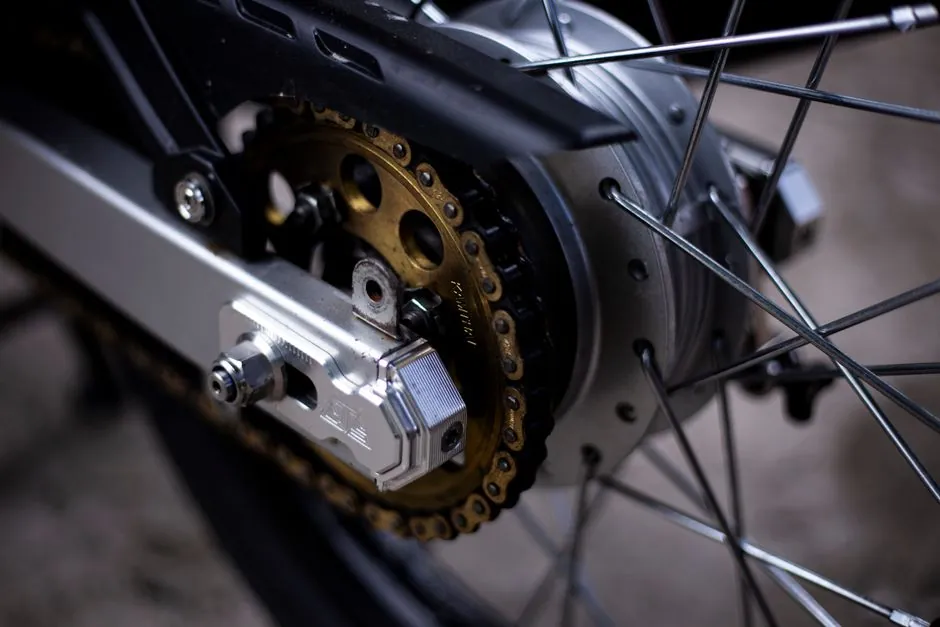
Chain-case service on a skid steer loader is a two-part job: confirm lubricant is at the fill-plug threads with the machine on level ground, then verify final-drive chain tension by rotating each tire and accepting 0-6.35 mm (0-1/4 in.) of movement at the tread before any shim adjustment [S2].
Most compact units run a separate chain case on each side of the frame, each sized at roughly 11 L (3 gal) per the John Deere operator manual procedure, and on Case 1845/1845C platforms field reports place fill volume around 6 quarts (about 5.7 L) per side [S2][S5]. Operators new to a machine frequently confuse the axle-hub fill port with the chain-case fill port, which leads to over- or under-filling when the access plate is removed [S4].
How to read the chain-case oil level correctly
The fill plug sits on the side of the skid-steer frame, one per chain case, and the accepted level is oil just appearing at the bottom threads of that plug, not above it and not below it [S2]. On a John Deere skid steer the procedure is to park the machine safely, remove the fill plug (A), observe whether oil is at the threads, and top up until it just appears at the threads, then repeat on the opposite side [S2].
On a Case 1845C, technicians describe the same target differently: the oil should just cover the chain at the bottom of the front sprocket, which on level ground with the OEM 6-quart fill works out to roughly 3/4 in. of depth in the sump, with a hard upper limit around halfway up the big sprockets [S5]. Going past the halfway mark on the sprocket is widely treated as over-fill, even if a small over-fill is tolerated in the field [S5].
Lubricant grade and what actually goes in the case
John Deere's published chain-case oil list names HY-GARD as the preferred fluid, with Low Viscosity HY-GARD for cold-weather operation and TORQ-GARD SUPREME / TORQ-GARD PLUS-50 as alternates, all of which are hydraulic-and-transmission grade products rather than engine oil [S2]. Case 1845C field practice, in contrast, calls for 10W30 motor oil at roughly 11/16 in. depth, with some owners reusing drained hydraulic oil on the next service [S5].
Brand of 10W30 is not a controlling variable; routine conventional motor oil at the listed viscosity is acceptable for the Case chain boxes, and the practical rule from technicians is to never let the level drop below chain coverage at the bottom of the sprocket [S5]. For a fleet running mixed equipment, sticking to the OEM fluid list avoids any warranty friction on the units still under coverage [S2].
Drive chain tension: the 0-6.35 mm tread-movement rule

John Deere specifies chain tension should produce 0-6.35 mm (0-1/4 in.) of rotational movement at the tire tread, measured after raising and blocking the skid steer and rotating each tire by hand [S2]. The OEM note states plainly that under normal operating conditions, checking and adjusting chain tension is not needed, meaning periodic chain tension is reserved for machines that show slack, noise, or track skip [S2].
On the Case 1845C, technicians describe a comparable mid-range deflection of roughly 1/2 in. to 1 in. at the chain, achieved by loosening the four motor mounting bolts slightly and using the adjuster bolt to back the motor away from the sprocket, which tightens the chain [S5]. The Case 1835/1845 published adjustment is to remove the inspection covers and verify the chain is less than drum-tight, with a comparable slack target rather than a precise number [S1].
Step-by-step: chain tension adjustment on John Deere-style axles
With the skid steer raised and blocked, the operator rotates each tire and confirms 0-6.35 mm (0-1/4 in.) movement is present, then removes the tire for access to the axle hub fasteners [S2]. The next step per the manual is to loosen eight (8) axle hub bolts so the hub can shift on its shim pack, then add or remove shims to push the hub outward and remove excess slack [S2]. After retorquing the eight bolts the tire is refitted and the rotation check is repeated, with the pass criterion unchanged at 0-6.35 mm (0-1/4 in.) [S2].
On Case-style final drives the equivalent is to back the drive motor off the mount with an adjuster bolt, retorque the four mounting bolts, and re-measure deflection at the chain run rather than at the tire, because the tire is decoupled from the chain by a sprocket hub [S1][S5]. Two tensioners exist per side on the 1845C: one for the motor-to-axle chain and one for the axle-to-wheel chain, and the wheel-side chains are typically addressed first because access is easier [S5].
Common failure modes from getting this wrong

Over-filled chain cases churn the oil, aerate it, push foam out the breather, and leak past input seals on the drive motors, which is the most common complaint on Case 1840/1845C machines that have been topped up to the axle-hub port by mistake [S4][S5]. Under-filling lets the chain run dry on the upper wrap, accelerates sprocket and chain pin wear, and shows up as a ratcheting skip under load rather than a steady noise.
Overtensioned chains load the drive motor bearings, the axle bearings, and the sprocket teeth, and the failure mode there is typically a hot motor or a snapped chain rather than a slow wear pattern, so the lower end of the deflection range is the safer target on both platforms [S2][S5]. Loosened axle-hub bolts left untorqued after a shim adjustment are a documented shop-floor failure mode on John Deere units, and the manual sequence (loosen eight, adjust, retorque eight, re-measure) exists specifically to prevent that [S2].
Service interval signals worth tracking
John Deere chain-case oil is typically inspected at the same 250-hour or 500-hour interval as the hydraulic system, with chain tension treated as a conditional check rather than a scheduled one [S2]. Bobcat publishes a chaincase fluid service video covering Pro, Classic, M-Series, and R-Series skid steers, framing the chain case as a maintenance item on the published service schedule rather than a sealed-for-life unit [S3].
For a 2026 fleet operating mixed iron, the lowest-friction signal to track is chain-case oil appearance on the dip stick or fill plug threads: a milky sample indicates water ingress from repeated pressure washing, a metallic sheen flags sprocket or bearing wear, and either condition is a trigger to drain, inspect the breather, and refill to the plug-thread level before returning the unit to service [S2][S5]. On a fleet of 1845C units specifically, the cheapest pre-failure indicator is the 10W30 level relative to the bottom of the front sprocket, because owners who let it drop below chain coverage are the ones who come back with stretched chains and worn driver sprockets [S5].
For a working technician the next step is to confirm the published service interval for the specific serial-number range, since the John Deere, Bobcat, and Case chain-case procedures do not all use the same lubricant, fill volume, or deflection target [S2][S3][S5]. Two trackable signals to watch over the next service cycle are whether the oil level holds at the plug threads across a 50-hour window and whether the 0-6.35 mm tread-movement figure is stable rather than trending toward the loose end of the range [S2].
Component reference pages worth checking: oil seal, and case packing machine.
This topic is covered further in ASTM A1034 splice testing: scope, revisions, and how to read the spec.