
Global cobalt production is projected to reach 410.9 kilotonnes (kt) by 2030, advancing at a 5.1% compound annual growth rate, with the Democratic Republic of the Congo (DRC) expected to contribute 271.3kt at a more moderate 1.8% CAGR [S3]. Twenty-five cobalt projects are in various development stages with high likelihoods of reaching commercial output before 2030, including Vale's Pomalaa operation [S3].
On the demand side, the Cobalt Institute's 2024 market report cites the Paris Declaration scenario, which puts refined cobalt consumption at 200,500 tonnes in 2025 and 344,000 tonnes in 2030, a 9.6% cumulative increase across the 2017-2030 window [S4][S6]. The IEA's reference technology scenario, by contrast, caps 2030 cobalt demand at 241,500 tonnes, a 6.7% annual growth rate for the 2017-2030 period [S4]. The spread between scenarios — 344,000t versus 241,500t — is the central planning variable for cathode-active-material buyers and OEMs mapping cathode chemistries out to 2030.
End-Use Mix: Batteries Dominate, Superalloys Climb
Battery applications remain the principal demand pillar, with electric vehicles and energy storage consuming the bulk of refined units; the Cobalt Institute's long-horizon Cobalt 2050 study shows superalloy demand rising from 15,000 metric tons in 2020 to 55,000 metric tons by 2050, a near four-fold lift driven by aerospace and gas-turbine specifications [S6]. The same 2050 chart series (Figure 10) tracks hard-metals, pigments, catalysts, permanent magnets, hard-facing and "other" industrial demand on the same time axis, with permanent-magnet growth materially tied to rare-earth-cobalt rotor chemistry used in high-temperature servo-motor stages [S6].
For procurement teams, the practical meaning is that any specification touching high-temperature process equipment — from turbine supervisory instrumentation to servo-driven valve actuators — carries an indirect cobalt exposure through superalloy and permanent-magnet sub-components. Buyers specifying pressure transmitters or flow meters for high-temperature service rarely think in cobalt terms, but the diaphragm and stem alloys often do contain cobalt-bearing grades when NACE MR0175 / ISO 15156 sour-service compliance is required.
Supply Concentration and Pricing Pressure
The DRC accounts for just over 80% of global cobalt output, with Indonesia at 6.7% after surging from 1.3kt in 2015 to 20.4kt in 2024 [S3]. Australia and Canada together held only 1.9% of global share in 2024 but are projected to reach 6% by 2030, led by Australia's Broken Hill Cobalt and Canada's Copper Cliff mine [S3]. Russia's national output is projected to stagnate at 3.1% growth through decade-end, constrained by EU and US sanctions following the Ukraine conflict [S3].
Cobalt pricing is at a multi-year low following a 2018 peak of $81,900 per tonne, weighed down by oversupply and a cathode-mix shift toward lithium-iron-phosphate (LFP) cells that are widely regarded as more cost-effective and thermally stable [S3]. The US Trade Act currently imposes a 25% tariff on refined cobalt metal imports from China, and the Cobalt Institute expects "prices will remain under pressure in the short term" before demand growth tightens the balance from the mid- to late-2020s [S3]. For industrial buyers, this translates to stable cathode-input cost forecasts for the immediate procurement cycle but elevated hedging exposure on 2028-2030 cathode supply.
Recycling Feedstock: Scrap Sub-Segment at 10.82% CAGR
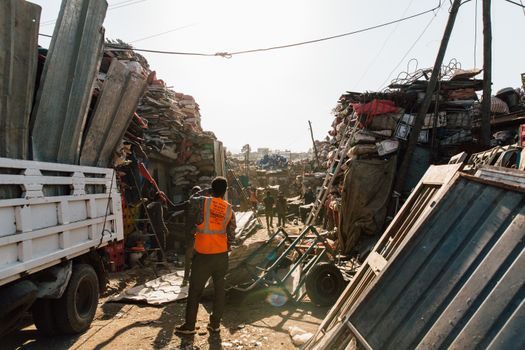
The purchased-scrap sub-segment of the cobalt market is forecast to post a 10.82% CAGR from 2026 to 2031 as regional battery-recycling plants scale up [S5]. Regulatory recycled-content quotas, paired with the economics of recovering nickel and lithium alongside cobalt from black mass, keep cobalt extraction financially attractive even at moderate prices; companies such as Electra Battery Materials are building dedicated hydrometallurgical circuits for scrap [S5].
For the broader battery supply chain, this recycling ramp directly affects the lithium battery manufacturer share picture, since recycled cobalt closes the loop on closed-loop OEM sourcing mandates that have become a procurement condition in EU and US OEM contracts. The growth differential — recycled feedstock at roughly double the headline 5.1% production CAGR [S3] — means that secondary supply will claim a larger share of total cobalt inputs each year through 2030, and any refinery qualification strategy that ignores black-mass feed will be exposed to tightening virgin-material allocations.
Comparison: Demand Scenarios vs Supply Trajectory
Three credible 2030 demand anchors bracket the planning range: the Paris Declaration scenario at 344,000 tonnes (Cobalt Institute, 2024 report) [S6], the Cobalt Institute's earlier 438,500-tonne JRC upper-bound figure [S4], and the IEA reference technology scenario at 241,500 tonnes [S4]. On the supply side, GlobalData's 410.9kt by 2030 [S3] sits between the lowest and highest demand scenarios, implying that under the IEA's 241.5kt case the market remains oversupplied, while under the JRC 438.5kt case the market tightens sharply by the late-2020s.
The 410.9kt GlobalData supply projection [S3] versus 241,500t IEA demand [S4] leaves a structural surplus of roughly 170kt that explains the multi-year low pricing noted by the Cobalt Institute [S3]. Conversely, the 25 named development projects with high probability of reaching first production by 2030 [S3] mean the supply ceiling can still be raised if demand lands closer to the Cobalt Institute/JRC scenario, which is why senior mining analyst Vinneth Bajaj flagged LFP cathode substitution as the principal downside variable on the demand side [S3].
Standards, Sourcing and Procurement Constraints

Industrial cobalt uses fall under several standards worth flagging for spec-first buyers: superalloy feedstock commonly references AMS specifications (aerospace material specifications) for nickel-cobalt-chrome grades used in turbine and downhole components, while sour-service process equipment is governed by NACE MR0175 / ISO 15156, which restricts cobalt-bearing alloys in hydrogen-sulphide environments. Permanent-magnet specifications for servo-motor rotors typically reference IEC 60034 for rotating machines — when spec-writing on servo motors for high-temperature duty, buyers should confirm magnet-grade traceability because the rare-earth-cobalt rotor chemistry is a meaningful cobalt line item. [S1]
Geopolitical sourcing constraints are equally concrete: the 25% US tariff on Chinese refined cobalt [S3] effectively partitions the market into three pricing zones — Chinese domestic, US-tariff-inclusive, and ex-China ex-tariff — and procurement contracts written in 2025-2026 are increasingly carrying dual-source clauses that name DRC and Indonesian origin separately. Sourcing from ESG-compliant Australian and Canadian production [S3] commands a documented premium, which is why ESG-grade cobalt is being positioned for aerospace and EV customers willing to pay above LME-quoted levels.
Selection Criteria for 2026-2030 Specifying Engineers
Three operational rules apply to anyone writing cobalt-bearing material specs through 2030. First, identify the chemistry path: LFP-substitution risk is highest in entry-level EV and stationary storage, while nickel-manganese-cobalt (NMC) and nickel-cobalt-aluminium (NCA) cathodes remain the cobalt-intensive segment supporting the 5.1% production CAGR [S3]. Second, lock the standards reference at the part level: superalloy service uses AMS grades, sour-service uses NACE MR0175 / ISO 15156, and process-control hardware such as industrial valves and PLCs carry no direct cobalt standard but inherit it through sub-tier alloy and magnet sub-components. Third, size the recycled feedstock assumption: at 10.82% CAGR for purchased scrap [S5] versus 5.1% for primary production [S3], the recycled share of total inputs will rise materially through 2030, and any long-term alloy supply contract should include a recycled-content option clause.
The Cobalt Institute's published guidance to its 2024 report is that "from the mid to late 2020s, strong demand growth is expected to outpace" current production capacity, which sets up a 2027-2030 inflection where the surplus-priced market transitions toward a balanced or tight market [S3]. For 2026 buyers the practical implication is to fix 2026-2027 cathode-input pricing now, but keep 2028-2030 volumes on shorter renewal windows to capture any tightening in the second half of the forecast horizon.
Trackable next nodes: GlobalData's next quarterly cobalt production update and the Cobalt Institute's 2025 Cobalt Market Report, both due in the second half of 2026, will be the principal reference points for whether the 410.9kt 2030 supply figure [S3] is reaffirmed or revised; the IEA's annual Global EV Outlook, also due in 2026, will determine whether the 241,500t reference scenario [S4] is adjusted upward. The 25 named development projects tracked by GlobalData [S3] — including Vale's Pomalaa — will be the leading indicators of whether supply can be lifted above the 410.9kt baseline if demand lands closer to the 344,000t Paris Declaration scenario [S6].