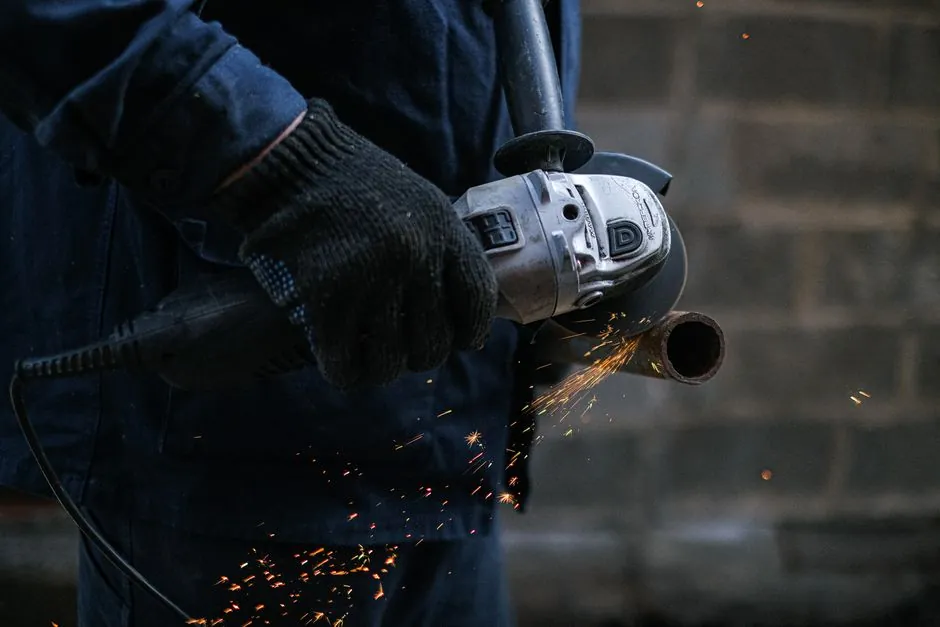
A fettling grinder is a heavy-duty abrasive machine, in pedestal, swing-frame, double-ended, handheld, or robotic configuration, used to knock gates, risers, parting-line flash, and weld spatter off castings and forgings [S4][S8].
The market splits across five format classes with 0.3-15 kW power band, 4-24 in (100-610 mm) wheel diameter, and 80-3821 rpm operating speed, with selection driven by casting mass, alloy, and dust-explosion zone rather than by brand [S2][S3][S5].
Handheld Angle Grinder Format
The handheld angle grinder format covers the 4-7 in (100-180 mm) wheel band at 0.3-1.5 kW and is the only class light enough for sub-1 kg cosmetic shells and thin-wall electronics housings, where swing-frame wheel mass would over-power the part [S7]. Tyrolit's freehand fettling line runs roughing and cutting discs at 115-230 mm diameter, with VIBSTAR vibration damping cutting handle vibration by up to 50% on foundry freehand duty [S1]. The 4-7 in handheld is the right pick for variable geometry, low-volume runs, and access into deep pockets, but the wrong pick above roughly 25 kg of gate or riser mass because wheel life collapses and rigid-guard containment is lost [S5].
Pedestal and Double-Ended Snagging Grinder Format
The pedestal snagging grinder (also called bench or stand grinder) runs 12-24 in (300-610 mm) wheels at 3-10 HP (2.2-7.5 kW), with the Ganesh PG-12 to PG-20 pedestal line spanning 3.7 kW at 2700 rpm to 11 kW (15 kW optional) at 1600 rpm and a fixed 860 mm centre height [S3][S5]. The Cast Grind Solutions CWG-DT400 single-end pedestal rough grinder anchors the lower mid-band at 5.5 kW (7.5 HP), 400x40x100 mm wheel, 80 m/s peripheral speed (3821 rpm), 380 V supply, and 340 kg machine mass, purpose-built for brazed diamond wheels on grey and ductile iron [S2]. Double-ended pedestal units mount two wheels on one spindle (typically one roughing, one finishing grit) for cells that need rough and fettle in one pass; they share the 3-10 HP, 12-24 in spec band of the single-ended pedestal [S3][S5].
Swing-Frame Grinder Format
The swing-frame grinder format hangs the wheel on a heavy pivoting arm at 5-15 HP (3.7-11 kW), with 12-24 in wheels at 1600-2100 rpm, and is the only format that handles castings from 25 kg up to several hundred kilograms without wheel deflection [S5]. The Ganesh SG-12 to SG-20 swing-frame line adds 2000-2300 mm overall length and 180-220 kg net mass on top of the pedestal spindle to absorb the pivoting load, with dynamically balanced spindles and external belt-tensioning provision [S3][S5]. The trade-off is ergonomic: swing-frame scores highest on stock removal but worst on cosmetic and thin-wall fit because the wheel mass and pivot geometry overpower delicate parts, so it pairs with a pedestal or handheld station rather than replacing them [S7].
Automatic and Robotic Fettling Cells
The automatic and robotic fettling cell format uses industrial robots carrying grinding spindles and resin-bonded or diamond cutting discs, with Tyrolit's foundry line specifying diamond cutting discs for grey and ductile cast iron to hit maximum service life and absolute precision at unattended duty [S1]. This is the high-volume answer for cells running the same casting geometry in batch, where freehand or pedestal labour cannot keep pace; pneumatic and electric servo-driven spindles both appear in this class, with the same 5-9 kW power band as heavy pedestal units but with closed-loop wheel-speed control instead of operator feel [S4][S5]. The abrasive side is consolidated: resin-bond grinding wheels for steel, diamond discs for grey/ductile iron, and silicon carbide (C) cutting discs for heavily sand-coated parts where zirconia or ceramic grains load up [S1].
Spec Gates That Decide the Format
Four spec gates decide the purchase order across all five formats: wheel diameter matched to motor power, spindle RPM matched to wheel rated RPM, dust port diameter matched to foundry extraction, and ATEX/IECEx zone rating for the cell [S4][S5]. The standard wheel-speed band is 80 m/s peripheral on diamond-spec pedestals (3821 rpm at 400 mm) and 1600-2700 rpm on resinoid-bonded 12-24 in snagging wheels, with a rated-RPM margin of 10-20% below the wheel blotter speed as the working safety window [S2][S3]. Electric models score on energy cost, with 1 kWh equal to roughly 5-7 m³ of compressed air at 7 bar, so pneumatic is about 70-80% less efficient wall-to-wheel; pneumatic still wins on intrinsic safety in Zone 1/21 where Ex-rated electrics add 25-40% to capital cost [S4]. For the dust side, ergonomic mass under 12 kg is the handheld ceiling, and noise/vibration follows the ISO 5349 hand-arm and EN ISO 11203 workplace noise limits [S4].
Format Comparison on Four Decision Criteria
Comparing the five formats on casting mass, stock removal rate, cosmetic control, and Zone 21 suitability: handheld angle (4-7 in, 0.3-1.5 kW) wins on cosmetic and access, loses on stock removal; pedestal snagging (12-24 in, 3-10 HP) wins on small-to-medium parts where the workpiece moves to the wheel and on Zone 21 compatibility with Ex-rated electrics; double-ended pedestal shares the pedestal band and adds one-pass rough-and-finish; swing-frame (12-24 in, 5-15 HP) wins on heavy casting stock removal but loses on thin-wall cosmetic; robotic cell wins on repeatability and unattended duty at high volume but loses on flexibility [S3][S5][S7]. For a mixed cell, the reference configuration is one PG-12 or PG-16 class pedestal plus one or two handheld angle stations, with swing-frame added only when part mass exceeds roughly 25 kg [S5][S7]. For hardware foundries running ferrous castings, the grain choice layers on top: brown or zirconia alumina for ductile and grey cast iron and for carbon/alloy steel, white aluminium oxide for heat-sensitive steel where burn must be minimised, and silicon carbide for low-tensile or sand-burnt surfaces including aluminium, copper, brass, and bronze [S5].
Where the Format Choice Goes Wrong
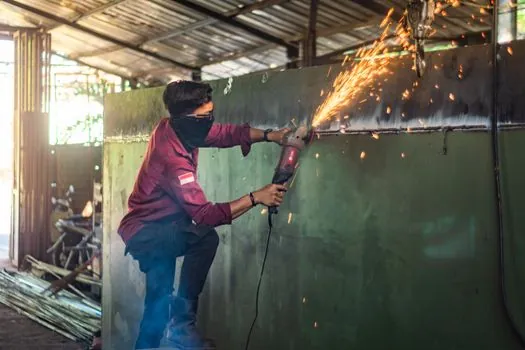
Three common mis-specs recur in foundry audits: a 7-inch handheld pushed onto heavy gates burns through wheels and loses the rigid-guard containment built into pedestal and swing-frame designs [S5]; an electric pedestal installed in an aluminium or magnesium cleaning cell without the Zone 21 rating will both void ATEX/IECEx compliance and stop the cell at the next insurance inspection; a swing-frame assigned to thin-wall electronics housings over-powers the part and fails cosmetic, where a handheld or pedestal with a finer-grit wheel is the correct tool [S4][S7]. The cross-reference to fettling grinder TCO and 5-year cost stack confirms the hidden-cost pattern: a 5-9 kW unit on two shifts hits 3-5x purchase price over 5 years once wheel consumption (30-40% of stack), labour and operator burden (20-30%), and dust extraction filter cartridges are tallied, and the format decision drives that stack more than the brand does [S4]. For a wider view on foundry sand-loop equipment, the sand reclamation vs fettling grinder spec cut lines the cleaning station up against the sand plant, since fettling fines feed the reclamation unit rather than substitute for it [S9].
Track these signals on the next 90-day cycle: (1) new ATEX/IECEx Zone 21 dual-certified electric pedestals entering foundry shortlists as Ex-electric premium compresses below 25% capital uplift; (2) wider adoption of 80 m/s diamond-spec pedestals (CWG-DT400 class) on grey and ductile iron cells where wheel life has been the constraint; (3) standardisation of the PG-12/PG-16 pedestal plus handheld pair on mixed-mass cells per the format map.
Spec-level background on the components involved: fettling grinder, angle grinder, and floor grinder.