Sand reclamation in modern foundries is organised into three process families: mechanical (dry attrition), wet, and thermal, with thermal units typically operating above 600°C and suited to non-ferrous and oil-bonded sands without clay content [S1].
For chemically bonded systems the same logic is split into three operational stages: primary attrition, secondary attrition, and thermal reclamation, which a foundry can run alone, in series, or combined with shake-out to recover grains while keeping AFS (American Foundry Society) average grain size close to the virgin sand baseline [S5].
Process family definitions and operating envelopes
Mechanical attrition reclamation relies on sand-on-sand impact inside vibratory or rotary drums to break down binder bonds; in VIBRA-MILL-style batch units, media and sand are confined in a vibrated chamber so grains scrub each other until binder coatings flake off, after which dust and oversize are screened out [S1]. Wet reclamation uses water washing to partially strip organic coatings and is generally paired with a dewatering stage before the sand returns to the mixer [S1]. Thermal reclamation exposes sand to high-temperature oxidising conditions, with rotary kilns being the most common hardware form for processing crushed or agglomerated lumps of used sand [S6].
Thermal units are the only family that fully burns out organic resin residues, which is why they are specified for chemically bonded sands where residual binder would otherwise build up in the system; mechanical units alone leave enough residual binder to limit reuse cycles on phenolic or furan systems [S1][S5].
Primary attrition: low-level, high-level, and combined shake-out/attrition
Low-level primary attrition units are floor-mounted, need no special foundation, and double as a shake-out deck; their main constraint is a maximum load of roughly three tons and throughput capped at about 15 tons per hour, which sets the practical ceiling for small jobbing foundries [S5].
High-level primary attrition sits in a pit, is fed by a separate shake-out and vibratory feeder, and is built for heavy castings or higher tonnage, at the cost of a larger footprint and dedicated feed handling [S5]. Combined shake-out/attrition units are also pit-mounted but accept higher static loads than the low-level variant, making them the default for medium-throughput iron foundries [S5].
All three primary attrition configurations share the same screening stack: a heavy-duty shake-out grid, a mild-steel secondary perforated plate with 6 mm diameter apertures, a stainless-steel third screen with 1.6 mm apertures in wedge-wire form for self-cleaning, and a final 1.6 mm square-aperture mesh for sand classification [S5].
Mechanical vs wet vs thermal: a four-criterion comparison

On capital cost, mechanical attrition is the lowest, wet is moderate (it needs tanks, pumps, and a dewatering stage), and thermal is the highest because of refractory-lined rotary kilns and off-gas treatment [S1]. On binder removal, mechanical handles clay-bound and lightly bonded systems well but leaves measurable residual resin on chemically bonded sands, wet strips water-soluble coatings effectively, and thermal is the only option that fully combusts cured organic binder [S1][S5].
On sand grain quality, properly tuned attrition rounds grain edges and tends to increase packing density, while excessive attrition or thermal exposure can fracture grains and shift AFS distribution, which the foundry then has to compensate for with new-sand make-up [S5]. On environmental footprint, mechanical attrition has the lowest energy intensity per ton, wet generates a contaminated water stream that must be treated, and thermal has the highest fuel demand and requires afterburner or scrubber compliance on the exhaust [S1].
A practical rule visible across both OEM and academic sources: the harsher the reclamation step, the more AFS drift and fines generation, so most foundries stage the process, running primary attrition first and only routing heavily contaminated sand to a thermal unit, with secondary attrition sitting in the middle for throughput balancing [S3][S5].
Where each unit type fits and where it does not
Mechanical attrition is the default for green-sand foundries where the binder is bentonite-clay and only needs to be rehydrated; running thermal on green sand would destroy the clay fraction and is therefore contraindicated [S1]. Wet reclamation fits non-ferrous foundries processing oil-bonded sands where water washing plus thermal drying can substitute for high-temperature calcination, but it is a poor fit where the foundry's water permits are constrained or where clay content would slurry out with the wash water [S1][S5].
Thermal reclamation is the correct answer for no-bake and shell sand systems carrying cured phenolic, furan, or phenolic-urethane binder, where residual binder levels above roughly 1.5–2.0% start to disrupt mix-water chemistry and tensile development; for an integrated view of the wider foundry equipment ecosystem see construction machinery and equipment and for upstream degassing of molten metal before pour see degassing unit [S5].
Foundries running mixed binder streams often chain primary attrition into secondary attrition into thermal in a 3-stage train, accepting the higher capex to keep Acid Demand Value (ADV) low and silica content high, both of which protect tensile strength in furan systems [S5].
Integration with shake-out, classification, and pneumatic conveying
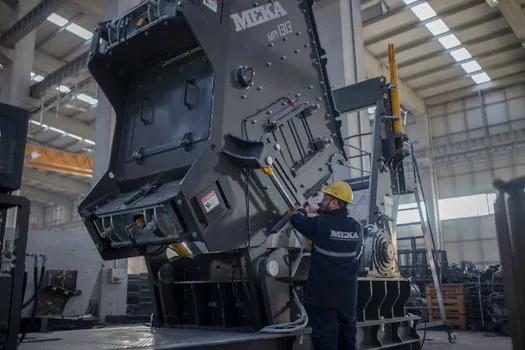
A reclamation line is rarely a standalone machine: it typically starts at the shake-out, passes through lump reduction and metal separation, then sand storage, and ends with pneumatic conveying of the reclaimed sand back to the mixer, with the attrition or thermal unit sitting between classification and storage [S2].
Screens used inside the attrition cell are specified in mild steel for the coarse 6 mm deck (wear life priority) and stainless steel for the 1.6 mm wedge-wire and mesh decks (corrosion and aperture stability priority), which is a common procurement spec for rebuild spares [S5]. For comparison with how compressed-air treatment packages are specified alongside foundry equipment, see FRL unit, and for plant-area lighting that meets foundry dust and heat zones see lamps and light fittings and lighting equipment and electric lamps.
Selection criteria a process engineer should lock down
First, identify the binder family (clay-green, phenolic-urethane no-bake, furan no-bake, shell, oil-bonded) because it determines whether thermal is required or wasteful [S5]. Second, set a target AFS band, usually the AFS number of the incoming new sand plus or minus a few points, and reject any equipment whose vendor cannot show steady-state AFS data over at least 200 operating hours [S5].
Third, define the maximum acceptable residual binder on the reclaimed sand, which for furan systems is typically below 1.0% loss-on-ignition (LOI) and drives whether secondary attrition alone is enough or thermal must follow [S5]. Fourth, map the throughput envelope: low-level attrition is bounded near 15 t/h per unit, so foundries above that line should plan high-level or multi-unit trains instead of oversizing a single cell [S5]. Fifth, audit the auxiliary systems, including dust collection at the attrition cell, afterburner sizing on the thermal kiln, and water treatment for wet lines, because the supporting utilities often cost more than the reclamation unit itself [S1][S3].
For an adjacent decision on mold stack-up and steel grade that the same foundry process engineer will own, see mold base selection for hardware manufacturing: plate stack, steel grade, and cost, and for upstream material decisions on refractory linings see quartz material selection for aerospace: specs, limits, and trade-offs, which apply the same mineral-grade logic to sand selection.
Limitations, failure modes, and common specification traps
Mechanical attrition cells fail most often on screen blinding, where fines pack the 1.6 mm wedge-wire and push carryover into the reclaimed sand bin; wedge-wire profile and vibratory amplitude are the two knobs that control this [S5]. Thermal kilns fail most often on refractory lining life and on burner calibration, both of which drive AFS drift upward as the sand overheats and fractures [S3][S6].
Wet lines fail on water clarity and underflow sand loss, which is why most designs route the wash water through a hydrocyclone or settling tank before discharge [S1]. A common specification trap is to size a thermal unit on nameplate tonnage without checking the residual binder specification: a 5 t/h kiln running at 700°C will not hit the same LOI as the same nameplate unit at 820°C, and the difference shows up as casting defects three shifts later [S3].
Sourcing, standards, and trackable signals
OEM and integrator documentation for sand reclamation equipment is published by names including General Kinematics (VIBRA-MILL line) and Sinto America (integrated reclamation systems), with academic process data on mechanical-thermal combinations appearing in peer-reviewed work indexed on ScienceDirect [S1][S2][S3]. South African foundry supplier Omega Foundry Machinery publishes the clearest staged-process description for chemically bonded systems, including the 6 mm / 1.6 mm screen stack used in primary attrition cells [S5].
For the engineering reference page that this article builds on, see sand reclamation unit. Two signals to track over the next procurement cycle: vendors publishing steady-state AFS and LOI curves rather than just nameplate throughput, and integrator bids that itemise the dust-collection and afterburner scope separately from the main unit, which is the cleanest indicator that the thermal design has been engineered rather than quoted [S3][S5].