
Demand for cold milling machines is being pulled by three structural forces: an aging global paved-road network, a strong shift toward large-class milling units for high-capacity rehabilitation, and a multi-trillion-dollar pipeline of highway and airport infrastructure spending concentrated in Asia-Pacific [S2][S3].
Market sizing varies by source, but the directional read is consistent: the segment tracked from roughly USD 1.69 billion in 2024 toward USD 2.96 billion by 2035 at 5.23% CAGR [S5], with alternative estimates of USD 1.8 billion in 2024 to USD 3.2 billion by 2034 at 5.9% CAGR [S2] and USD 4.8 billion in 2025 toward USD 8.1 billion by 2034 at 6.0% CAGR [S6]. All three sit in the same 4.6% to 6.1% CAGR band [S1][S3][S5].
Aging Road Networks and the Rehabilitation Backlog
The single largest pull on cold milling machine demand is the maintenance backlog on roads already in service: per Federal Highway Administration figures cited in the market.us report, the U.S. alone has over 4 million miles of paved roads that require continuous maintenance [S2].
Most of those roads are reaching or have already exceeded their designed service life, and the combination of traffic loading and environmental stress is forcing periodic milling rather than full-depth reconstruction [S3]. Cold milling fits that profile because it removes the surface or binder course to a controlled depth and leaves a uniform substrate for overlay, which is faster and cheaper per lane-mile than remove-and-replace [S1]. The same source notes that Wirtgen-class machines can strip the full pavement or only the surface, binder, or foundation course, which gives road authorities a tool to match mill depth to the actual distress rather than over-demolish [S1].
Large Cold Milling Machines Capture the Growth
Large cold milling machines held 60.5% of the machine-type segment in 2024, with road construction accounting for 58.2% of application share and construction plus infrastructure leading end-use at 72.8% [S2]. That mix is not accidental: large-class units have higher working width and engine power, and they cover area faster, which directly improves productivity on highway-class jobs [S2].
By product type, crawler-type cold milling machines are the dominant platform: Stratview Research puts crawler share at more than 75% of 2022 revenue, with asphalt road applications the faster-growing split [S4]. The two are not the same axis: large-class and crawler-class overlap heavily on highway rehabilitation, but the cut is working width and power on the first, undercarriage type on the second. Buyers running airport runways, motorway rehabilitations, and port yards converge on large crawler units because the undercarriage spreads load on milled substrates and the wider drum takes deeper cuts in fewer passes [S2][S4]. The market.us dataset also flags a steady drift toward 1 m-class machines such as the XM1005H format, which is positioned for highway, city street, airport, freight yard, and parking lot work [S1].
Regional Engine: Asia-Pacific and U.S. Infrastructure Bills
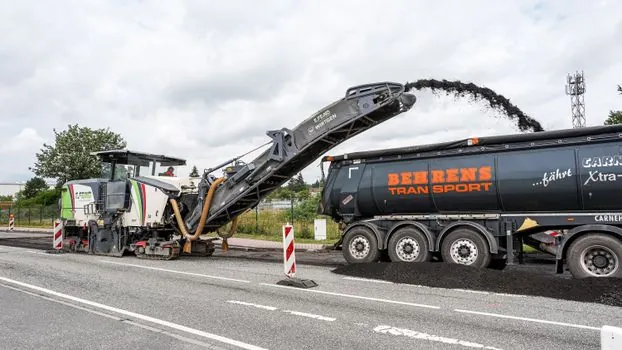
Asia-Pacific is the volume center: market.us shows APAC at 40.7% share and USD 0.73 billion in 2024 [S2], while FactMR puts East Asia at 23.3% regional share for 2024 [S3] and Stratview puts APAC above 35% in 2022 [S4]. Grand View Research earlier estimated APAC at 39.9% in 2022 [S1]. The Asia-Pacific position is anchored in rising population, accelerating transport infrastructure programs, and active penetration by Chinese OEMs including XCMG, SANY, LiuGong, Shantui, and Zoomlion [S3][S4][S5].
North America is being driven less by greenfield highways and more by airport and urban resurfacing funding. Grand View Research cites the U.S. Department of Transportation announcement of roughly USD 1 billion in bipartisan infrastructure law airport financing in February 2023, including USD 10.8 million to Des Moines International and USD 29 million to Salt Lake City International [S1]. The same source tracks U.S. highway and street construction spending rising from USD 117,272 million in November 2022 to USD 122,548 million in March 2023, a measurable lift in the relevant line item [S1]. Market Research Future separately flags North America as the largest single market for cold milling machines, with APAC the fastest-growing region on the back of urbanization [S5].
Automation, Smart Controls, and the Productivity Premium
Technology is the second-order demand lever: integration of automation, smart controls, and digital job data is changing what contractors will pay for a milling machine. Grand View Research describes a feature stack on modern units that includes one-key construction control, speed control, power self-distribution, water-spraying control, construction data management, and vehicle health management, all of which shorten setup, stabilise milling depth, and feed live productivity data back to the site office [S1].
Market Research Future and EIN Presswire both flag the automation and smart-technology trend as a defining shift, with EIN Presswire sizing the market path toward USD 2.6 billion by 2033 and naming Caterpillar and Astec Industries as key listed players [S7]. FactMR's medium-term outlook (2027 to 2030) sees smart-technology integration as the accelerator for the segment, with predictive maintenance and digitalization carrying the long-term (2030 to 2034) phase once the infrastructure boom matures [S3]. For a process-engineer audience, the practical read is that machines with closed-loop grade control, telematics, and on-board diagnostic data command a productivity premium on competitive tenders, even when the diesel platform underneath is conventional. For a broader view of how automated controls are reshaping adjacent industrial equipment categories, see this automation and smart controls digest.
Comparison Snapshot: Driver Class vs. Indicator
A simple criteria-based read of the main demand drivers, lined up against the data points that quantify them, helps separate signal from slogan. [S2]
Rehabilitation backlog: over 4 million miles of U.S. paved roads requiring continuous maintenance [S2], with most networks past designed service life [S3]. Large-class equipment: 60.5% of machine-type revenue in 2024, with road construction at 58.2% of applications and construction plus infrastructure at 72.8% of end-use [S2]. Crawler undercarriage: more than 75% of 2022 revenue [S4]. APAC share: 40.7% in 2024 (USD 0.73 billion) [S2], with China-based OEMs among the named key players [S3][S5]. U.S. infrastructure spend: highway and street construction outlays at USD 122,548 million in March 2023, up from USD 117,272 million in November 2022 [S1], with USD 1 billion in bipartisan airport financing announced in February 2023 [S1]. Automation: predictive maintenance, telematics, and digital job data are now listed as defining trends in the 2024 to 2034 outlooks from multiple analysts [S3][S5][S7].
Limitations and Failure Modes Buyers Should Pressure-Test
Market size estimates for the same year diverge by roughly a factor of three, from USD 1.69 billion in 2024 (Market Research Future [S5]) to USD 4.8 billion in 2025 (Dataintelo [S6]) to USD 1.987 billion in 2023 (FactMR [S3]). That spread means any procurement budget benchmark should be treated as directional, not absolute, until the scope is reconciled against the same definition of cold milling machines.
Regionally, growth is not uniform. FactMR's North America CAGR of 4.4% trails the global average of 4.6% [S3], and Stratview flags market saturation in regions where road infrastructure is already highly developed [S2][S4]. The FactMR base case is that cold milling makes up over 2% of the broader road construction equipment market, which is expected to reach USD 180 billion in 2024, and that the cold milling segment is expected to grow by 1.5 times during the 2024 to 2034 forecast [S3]. Buyers should also weigh operating constraints: dust suppression water systems, milling depth accuracy under varying substrate hardness, and the logistics of moving large-class units between job sites, since these drive total cost of ownership more than headline price. For context on how cost-of-ownership math is breaking down in another process-driven industrial segment, see this process-engineer breakdown of cold-box amine and binder cost per kilogram of core in 2026.
Sourcing Signals and Standards to Track

Buyers tracking capital equipment should watch three verifiable nodes. First, the U.S. Federal Highway Administration pavement condition data, which is the upstream input for any rehabilitation-backlog forecast. Second, OEM quarterly order books from Wirtgen, Caterpillar, Volvo CE, CASE, Hitachi, Komatsu, SANY, XCMG, and LiuGong, all of whom are named as key players across at least three of the cited reports [S2][S3][S5]. Third, the named-feature gap between machines, specifically whether telematics, automatic grade control, and one-key construction control are standard or options, since the productivity premium is no longer optional on competitive tenders [S1][S3][S7]. Industry-standards anchoring is light in the public sources, but milling depth control, dust suppression, and operator safety are the engineering parameters most often cited in OEM documentation; procurement specs should pin these to a tolerance, not a marketing claim. Adjacent process-engineering reference material, including a cement-adjacent procurement and engineering signal pack, illustrates the same spec-discipline approach for a different heavy-industrial segment.
For the relevant spec sheets and selection criteria, see cold milling machine, cold chamber machine, and cold box core machine.