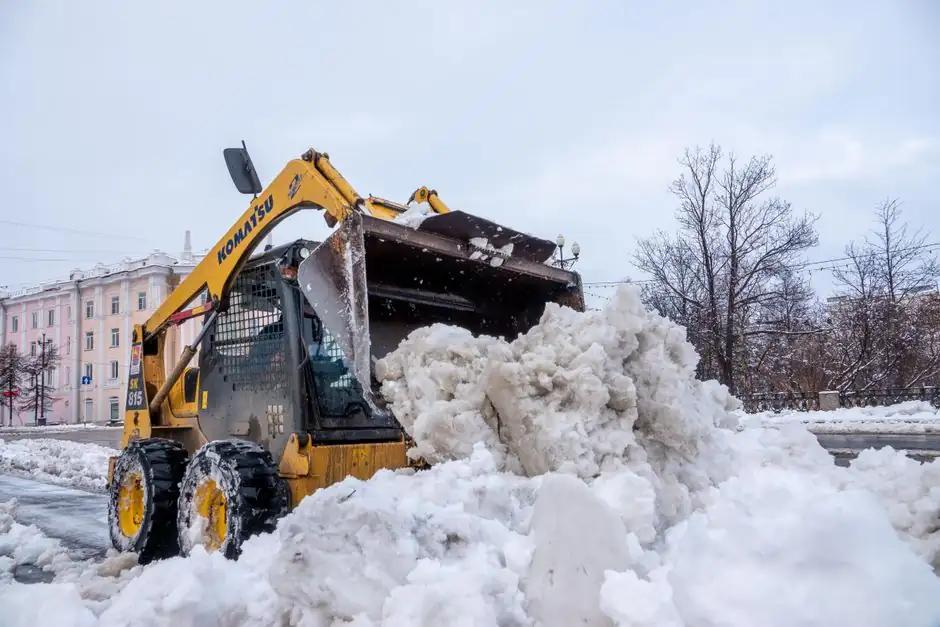
A 2 m-class Wirtgen W 210 / W 210 i carries an 885 gal (3,350 L) on-board water tank, with that water metered through nozzles in the cutter housing to suppress dust and cool cutting teeth rather than delivered as a continuous flow [S4].
That single sentence separates the two questions contractors actually ask: tank size, which is published in litres and gallons on the OEM data sheet, and instantaneous water consumption, which manufacturers report only as a feature, not as an L/h number [S1][S4].
Why OEM brochures list tank capacity, not L/h
Wirtgen's W 50 HR(i) / W 55 HR(i) half-metre miller spec sheet calls out an "adjustable amount of water for low water consumption" as a productivity feature, with no published litres-per-hour figure [S1]. The W 210 / W 210 i technical sheet, by contrast, gives a 3,350 L water tank and 1,220 L fuel tank, plus a 200 L hydraulic tank, so operators can calculate refill intervals from consumption of the other fluids [S4]. Fuel is published at 131 L/h (W 210) and 136 L/h (W 210 i) at rated power, 52 to 54 L/h in a typical field mix, while water is deliberately treated as a work-variable spray, not a steady-state load [S4]. That asymmetry is the first engineering fact a buyer has to internalise: water use scales with milling time, dust load, ambient temperature, and tooth condition, so a single L/h number would mislead.
The 2025 United Equipment rental guide reinforces this: "automatic engine-speed adjustment, water spray metering, and steady conveyor control reduce fuel and water consumption" are sold as a bundled efficiency package, not as a fixed GPM spec [S5].
What the spray system actually has to do
Per the Road Resource definition of cold planing, "water is sprayed on the teeth by a number of nozzles in the cutter housing to control the amount of dust generated and to cool and extend the life of the cutting teeth" [S3]. Two functions, one plumbing circuit: dust suppression at the cutter housing, and thermal management of tungsten-carbide-tipped conical picks, which fail prematurely above their design temperature envelope.
The 2019 Heavy Equipment Guide Canada feature adds a field practice: water can be added "on-the-fly" so the machine never stops for a refill, which is why tank size, refill logistics, and on-site water-truck cycle time dominate the water budget far more than a nominal L/h figure [S2]. Cutting teeth in this service are typically conical with tungsten carbide tips, with newer diamond-tipped variants offered for longer wear life, and both styles are sensitive to under-cooling [S3].
From tank size to operating water budget
With a 3,350 L tank and no published hourly draw, the working number an estimator can ground in published data is tank capacity divided by effective milling hours between refills. The For Construction Pros Best Practices article (2016) reports that "if you look at the average milling job per hour, you're only cutting for 30 to 40 minutes," so on-the-clock water use is bounded by cut time, not elapsed shift time [S6]. Truck exchange, water stops, and grade transitions are the productive-time losses the article highlights, all of which are also the windows when the spray system is idle.
For a 1.5 m or 2.0 m half-lane mill, that means a 3,350 L fill is sized for sustained cutting, not shift length, and field experience suggests the limiting factor is usually water-truck cycle time, not pump capacity. Smaller Wirtgen half-metre mills (W 50 HR(i) / W 55 HR(i), 0.5 m drum) carry proportionally smaller tanks, and the same spray-metering logic applies [S1].
Cross-checking against hydraulic and fuel flows
The skidsteers.com cold planer guide (December 2025) frames the same machine family by hydraulic demand: "cold planers demand 25 to 50 gallons per minute (GPM) of hydraulic flow, ranking among the most power-hungry skid steer attachments" [S7]. For a self-propelled half-lane or full-lane mill, hydraulic circuits run at far higher GPM and pressure than the water spray circuit, which is why OEM literature leads with hydraulic and fuel data and buries water in a bullet point.
For reference, the W 210 / W 210 i publishes 470 kW (W 210) and 507 kW (W 210 i) at 2,100 min-1, with a 200 L hydraulic tank, a 850 mm (33 in) wide primary conveyor, and a 375 m3/h theoretical discharge capacity [S4]. Water consumption is a small fraction of the energy and fluid budget of the same machine.
Decision criteria when water actually matters
Three operating cases drive water from "feature" to "constraint": high ambient temperature with deep cuts, urban sites with strict visible-dust limits, and remote jobs without a water truck on standby. In all three, the published specs that matter are tank size (3,350 L on W 210 / W 210 i, smaller on W 50 HR(i) / W 55 HR(i)), spray-system adjustability (called out explicitly on the Wirtgen small-miller datasheet), and on-site refill logistics [S1][S4]. Cold milling cutting picks, which are the components the water is actually protecting, are specified and priced separately, so their wear rate sets the water demand indirectly.
For contractors comparing half-metre, compact, and large mills, the underlying cold milling machine class is the right unit of analysis, not a single L/h figure, because tank size, cutter housing width, and pick count all scale together.
Standards, sourcing, and what is not in the data
No ISO, EN, or ASTM standard cited in the research pins a numerical L/h value to cold-planer water spray, and the OEM sources treat water consumption as an adjustable operating parameter, not a regulated spec [S1][S3][S4]. EPA NSPS and equivalent EU directives regulate particulate emissions from pavement-milling equipment, but the research material does not state a numerical water-rate requirement under any of those rules. Operators therefore specify water on tank capacity, on dust-suppression performance, and on water-truck logistics, not on a published L/h benchmark [S2][S5].
Trackable next signals: Wirtgen and competitors publishing per-model GPM or L/h figures on future datasheets; updates to US Tier 4 final / EU Stage V documentation that couple water spray to particulate compliance data; and 2026 field reports from rental fleets quantifying refill intervals on 2 m-class mills. Related field data on cold milling fuel use per lane mile sits one click away for estimators building a full fluid-and-energy model.