
ACT broke ground in May 2026 on a U.S. cold plate line sized for more than 500,000 plates per year at full ramp, with output coming online in phases through 2027 to serve AI data center liquid cooling [S1].
AI rack densities have crossed 70-120 kW per rack, up from a 5-10 kW envelope just a few years back, and direct-to-chip (D2C) cold plates now capture 75% to 80% of a server's total heat load at the source, with the remaining 20% shed through ambient air paths [S3][S8].
Cold plate function and where it sits in a D2C loop
A cold plate is a copper or aluminum block with internal microchannels or fin arrays that bolts directly to a CPU or GPU integrated heat spreader, pulling hundreds to over a thousand watts off the die into a recirculating dielectric or water-glycol coolant [S3].
The technology traces back to 1960s mainframes, but the modern ramp began in the early 2000s once CPU power crossed 100 W, then accelerated with AI accelerators now pushing thermal design power (TDP) past 400 W per chip and approaching 700 W on specialized processors [S4]. Engineering targets have tightened accordingly: thermal resistance below 0.1 °C/W at the cold plate interface, uniform die-surface temperature to suppress hot spots, and zero-contact-time mounting that survives 5+ year maintenance intervals [S4].
2026 capacity moves and where the volume is going
ACT's U.S. expansion is the single largest disclosed capacity addition in the public record for 2026, with phased production lines targeting a steady-state nameplate above 500,000 cold plates annually [S1]. The build-out is calibrated to hyperscaler D2C deployments where each accelerator socket typically requires one or more plates, so a 1 GW AI campus running roughly 50,000-100,000 GPUs consumes cold plate volume in the tens of thousands per phase.
On the demand side, the direct-to-chip cold plate market is forecast to grow from USD 3.4 billion in 2026 to USD 6.7 billion by 2036, a 7.0% CAGR, indicating that today's capacity additions are being absorbed rather than over-built [S7]. The wider AI-driven cooling review literature treats D2C and rear-door heat exchangers (RDHx) as the two commercially mature pillars, with immersion, two-phase, spray, jet impingement, and thermoelectric approaches still sitting below them on a technology readiness scale [S5].
Material, machining, and process choices that drive throughput
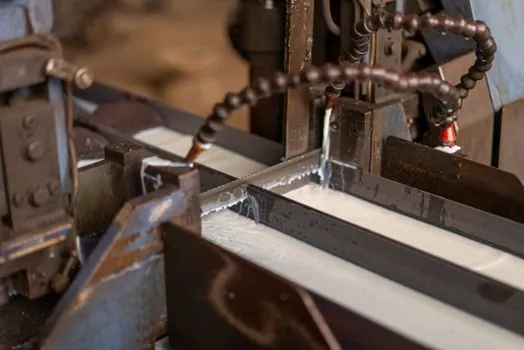
Copper remains the default high-performance cold plate substrate thanks to thermal conductivity around 385-400 W/m·K, with aluminum (around 200 W/m·K) used where weight or cost dominate and the per-plate heat load stays under roughly 5 kW [S2].
Machining routes split into three families that each set different capacity ceilings: skived fin copper or aluminum blocks (high fin density, moderate cycle time, limited to rectangular footprints); vacuum-brazed or diffusion-bonded plate stacks built from stamped or photo-etched covers (best thermal performance, multi-step joining, higher capital cost); and additive-manufactured titanium or aluminum cold plates with conformal internal channels (complex geometry, slow build rate, used for prototype or low-volume specialty parts) [S5]. Asetek's ECAM (Electrochemical Additive Manufacturing) process, developed with Fabric8Labs, eliminates post-processing and scales cold plate output without the machining bottleneck that conventional CNC skiving hits at high fin densities [S6].
Per-chip and per-rack cooling load benchmarks
Per-plate heat dissipation in 2026 production spans roughly 500 W for mainstream CPUs up to about 9 kW for top-end AI GPU cold plates, with vendor offerings explicitly rated for the 9 kW envelope on accelerators [S2]. D2C cold plates capture 75% to 80% of a server's total heat load at the source, with the remaining 20% handled by ambient air paths and rear-door heat exchangers [S8].
Direct-to-chip configurations can remove over 90% of a server's heat load without the energy draw of high-RPM fans or oversized computer room air conditioning (CRAC) units, which is the efficiency claim driving hyperscaler adoption at rack densities above 70 kW [S3]. For comparison, mainstream 2026 AI racks run at 70-120 kW, and the thermal envelope continues to push higher as accelerator TDPs approach 700 W per chip [S3][S4].
Selection criteria: copper vs aluminum, skived vs bonded
Four decision criteria dominate cold plate sourcing for AI servers in 2026: thermal performance (W/K per plate and °C/W interface resistance), per-unit cost (USD per kW cooled), cycle time at volume (seconds per plate), and compatibility with the chosen coolant chemistry (water-glycol, dielectric, or mineral oil for immersion-adjacent systems) [S5].
Procurement teams specifying for AI server builds in 2026 should weigh the 9 kW per-plate headroom [S2] against the under 0.1 °C/W interface resistance target [S4] and the operational reality of capturing 75-80% of heat at the source [S8].
Where D2C fits, and where it doesn't
D2C cold plates are a strong fit for accelerator-dense AI training racks, HPC nodes, and any single-CPU/GPU package pulling more than about 300 W where air cooling has run out of headroom [S3][S4]. They are not a fit for legacy low-density enterprise rooms under 20 kW per rack, for retrofit deployments where the chassis was not designed for liquid plumbing, or for environments where leak risk outweighs the thermal gain, such as edge sites without secondary containment [S5].
For those edge or low-density cases, RDHx and optimized air cooling remain the cost-effective path, and the 2026 cooling literature treats them as complementary rather than competitive with D2C inside a hybrid topology [S5]. Procurement should also weigh material supply: copper cathode availability is a binding constraint on cold plate output, which is why the copper price 2026 outlook and the refined copper deficit discussed in the copper 2026 supply analysis directly feed cold plate lead times. Where the heat load is well below 1 kW per device and the host equipment is not a liquid loop, traditional steel plate heat sink fabrications still cover the bulk of installed base in industrial controls and motor drives.
Trackable signals for the rest of 2026 and into 2027

Watch ACT's phased U.S. ramp through 2027 against hyperscaler D2C deployment announcements: any slippage on the 500,000-plate annual target [S1] will show up first as lengthening lead times on copper cold plate SKUs and as spot-price moves on copper cathode and skived-fin tooling capacity [S7]. The Fact.MR projection of USD 3.4B in 2026 ramping to USD 6.7B by 2036 [S7] gives a numeric envelope to test whether announced capacity actually matches demand, and a cold chamber die casting machine supply line is a useful proxy for the aluminum cold plate tier of the same market. If a second major U.S. or EU cold plate fab breaks ground before year-end 2026, that would confirm the 7.0% CAGR trajectory is binding on capacity, not just on demand.
For the relevant spec sheets and selection criteria, see cold milling machine.