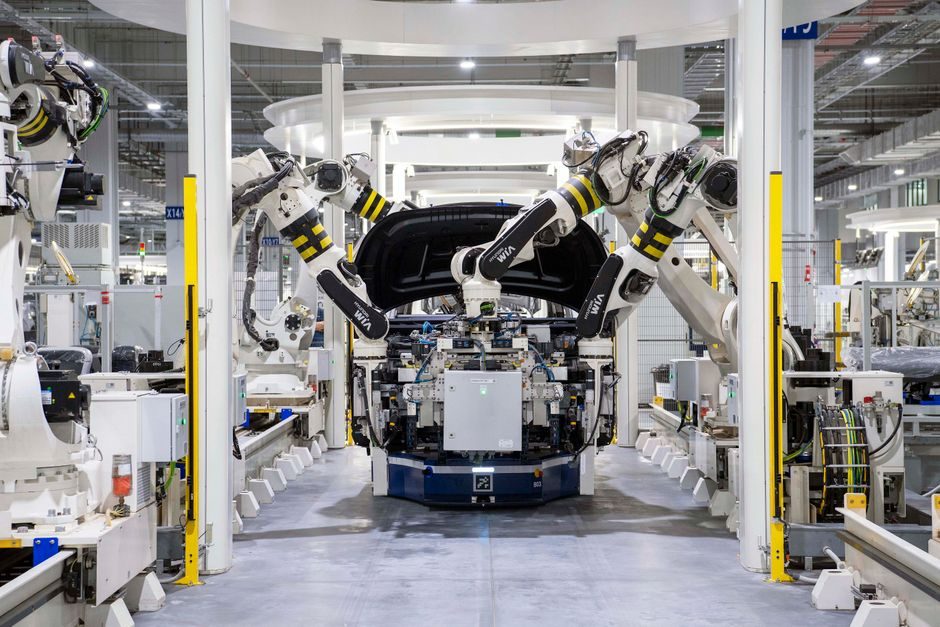
A collaborative robot is defined in the industrial-robot taxonomy as a power- and force-limited manipulator arm that meets ISO 10218-1 / ISO/TS 15066 contact-force thresholds and is permitted to operate in the same workspace as a human without cage guarding [S5]. An AGV robot is an automatically controlled, reprogrammable mobile platform — usually a wheeled vehicle guided by magnetic tape, QR, 2D SLAM or contour following — used to move workpieces, totes, or pallets between fixed points rather than to perform manipulation. The two classes differ on axis count, mobility, payload behaviour, and the safety standard they are built around.
Real 2025-2026 OEM lineups confirm the split: ABB positions YuMi as a dual-arm 7-axis cobot for small-parts assembly that a human can hand-guide without fencing [S1]; Mitsubishi classifies MELFA ASSISTA as a cobot sharing workspace with humans via advanced safety functions and hand-guidable programming [S3]. Neither vendor markets either product as a mobile vehicle — that role is filled by AGVs and AMRs, not by cobots.
Defining the Two Categories: ISO 8373 Taxonomy
ISO 8373:2012 frames a robot as an automatically controlled, reprogrammable, multipurpose manipulator programmable in three or more axes, which can be either fixed in place or mobile for use in industrial automation applications [S5]. That single sentence is the dividing line between today's two product classes: a cobot is "fixed in place" and satisfies ISO/TS 15066 power-and-force-limiting biomechanical limits; an AGV/AMR is the "mobile" branch and is governed by ISO 3691-4 driverless industrial truck requirements.
In the cobot branch, a typical cell has 6 or 7 rotary axes, a 3-16 kg payload envelope, a 500-1300 mm reach, and a repeatability quoted in the ±0.02-0.05 mm band. In the AGV branch, the platform has zero manipulator axes of its own; it carries a 50-2000 kg payload, runs at 1-1.5 m/s in mixed traffic, and positions to ±10 mm under standard SLAM. Treating the two as substitutes produces a mis-specified cell.
Selection Criteria: Payloads, Reach, Safety Standard, Footprint
Engineers who correctly pick between the two usually start from four decision criteria. (1) Does the task require tool motion along an axis, or transport of mass? Manipulation picks the cobot; transport picks the AGV. (2) What is the duty cycle? A cobot cycle is short — pick, place, screw, inspect — measured in seconds; an AGV cycle is a transit leg measured in tens of seconds to minutes. (3) What is the safety case? A cobot cell is governed by ISO 10218-1 + ISO/TS 15066 with a risk assessment for each contact event; an AGV is governed by ISO 3691-4 with laser-scanner or bumper-based field protection and a defined speed-vs-obstacle-distance map. (4) What is the facility commitment? A cobot usually wants a 2-3 m² cell with a stable mount; an AGV wants a mapped, signalised floor and a fleet manager. [S1]
Spec economics reinforce the split. UFACTORY's 2025 market briefing cites a cobot segment projected to roughly $2.14 billion by 2025 with a ~31.6% CAGR through 2030 and an estimated 3-5% annual price decline as new entrants enter [S4]. AGV pricing follows a different curve because the bill of materials is dominated by batteries, drives and the fleet software stack rather than by precision reducers and force-torque sensors.
Comparative Matrix: Cobot vs AGV on the Same Decision Axes

Lining the two options up against the same four decision axes makes the choice mechanical for a process engineer:
• Function: cobot = tool motion / process on part; AGV = mass transport between stations.<br>• Primary standard: cobot = ISO 10218-1 + ISO/TS 15066; AGV = ISO 3691-4 (driverless industrial trucks).<br>• Typical payload: cobot 3-16 kg; AGV 50-2000 kg (tow tractor / unit-load / forklift variants).<br>• Mobility: cobot = fixed base, zero navigation; AGV = SLAM / QR / magnetic guidance, 1-1.5 m/s in mixed traffic.<br>• Position accuracy: cobot ±0.02-0.05 mm repeatability at TCP; AGV ±10 mm at docking fiducial, higher with fine-positioning jigs.<br>• Safety story: cobot uses power-and-force limiting and collision detection; AGV uses 2-D safety LiDAR + bumper + speed-zone logic.<br>• Buyer profile: cobot = small/medium batch assembly, lab automation, inspection; AGV = warehouse, line-side delivery, hospital logistics.
Where the matrix points to a tie — for example, when a part must be moved and then processed — the answer is a mobile manipulator combining an AMR robot base with a 6-axis cobot arm, not a "cobot vs AGV" decision.
Use Cases: What Each Class Does Well in 2026
Current cobot deployments cluster around three tasks. First, small-parts assembly — ABB's YuMi is sold explicitly for collaborative small-parts assembly on lines that have been re-engineered to remove cages [S1]. Second, screw-driving, dispensing and inspection in cells where a human operator must load the part by hand and cannot be excluded. Third, out-of-the-cage applications in medical and research settings: ANT Neuro's vmove neuronavigation system integrates a collaborative robot arm to hold a transcranial magnetic stimulation coil alongside a researcher, with documented compensation for natural head movement during a session [S2].
AGV/AMR use cases are structurally different. They dominate line-side delivery of totes and bins in automotive final assembly, pallet transport in 3PL warehouses, and sterile-zone logistics in hospitals and semiconductor fabs. The dominant buyer question is fleet management and traffic control — software that does not exist in a cobot's stack — and the dominant risk is path blockage, not contact force.
Limitations and Failure Modes of Each Class

Cobots have three failure modes engineers underweight. (1) Payload and reach constraints: pushing a cobot above its rated payload degrades its force-limiting safety case and can stall the joint torque sensors. (2) Cycle-time penalty: a guarded-stop event triggered by an unintended contact stops the cell until a reset is acknowledged, so high-speed lines need a separate fenced cell. (3) Workspace hygiene: cobots cannot traverse aisles, so they do not relieve congestion between workstations — that is an AGV job. [S3]
AGVs and AMRs have their own failure modes. (1) Floor discipline: a reflective floor, a rearranged pallet rack, or a poorly mapped mezzanine can degrade SLAM-based localisation below the docking tolerance. (2) Mixed-traffic policy: ISO 3691-4 requires a defined set of speeds and stop distances for each zone, and a robot that fails to enforce them is not a compliant AGV. (3) Battery and opportunity charging: cycle economics depend on opportunity-charge windows that a fixed-base cobot cell does not have to plan for.
Standards, Sourcing, and Where to Verify Specs
The relevant published standards for a buyer comparing these two classes are ISO 10218-1 and ISO/TS 15066 for cobots, ISO 3691-4 for driverless industrial trucks, and the umbrella ISO 8373:2012 definition of an industrial robot [S5]. Vendor data sheets are the second source layer: ABB YuMi [S1] and Mitsubishi ASSISTA [S3] both publish safety-rated monitored stop, collaborative operation, and power-and-force-limited modes, and explicitly call out the cell conditions under which those modes are valid. A 2025 market data point on cobot segment economics and price decline comes from UFACTORY's industry overview [S4]. A field-deployment reference for cobot arm use outside manufacturing — research neuroscience — is ANT Neuro's vmove product page [S2].
For broader industrial-robot quality benchmarks, see the industrial robot manufacturing quality standards spec map, which covers ISO 9283 repeatability, ISO 13849-1 safety category, and IEC 61508 SIL ratings that apply to either class.
Decision Rule and Trackable Signals

The decision rule is short. If the value stream is "process this part" — assemble, screw, test, inspect, dispense — specify a collaborative robot from one of the major OEM cobot lines (ABB YuMi, Mitsubishi ASSISTA, FANUC CRX, Universal Robots UR, Yaskawa HC) and integrate it into a fixed cell with an ISO/TS 15066 risk assessment. If the value stream is "move this part between stations", specify an AGV robot or an AMR robot with a fleet manager and ISO 3691-4 conformity. If both are required, the spec is a mobile manipulator — not a choice between the two. [S3]
Trackable signals to watch before the next spec review: (1) any update to ISO/TS 15066 biomechanical limits and how it reshapes cobot power-and-force-limited certification; (2) the next price-data point in the cobot segment, which UFACTORY's 2025 overview already sized at roughly $2.14 billion and projected to decline 3-5% annually [S4]; (3) the rate at which articulated robot vendors release hand-guidable, no-code-programming variants, which is the main competitive pressure on traditional cobots.