
Specifying the wrong crane family burns budget fast: crawler cranes move at 1-2 km/h on track shoes, lift past 3,000 tonnes on Manitowoc-class lattice booms, and need no outriggers, while automated stacker cranes (AS/RS) shuttle 1-5 tonne unit loads on rails inside warehouses with cycle times measured in seconds [S3][S7].
One runs on soft ground, the other on a 9 m aisle rail — they share almost no component, footprint, or operating envelope, and the procurement team that conflates them pays for it in rigging, foundation, and integration rework.
Crawler Crane: Definition, Load Class, and Configuration Envelope
A crawler crane is a lattice- or telescopic-boom crane mounted on twin continuous tracks ("crawlers"), giving it ground-bearing pressure as low as 30-80 kPa and lift capacity that scales from 40 t telescopic models up to 3,000+ t on heavy-lift lattice rigs [S1][S3]. The undercarriage is built from track shoes, track rollers, top rollers, idlers, and sprockets — Yantai Evergrowing's export catalogue alone lists replacement undercarriage parts for Hitachi, Sumitomo, Kobelco, IHI, Manitowoc, Terex, Liebherr, SANY, Zoomlion, XCMG, and FUWA, signalling the breadth of installed base that the global parts aftermarket services [S2].
Manitowoc's MLC-series modular base units (MLC 80A-1, MLC 100-1, MLC 150-1, MLC 165-1, MLC 250, MLC 300, MLC 650, plus legacy 999 / 14000 / 16000 / 18000 / 31000) and the Grove wheeled range are the line TIL distributes across India, designed as modular platforms so a customer can add jibs, boom extensions, or variable-position counterweights without buying a new carrier [S3]. TIL also confirms the practical operating envelope: 50 m to over 100 m hook height depending on boom configuration, 1-2 km/h travel speed, and hydraulic cylinders driving both boom hoist and travel motors for precision load control on uneven terrain [S3].
UK and European hire fleets lean on similar models — Delden Cranes has run crawler-only operations since 1975 and aggregates "over 300 years of combined workforce experience" on these machines, indicating that crawler crane serviceability, not just lift chart, is the procurement gate [S6].
Stacker Crane: Definition, Load Class, and Configuration Envelope
A stacker crane — formally a unit-load AS/RS crane or mini-load AS/RS crane — is a rail-guided, mast-supported crane that runs inside a warehouse aisle on a top or bottom rail and stores/retrieves pallets, totes, or trays from rack positions up to 40 m high. Standard unit-load ratings sit at 1-5 t per cycle, with cycle times of 60-120 s for single-deep and 90-180 s for double-deep storage, and aisle widths as narrow as 1.0-1.6 m versus the 3-5 m a mobile crane needs for setup. [S1]
Unlike the crawler, the stacker crane is a fixed asset: a steel mast with a single or telescopic mast column, a trolley running up/down the mast, a load-handling device (telescopic fork, chain conveyor, or clamping head), and an electrical busbar or festoon system along the aisle rail. Energy comes from mains-powered busbar or, in newer greenfield builds, lithium-battery or super-capacitor hybrid drives that recover braking energy. Control is via PLC or WMS-coupled stacker-crane controller, and the system depends on absolute encoders and laser/rfid positioning for ±5 mm repeatability at the storage location.
Procurement lines that should be tracked against any stacker-crane quotation: minimum/maximum aisle length, mast height to top tie-rod, single- vs double-deep mast, load-handling-device type and stroke, acceleration/deceleration profile, and total number of storage positions served (one crane typically services 800-2,000 single-deep pallet positions, depending on rack depth and shuttle use).
Decision Criteria: Where Each Crane Earns Its Place
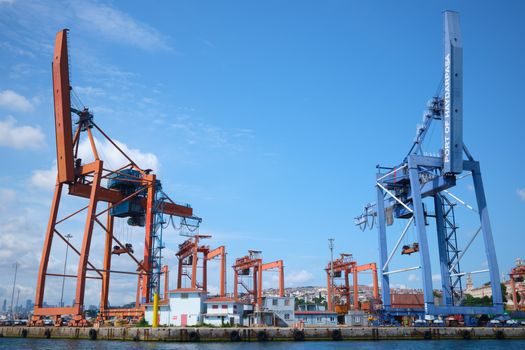
Use four gates to choose. If your lift site is outdoor, load exceeds 50 t, ground is soft or uneven, and the lift count per year is in the dozens — not thousands — the crawler crane wins on ground-bearing pressure, transport-without-disassembly (modular Manitowoc base units ship in container-loadable modules), and rigging tolerance for 100 m+ booms [S3][S6].
If your operating envelope is indoor, load is 1-5 t per pick, the warehouse runs two or three shifts, and you need 20,000-100,000+ pallet picks/month, the stacker crane wins on cycle time, footprint, and WMS integration — the cases where a crawler cannot physically fit or would be commercially absurd. The two machines meet only at the warehouse-yard interface, where a crawler may unload containers for an indoor stacker crane to rack.
Criteria-by-Criteria Comparison
Load capacity: crawler cranes dominate — Manitowoc's published crawler range starts in the 80 t MLC 80A-1 and climbs past 3,000 t, while stacker cranes max out around 1-5 t per load and drop to 50-300 kg for mini-load AS/RS variants [S3]. Operating environment: crawlers run outdoors on soft ground, stacker cranes run indoors on a steel rail with a controlled atmosphere (often 0-40 °C, ≤95 % RH non-condensing).
Mobility: crawlers self-propel at 1-2 km/h and walk to the next lift on their own tracks, requiring no outriggers on firm ground; stacker cranes are anchored to the rail and require rail extension to "move" to a new aisle [S3]. Footprint and aisle: a crawler needs a 3-5 m setup pad plus swing radius for tail and counterweight; a stacker crane needs a 1.0-1.6 m aisle and a fixed mast base. Cycle economics: a crawler measures lifts per day (single digits to low tens), a stacker crane measures picks per hour (30-60 single-deep, 20-40 double-deep).
Undercarriage wear: crawlers consume track shoes and rollers on every move — Yantai Evergrowing alone lists replacement shoes for 20+ OEM families including Hitachi, Sumitomo, Kobelco, Manitowoc, Liebherr, SANY, Zoomlion, XCMG [S2]; stacker cranes wear rail wheels and busbar collectors, not full-width tracks. Crew and certification: crawlers need a certified crane operator and often a rigger/signal-person; stacker cranes run unattended inside a fenced AS/RS with a WMS-coupled controller and only need human intervention for fault-recovery.
Use Cases and Failure Modes

Crawler crane sweet spots: wind-energy erection (3 MW+ nacelle lifts on Liebherr LR 1600/2-class rigs), refinery and petrochemical module installs, bridge girder erection, shipyard block lifts, and heavy-haul transport on soft pad — the exact reasons B&B Crane Service and Delden Cranes position crawler hire as their core offering in the US Gulf Coast and UK/European markets [S5][S6]. Common failure modes: track-shoe pin wear on abrasive ground, slew-ring bolt loosening, boom-pin galling on lattice chords, and hydraulic contamination when the machine sits idle between lifts.
Stacker crane sweet spots: 20,000+ SKU distribution-centre racking, cold-store pallet AS/RS, mini-load tray handling for e-commerce piece-picking, and automated production-line buffer storage. Common failure modes: rail-wheel flat-spotting from misalignment, busbar shoe wear, encoder/laser-positioning drift, and mast vibration above 30 m if the mast tie-rod spacing is undersized. For broader crane-sourcing context the Gantry Crane vs Stacker Crane selection map and the Overhead Bridge Crane vs Stacker Crane map show the same indoor-AISLE envelope logic applied to the gantry and bridge-crane families.
Sourcing, Standards, and Procurement Gates
Crawler-side procurement gates: nameplate capacity at the working radius, modular-boom configuration options, hydraulic-load-moment-indicator (LMI) certification to ISO 4309 / EN 13000, transport dimensions for road/rail/sea, and aftermarket coverage for the undercarriage — Juyi International's catalogue of 318 crawler-crane SKUs plus OEM-specific track chains signals that the aftermarket parts chain is mature enough to keep a 20-year-old Manitowoc 999 or 14000 serviceable [S7].
Stacker-side procurement gates: rail length and tolerance, mast deflection under full load, cycle-time guarantee with single- and double-deep storage, energy-recovery specification, WMS/PLC interface protocol (typically OPC-UA, PROFINET, or Ethernet/IP), and seismic/wind classification for the rack structure. For a wider cross-check against other warehouse-material-handling kit the Reach Truck vs Forklift aisle map and the Pallet Jack Suppliers 2026 sourcing map provide the floor-level companion spec logic.
One operating detail that bites specifiers on both sides: a crawler crane's max-capacity figure assumes outriggers extended or, on a crawler, full-track contact and level ground — derates of 20-40 % are common on soft ground without timber mats, and the LMI cut-out is the engineering control, not a soft guideline.
Track the undercarriage-parts aftermarket for Hitachi, Sumitomo, Manitowoc, Liebherr, SANY, Zoomlion, and XCMG against your installed base [S2], and watch for AS/RS retrofit cycles in mid-2010s-built European distribution centres — both signals forecast where crawler spares and stacker-crane replacement demand will concentrate in 2026-2027.