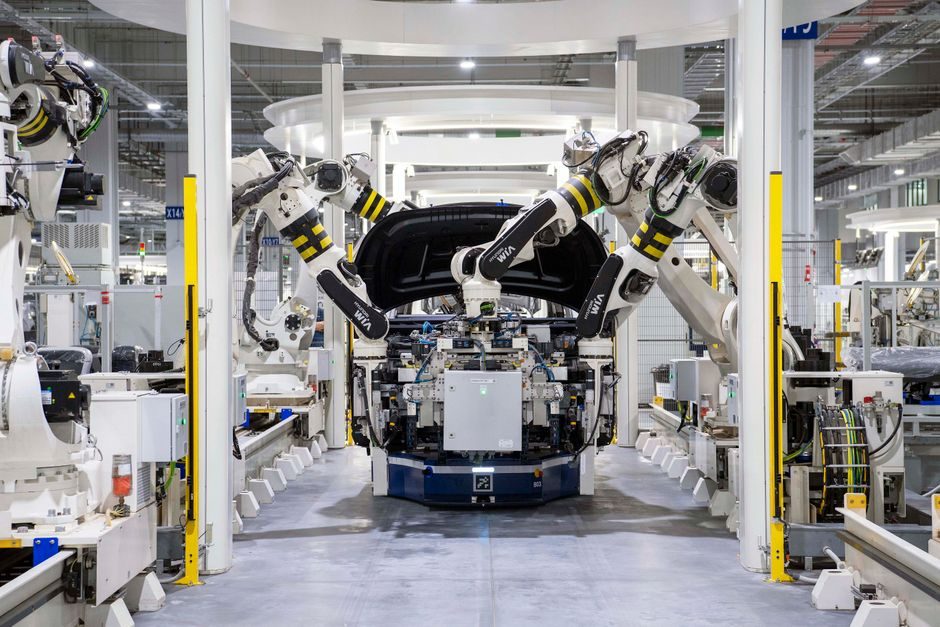
ISO 9283 sets the methodology for industrial robot performance testing — repeatability, pose accuracy, path accuracy, dwell-time stability, and cycle time are measured under defined payload, speed, and pose-window conditions rather than as marketing numbers [S1]. The standard's three performance classes (Class 1 baseline, Class 2 mid-range, Class 3 high-precision) form the reference grid that procurement and quality teams use when comparing 6-axis arms from different suppliers.
For collaborative cells, ISO 10218-1 (robot safety) and ISO 10218-2 (cell integration) supply the hard requirements, with ISO/TS 15066 layering in collaborative-mode limits — quasi-static contact, transient contact, and speed-and-separation monitoring thresholds that map directly to the four collaborative operations (power-and-force limiting, hand-guiding, speed-and-separation, safety-rated monitored stop). The peer-reviewed coverage of "robot reliability and safety" in the *Industrial Robot* journal (ISSN 0143-991X, IF 2.5) confirms this is an applied, implementation-validated field, not a simulation-only discipline [S1].
Pose Accuracy vs Repeatability: the Two Numbers Buyers Confuse
Pose accuracy captures the absolute deviation of a commanded TCP pose from the actual pose at the end of a single motion; repeatability captures the statistical spread (typically 3σ or 2σ depending on the OEM datasheet) of many return motions to the same commanded pose, measured per ISO 9283 at a defined payload, temperature, and warm-up cycle [S1]. A 6-axis arm with ±0.02 mm repeatability and ±0.5 mm pose accuracy is a normal mid-range data set, with the gap between the two figures telling the buyer how much of the error is calibration drift versus mechanical slop.
Buyer-side, the recommended gate is to test the cycle-time-under-payload figure rather than the no-load number, because the *International Journal of Advanced Manufacturing Technology* two-stage model (2026-06-20) makes the case that quality and output trade off non-linearly once the robot carries a real workpiece, and that single-axis speed specs overstate throughput in mixed-product cells [S2]. Repeatability under load is the metric that survives contact with production reality.
SCARA, 6-Axis Articulated, and AGV: Choosing by Spec, Not Brochure
Spec-driven selection in 2026 still comes down to three architectures: SCARA (fast, planar, high-cycle pick-and-place), 6-axis articulated (general welding, machining tending, assembly), and AGV/AMR (material flow, conveyor handoff). The relevant spec axes are reach envelope, payload at wrist, repeatability under load, axis count, and footprint, weighed against the cell's cycle-time target and takt pressure. For a deeper look at the SCARA-vs-AGV decision grid, see SCARA Robot vs AGV: Spec-Driven Selection for 2026 Plants. [S2]
For high-arc-on-time welding cells, a 6-axis articulated with payload in the 6–20 kg class remains the default; for conveyor-fed inspection or foreign-object removal, an AI-guided articulated arm with vision is now a standard catalog SKU, with mining-conveyor variants listed at US$208,000–286,000/set MOQ 1 on mainstream B2B marketplaces [S3]. For collaborative cells under power-and-force limiting, the gate is the ISO/TS 15066 biomechanical limit map against the part being handled, not a generic "cobot" label.
Welding Robot Cells: Where Standards and Specs Intersect

Welding-robot acceptance testing is the place where robot quality standards meet weld-quality standards: ISO 9283 covers the arm's repeatability and path accuracy on a defined test path, while ISO 3834 governs the welding-shop's quality requirements and ISO 5817 sets weld-quality levels (B, C, D by defect type and limit) that the cell must sustain in production. A buyer-side spec sheet therefore needs two parallel columns — robot-side (repeatability, path accuracy, TCP speed at the seam) and weld-side (ISO 5817 level, NDT coverage, bead profile tolerance). The upstream/downstream picture for welding cells is mapped in Welding Robot Upstream and Downstream Industries: 2026 Spec Map. [S2]
OEM-side, suppliers routinely publish arc-on-time, mean-time-between-failures (MTBF) for the wire feed and torch consumables, and seam-tracking accuracy; the procurement gate should require these on the same test coupon the arm will run in production, not on a factory-floor demo path.
Reliability, Calibration, and the Two-Stage Selection Model
Reliability is treated under "robot reliability and safety" in the *Industrial Robot* journal's scope, with applied, experimentally validated work preferred over simulation-only studies [S1]. That posture is consistent with the Springer (2026-06-20) two-stage model that couples robot selection (long-term capacity decision) with robot operation (short-term production decision) inside a multi-product cell, and which explicitly treats cycle quality — not just throughput — as a first-class variable [S2].
Calibration intervals on a 6-axis arm are typically tied to hours-of-use and collision events; some OEMs publish a TCP re-check after every N hours and a full kinematic recalibration annually, but the actual gate depends on the part's tolerance budget. Buyers should treat the calibration certificate as a live document and tie acceptance to re-check data after commissioning, not to the factory-fresh datum.
Limits, Gaps, and What Spec Sheets Still Hide

Spec sheets routinely omit path accuracy under combined multi-axis motion, behaviour at the corner of the workspace envelope, and thermal drift over a warm production shift. ISO 9283 governs the *test method*, not the *minimum acceptable value*, so a "Class 1" claim from a Tier-2 supplier can be technically compliant and still out-performed by a Tier-1 supplier on a tighter in-house gate — a real comparison only closes at the acceptance-test stage. The same gap shows up in collaborative cells, where ISO/TS 15066 provides a biomechanical map but does not certify a specific cell as safe; that is an integrator's responsibility under ISO 10218-2. [S1]
Supply-chain gaps persist for replacement gearboxes, encoder service kits, and certified end-of-arm tooling, and 40-year-in-business distributors (such as the North American Industrial Manufacturing support channel) position spare-parts-on-shelf as a procurement gate in their own right [S4]. Long-established robot OEMs with SCARA, 6-axis, and linear-module portfolios — Epson's 40-year industrial-robot line is a typical example — tend to publish more complete lifecycle and support data than newer entrants, which narrows the spec-vs-real-world gap [S5].
Acceptance Test: The Minimum Gate Before Sign-Off
An ISO 9283-based acceptance test is the single document that closes the spec-vs-production gap, and it should run at the cell's full production payload, full production path, and over a defined warm-up cycle that mirrors the actual shift. Required outputs are the repeatability figure (3σ), pose accuracy, path accuracy, dwell-time stability, and a cycle-time-under-payload measurement — typically averaged over 50–100 cycles. The contract should reference the standard and the test path explicitly; "factory acceptance" without a named standard and a named path is a soft gate that tends to drift in the supplier's favour. [S2]
For cell-level safety, ISO 10218-2 plus a risk assessment per ISO 12100 is the minimum documentation, and for collaborative cells, ISO/TS 15066 thresholds plus a measured stop-time / stop-distance test close the safety file. Procurement teams that treat safety and performance as two separate acceptance packages, with the standards cited by number, avoid the most common commissioning dispute — a robot that passes one and fails the other.
Watch two signals over the next quarter: OEM datasheet revision toward a unified ISO 9283 + ISO 10218-2 disclosure format, and integrator-side publication of collision-event post-mortems as anonymised data. Both are leading indicators of whether the spec map is tightening or staying fragmented. The deeper buyer-criteria version of this analysis, with gap-by-gap scoring, is in Robotics manufacturing quality standards: spec map, gaps, and buyer criteria.
For the relevant spec sheets and selection criteria, see additive manufacturing material, air quality monitor, and power quality analyzer.