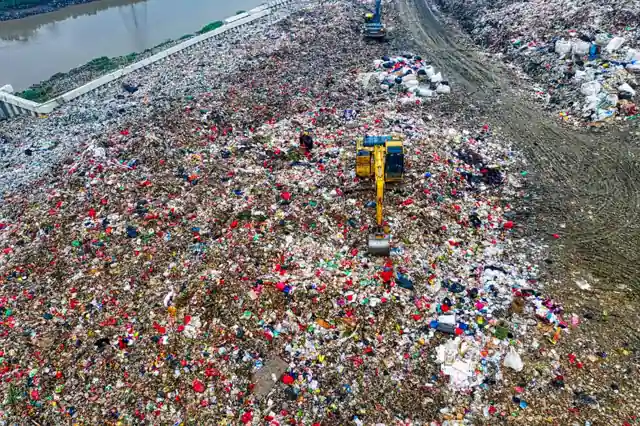
Specifying a concrete batching plant for landfill construction and closure work differs from a generic ready-mix buy: the mix must resist aggressive leachate chemistry, the plant must accept returned concrete without sending it to landfill, and the selected output class must match the daily pour volume of a cell-lining or leachate-tank crew.
For landfill cells, leachate tanks, and capping slabs, the working envelope is roughly 25-240 m³/h, the aggregate side must tolerate chloride- and sulfate-laden feed sources including CDW fine fractions, and the binder system should accept 20-50% supplementary cementitious material by mass to displace landfill-disposed fines [S1][S4].
Output Class and Plant Configuration
Stationary plants in the 90-240 m³/h band are the right pick for landfill cell construction where daily pours of 300-800 m³ are common and the site is dedicated for 12-36 months, while mobile or compact plants in the 25-60 m³/h band fit closure-phase capping work and remote leachate-tank pads where the plant relocates every 4-8 weeks [S1].
For demolition-derived aggregate jobs, mobile vs stationary trade-offs include foundation cost, erection time (typically 7-21 days for a stationary 120 m³/h unit versus 2-5 days for a wheeled mobile plant), and the ability to relocate the weigh batcher as the cell advances, as mapped in the demolition project spec gate [S1].
A plant that swings between stationary and skid-mounted configurations is the most flexible when the landfill operator runs both new cell construction and capping on the same permit boundary, because the same cement silo, screw conveyor, and admixture doser can be redeployed without re-buying the controls package [S1].
Aggregate Sourcing from CDW Fines and Bottom Ash
Construction and demolition waste (CDW) fine fractions typically represent 20-50% of processed mass and are routinely landfilled because of inadequate regulatory pull-through, but they can be engineered into non-structural concrete including paving blocks, decorative pathways, and lightweight blocks when particle size, moisture, and organic content are controlled [S4].
Reducing CDW fine fraction particle size improves compressive strength, while moisture condition significantly affects hydration behaviour and durability, so landfill-side plants should specify variable-frequency vibratory screens and a moisture probe in the aggregate bin, plus a controllable water meter that compensates for aggregate moisture in real time [S4].
Bottom ash from coal-fired utilities, processed as a lightweight aggregate such as PriceLite, has been used in bagged concrete mixes containing 55% recycled material meeting ASTM Standards, and landfill operators with on-site ash mono-fills can adopt the same chain on a larger mixer output to consume stockpiled ash into structural fill and closure-layer concrete [S2].
Life Cycle Cost Analysis on CDW fines shows that equipment ownership is more economical than rental under variable waste compositions, which is the common case at landfills where demolition feed swings between clean concrete, masonry, and mixed commercial debris, so the plant should be purchased, not rented, when the landfill has a 10+ year horizon [S4].
Mix Design, Admixtures, and Sulfate Resistance
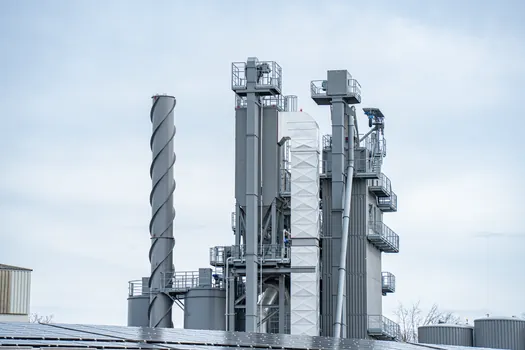
Landfill leachate chemistry exposes concrete to chlorides, sulfates, and low pH (often 4.5-6.5) which attack ordinary Portland cement paste, so a cement concrete mix for landfill structures should use Type II or Type V cement, Class F fly ash at 25-40% replacement, and a water/binder ratio at or below 0.42 to keep capillary porosity low. [S2]
Chemical admixtures specified for this duty include a water-reducing admixture to hold the water/cement ratio at placement, a retarder for hot-weather pours on black geomembrane, and a corrosion inhibitor where reinforcing steel contacts leachate, with the concrete admixture dosing skid sized to the plant's hourly output so residence time in the mixer is consistent.
For paving and erosion-control layers built from CDW fines, macro-synthetic or fibrillated polypropylene fibres at 0.6-1.2 kg/m³ reduce plastic-shrinkage cracking in the 24 hours after pour, and a concrete fiber dosing unit should be specified as a factory-fit option rather than field-added to keep dosing accuracy within ±5%.
Zero-Waste Returned-Concrete Handling
Holcim's Epping and Preston concrete plants in Melbourne completed a zero-waste pilot over September-November 2025 that diverted 2.56 tonnes of cardboard and paper, 150 timber pallets, 240 kg of commingled recyclables, and approximately 50 kg of food waste, while also routing returned concrete to a quarry for recycling into aggregates [S3].
The same waste-stream triage should be written into the landfill plant's HSE plan: separate bins for pallets, commingled recyclables, and organics plus a concrete-reclaim pan that washes returned mix and feeds a reclaimer screw back to the aggregate stockpile, with the goal of zero waste disposal to landfill, zero Scope 2 CO₂ from grid electricity, and zero water discharge incidents [S3].
Adjusted collection frequency and bin sizing at Epping and Preston delivered an estimated $10,000 in annual savings across both plants, indicating that a landfill-side plant that bakes waste-segregation into the layout recovers the cost of the reclaim system within 12-18 months of operation [S3].
Comparison: Stationary vs Mobile vs Compact for Landfill Duty
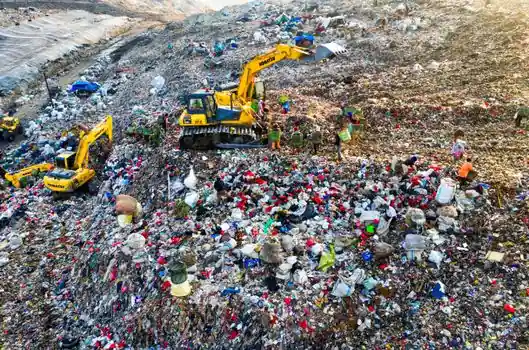
Three plant classes compete for landfill work, and the right choice is set by daily pour volume, project duration, and relocation cadence rather than headline price. The table below maps the realistic envelope: stationary 90-240 m³/h fits new cell builds and leachate-tank foundations where the plant stays put for 12-36 months, mobile 60-120 m³/h fits closure-phase capping where the cell is filled and capped in 6-18 months and the plant moves 2-4 times, and compact 25-60 m³/h fits small daily pours under 200 m³, including backfill around vertical wells and access slab repairs [S1].
On aggregate flexibility, stationary plants can host a 4-bin aggregate batcher with cold-feed bins sized for 200-400 tonnes of live storage per bin, which is enough to keep separate CDW fine, virgin crushed stone, bottom ash, and natural sand simultaneously, while mobile plants typically run 2-3 bins and require manual bin swaps for multi-source pours [S1].
On certification and audit readiness, stationary plants in the major OEM lines carry CE, ISO 9001, and GOST-R markings as standard, mobile plants carry CE and ISO 9001, and compact plants are frequently supplied without GOST-R because the export market is smaller, so any landfill operator shipping concrete into a regulated cell under EN 206 or ASTM C94 should confirm certification before purchase [S1].
Secondary Containment and Site Layout
A landfill-adjacent batching plant sits on top of or adjacent to a concrete retention basin, which serves simultaneously as the plant foundation and as secondary containment for any spill from the mixer, additive tanks, or fuel store, following the dual-use pattern documented on a Superfund landfill leachate treatment project where an existing concrete basin was used as foundation and secondary containment [S5].
The basin volume should be sized at 110% of the largest single tank on site (typically the water or additive tank), with a chemical-resistant liner or coating on the interior face, a drain valve that defaults to closed, and a sump for sampling, mirroring the leachate plant's retention and monitoring configuration [S5].
A truck washout bay feeding the reclaim pan should be graded back toward the basin, not toward the active cell, so wash water cannot carry cementitious fines into the leachate collection system; this is a layout decision that has to be locked at civil-works stage because retrofitting a wash bay into a closed landfill is impractical [S5].
Sourcing, Standards, and Audit Trail
[S1]
Mix acceptance should reference ASTM C94 for ready-mix, ASTM C150 for cement type, ASTM C618 for fly ash and bottom ash, and ACI 350 for environmental engineering concrete structures, with the latter governing crack-width and cover requirements for leachate-contact elements.
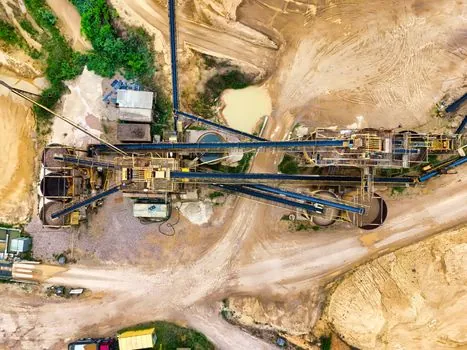
For sourcing of mobile and stationary plants, the practical shortlist is dominated by Chinese OEMs in the 25-240 m³/h range with CE, ISO 9001, and GOST-R marks, and for plant selection on demolition and waste-streams specifically, a 2026 guide on concrete batching plant selection for demolition projects walks the mobile-vs-stationary decision tree in more detail.
Trackable signals to watch over the next two quarters: a second commercial deployment of the Holcim-style zero-waste template at a non-Australian operator, and a regulatory update that re-classifies CDW fine fractions as a recognised aggregate rather than a waste, which would shift the LCC math sharply in favour of on-site CDW-fine processing at landfill plants [S3][S4].