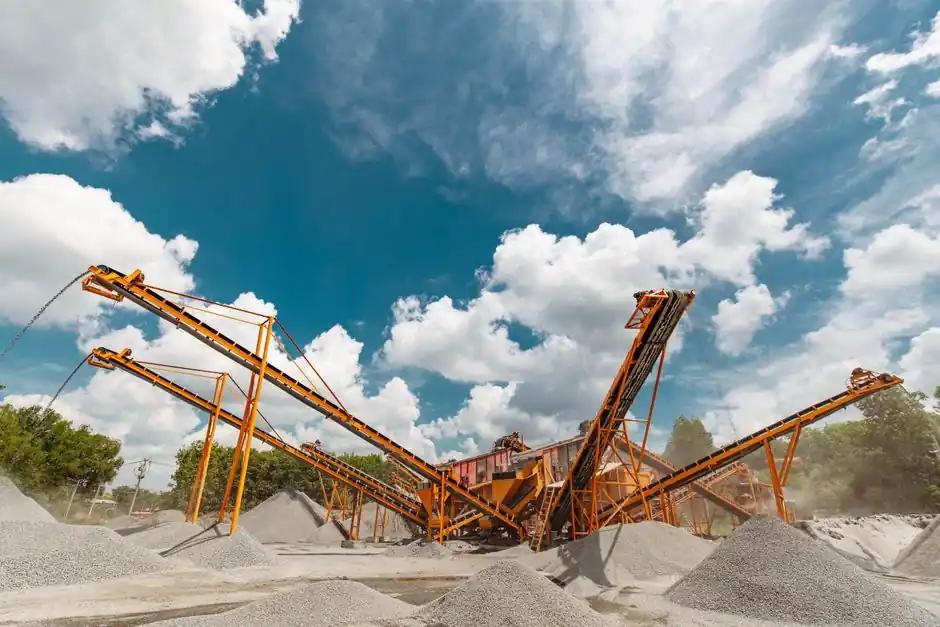
Quarry operators specifying a concrete batching plant in August 2026 should anchor the decision on the HZS output tier, the JS/MP mixer family, and weighing-accuracy bands rather than on sticker price, because aggregate-bin configuration and weighing tolerance dictate both the abrasion wear rate and the w/c ratio the plant can hold on structural pours [S1][S4].
Stationary HZS60 to HZS180 frames cover 45–60 up to 150–180 m³/h from JS1000/JS1500/JS3000 twin-shaft mixers at 130–280 kW installed power, with 3–4-bin PLD batching machines and 3.8–4.5 m discharge heights that match ready-mix truck loading geometry on quarry access roads [S2]. For projects below 25 m³/h, a site-mix workflow with a concrete vibrator anchored lay-down area is generally a better economic fit than a fixed plant [S4].
Capacity Bands Matched to Quarry Throughput
A quarry running continuous road-base, haul-road patch, and crusher-foundation pours typically needs 1,000+ m³/day, which lands inside the HZS90 to HZS180 envelope where 90 m³/h belt-conveyor frames and 180 m³/h inclined-belt units both qualify; the 90 m³/h tier is positioned as the balanced choice when total cost of ownership, including silo and foundation civil works, is weighed against the headline capacity number [S4][S1].
Annual output below 200,000 m³ points to an HZS90 or HZS120 with 110–130 kW total power, while 200,000–300,000 m³/year typically scales to an HZS120 or HZS180, and programmes above 300,000 m³/year justify the HZS180's 280 kW, 3 m³-per-cycle JS3000 mainframe paired with a 700 t/h inclined-belt aggregate conveyor [S3][S1]. The concrete batching plant class on offer in 2026 also includes mobile YHZS25/35/60/75 trailer units, but these cap out near 60–75 m³/h due to single-bucket skip-cycle limits and rarely support a multi-year quarry contract [S4].
Mixer Family and Aggregate Feeding Topology
JS-series twin-shaft compulsory mixers (JS500, JS750, JS1000, JS1500, JS2000, JS3000) are the default agitation core for HZS-class quarry plants, with twin-shaft geometry chosen for short-cycle, high-intensity mixing of 80 mm aggregate batches that match crushed-stone output from on-site crushers [S2][S4]. The reference spec set shows HZS25 carrying a 0.5 m³ JS500 at 35–40 kW, while HZS60 steps to a 1.5 m³ JS1500 at 80–90 kW, and HZS120 reaches a 3.0 m³ JS3000 unit on a 4-bin PLD4800 batcher [S2].
Skip-hoist plants keep the structural footprint narrow and fit constrained quarry lay-down areas, but the single tipping-bucket cycle bottlenecks output near 60–75 m³/h, so any HZS-class frame above 90 m³/h is paired with an inclined or enclosed belt conveyor to lift aggregate at 700 t/h continuous feed rates [S1][S4]. For projects that batch fibre-reinforced shotcrete or steel-mill floor slabs in parallel, the same weigh head on the concrete fiber dosing line can share the PLD skid if the recipe table is mapped at the PLC.
Weighing Accuracy, Admixture Dosing, and Recipe Control
The YG Machinery 2026 data sheet for the YG20, YG30, YG60, and YG100 stationary batching plants lists aggregate weighing accuracy at ±2% and cement, water, and additive weighing accuracy at ±1% [S5].
PLC-driven weigh cycles with per-batch data logging are now standard on HZS-class frames, and the same control loop governs the concrete admixture dosing pump so that water-reducer or retarder addition stays inside the w/c ratio the mix design assumes, which is the lever that delivers compressive-strength uniformity from the first batch to the last [S1][S9]. Moisture probes on the sand bin trim batch water on the fly, and modern plants add dust-collection plus water-recovery loops that cut raw-water draw on arid quarry sites, a binding constraint where haul-road wash-down and dust suppression already compete for the same supply [S1].
Stationary vs Mobile for Quarry Deployment
Stationary plants win on throughput and quality control for quarry programmes running more than 1,000 m³/day at a fixed location, with quoted ex-works prices of USD 17,500–285,000 per set in the 60–180 m³/h band before civil works, silos, and erection labour, which means payback depends on a sustained 2–5 year pour programme rather than a single bench cut [S1][S5]. Mobile YHZS35/60 units cut site-prep expense by up to 40% and can be assembled within 2–3 days, but their 35–60 m³/h nameplate rarely keeps up with a continuous quarry-pour schedule, and the 10–15 year operational lifespan of a heavy-duty stationary frame is the better TCO anchor on a multi-pit project [S5].
Quarry projects where the pour point migrates between benches every 6–12 months, typical of open-pit copper, lithium, and aggregate operations, are the one case where a mobile plant earns its keep, and the same trade-off shows up in truck-mounted concrete pump sizing for pipeline construction pours where mobility and pour-rate compete for the same budget line. For static processing-plant foundation pads and tailings dam construction, the stationary belt-conveyor HZS remains the spec default, and the concrete batching plant class decision should be locked before any silo or foundation quote is issued [S1][S5].
Capex, Footprint, and Permiting Drag
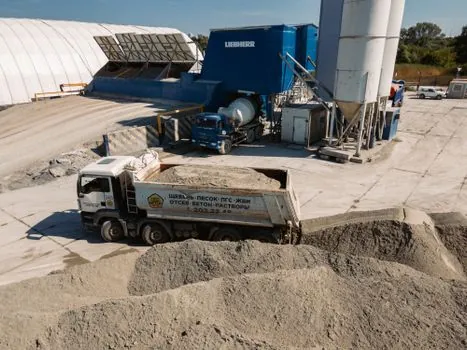
The dominant drawback on a stationary quarry plant is the upfront capex envelope: USD 17,500–285,000 per set ex-works in the 60–180 m³/h band, before civil works, cement silos, standby generators, and erection labour, with reference footprints of 630 m² (35×18) for HZS60 up to 800 m² (40×20) for HZS90 and larger for HZS120/HZS180 frames [S1][S2]. Aggregate stockpiles, cement silos, and a 4.1–5.0 m discharge-height foundation must all be in place before commissioning, which adds permitting lead-time on top of fabrication lead-time.
Quarry sites that already hold a mining permit and have a crushing circuit running typically clear batching-plant permitting in weeks, while greenfield urban sites can face multi-month review, and the cement-silo dust-collection package plus aggregate-bag dust hoods are now a hard spec on most regional air-quality permits [S1]. A control system that records every batch for quality tracking and cost analysis is the cheapest insurance against the rejected-pour risk that otherwise eats the capex differential, and it also feeds the same data stream used by the QC lab for cement concrete compressive-strength reporting [S9].
Quarry-Specific Decision Map
Three criteria pick the model in practice. First, daily pour volume: below 500 m³/day a mobile YHZS60 is enough, 500–1,500 m³/day an HZS90 belt-conveyor frame is the workhorse, and above 1,500 m³/day an HZS120 or HZS180 with twin 100 t cement silos is the realistic fit [S3][S5]. Second, project duration: under 12 months a mobile unit's 40% lower site-prep cost dominates, while a 2–5 year programme recovers the stationary premium through per-cubic-metre margin stacking versus third-party ready-mix supply [S5][S1].
Third, mix-design spread: a quarry pouring both structural-grade foundations and road-base lean-mix benefits from a 4-bin PLD batching machine so on-the-fly aggregate-ratio changes do not require a re-tender, and the same weigh head can carry two cement types if a low-heat and an OPC silo are both plumbed in [S2][S9]. For a multi-pit operation the concrete vehicle fleet sizing should be matched to the plant's nameplate output, because an HZS180 at 150–180 m³/h will idle a transit-mixer fleet that is sized for 90 m³/h, and a downstream boom-pump spec for crusher-line foundations can be cross-checked against the truck-mounted concrete pump selection guide before the pour-rate commitment is signed.
Track the next revision of ISO 18650-1 concrete batching plant terminology and any regional dust-emission rule update for cement-silo bag filters as the two signals that will shift the stationary-versus-mobile calculation for quarry projects through the rest of 2026; meanwhile, lock the model code (HZS plus JS mixer plus PLD bin count), the ±2% / ±1% weighing tolerance band, and the PLC recipe-control interface on every quote before the silo foundation is poured [S2][S5][S9].