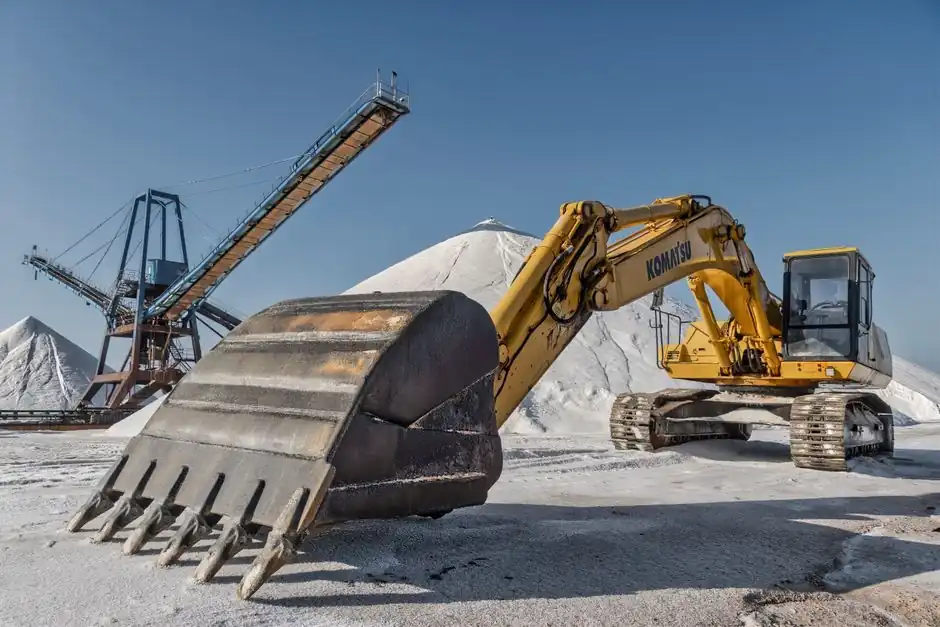
Open-pit copper, lithium, and iron-ore operations in Chile, Peru, and Australia are pulling batching plants into service envelopes the original ready-mix catalog never anticipated: elevations above 3,000 m, ambient swings of 30 K between day and night, and aggregate that is quarried from the same hard rock the mine is processing [S1].
Selecting a plant for that envelope is a six-gate decision, not a catalog browse. The gates are: rated output versus truck fleet capacity, stationary versus mobile topology, maximum aggregate size and bin geometry, discharge height, connected power with altitude derating, and abrasion-resistant component spec on mixer liners, gates, and conveyor belts [S2][S5]. Get any one wrong and the rest cascade, which is why experienced mining contractors treat the six gates as a locked triplet-plus.
Output and Mixer Pairing: HZS60, HZS75, HZS180, and the Mid-Tier Gap
The HZS60 class delivers 45-60 m³/h through a JS1000 twin-shaft compulsory mixer at 1 m³ per cycle with 130 kW total power, the HZS75 class raises output to 60-75 m³/h on a JS1500 mixer with 80 mm max aggregate and 165 kW, and the HZS180 class pushes 150-180 m³/h through a JS3000 twin-shaft mixer at 3 m³ per cycle with a 200 t/h aggregate belt [S2]. For a 1.5 m³ per batch mixing time budget of 60-90 seconds, a 70-second cycle is the upper bound before the plant loses 15-25% of theoretical capacity to aggregate and cement supply-chain idle time [S5].
For a 100 m³/h target that the HZS60/75/180 ladder does not address natively, the PROMAX C100-TWN L compact stationary plant fills the gap at 100 m³/h (3,531 ft³/h) on a plug-and-play chassis [S2]. On a copper concentrator pour where the structural drawing calls for 800-1,200 m³ of raft foundation per week, the HZS180 is the only tier in the Chinese catalog that finishes the pour inside a single weather window, while a 60-75 m³/h HZS75 doubles the placement calendar and the dust-control exposure.
Mobility Gate: Stationary for the Mill, Mobile for the Haul Road and the Stope
Mobile plants on heavy-duty wheel chassis can be repositioned along advancing tunnel lines and haul-road segments without major disassembly, and they cut civil-works time on greenfield sites where the loader has not yet built a foundation pad [S1]. Stationary HZS-class plants assume a 2-5 year site tenure and amortize deeper aggregate bins, taller cement silos, and enclosed weigh housings that protect load cells from abrasive dust [S2][S4].
Buyers running three or more sequential sites inside 24 months net positive on mobile because redeployment labour is recovered across sites; buyers building a single ready-mix yard for five or more years always net positive on stationary because larger silos and higher connected load amortize only on long tenure [S2]. For an underground mine driving shotcrete on a retreating face, the mobile YHZS75 is the right tool, with high-slump wet-mix recipes delivered through the truck-mounted shotcrete pump. For a tailings dam raise that will consume concrete for the next decade, the HZS180 stays put.
Aggregate, Discharge Height, and Power: The Mechanical Triangle
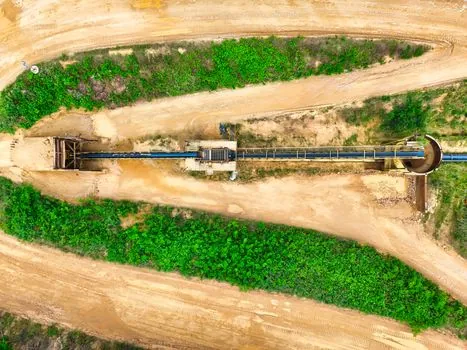
Three numbers govern whether a plant physically fits a mining site: maximum aggregate size, discharge height, and total connected power. The HZS60, HZS75, and HZS180 all discharge at 4.1 m, which means the same transit-mixer geometry accepts all three tiers, but the supporting silos, conveyor runs, and total connected load do not transfer down [S2]. A conveyor belt 800 mm wide running at 1.5 m/s handles approximately 200 t/h of aggregate, so a 120 m³/h plant producing roughly 300 t/h is already at 150% of belt capacity and should be re-specified to 1000 mm or 1200 mm width to prevent spillage and premature belt wear [S5].
High-altitude sites above 3,000 m in the Chilean and Andean corridors require electric drives to be derated for thinner air, air compressors to be up-sized for the same reason, and diesel generators to lose thermal efficiency [S1]. On the Antofagasta copper belt, a 165 kW HZS75 in the Atacama salt flat typically needs a 10-15% connected-load uplift versus sea-level nameplate, which is a documented engineering practice rather than a vendor rule. Plants should feature integrated heating for water and aggregate, insulated mixer enclosures, and automated moisture probes to hold the water-cement ratio across desert-day to alpine-night temperature swings of 30 K [S1].
Abrasion Resistance and Component Longevity on Hard-Rock Aggregate
Mining aggregate processed from the same hard rock the mine is milling is measurably more abrasive than river-run gravel, and it wears mixer liners, batcher gates, and discharge chutes on a shortened cycle. The cement silo vent filter area should not drop below 1.5 m² per 100 tons of silo capacity, or fly ash blends bridge and the cement screw stalls mid-charge [S5].
For high-chromium mixer liners and Ni-Hard gate liners, the documented service life on hard-rock aggregate is roughly half the gravel-aggregate benchmark, so a high-altitude copper mine should plan liner replacement on a 6-9 month cycle rather than the 12-18 month cycle typical of urban ready-mix service. Weighing accuracy holds only when the load cells are protected from dust ingress, so enclosed weigh housings, dust skirts on the conveyor, and a PLC scan cycle under 50 ms are not optional on a mine site; budget PLCs at 100 ms or higher cause ±2% batching errors on cement that quietly bleed strength out of every truck [S5].
Selection Comparison: HZS60 vs HZS75 vs HZS180 vs Mobile YHZS on Six Decision Criteria
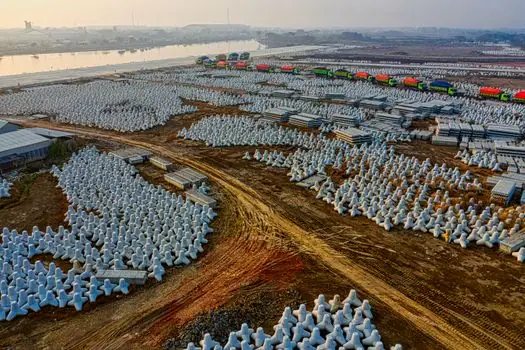
On six mining-specific criteria, the comparison reads as follows. Rated output: HZS60 at 45-60 m³/h, HZS75 at 60-75 m³/h, HZS180 at 150-180 m³/h, mobile YHZS75 typically 60-75 m³/h on a tow chassis. Mixer: JS1000, JS1500, JS3000, JS1500 respectively. Max aggregate: 60-80 mm, 80 mm, 80-100 mm, 60-80 mm. Mobility: none, none, none, full wheel-chassis redeploy in under 48 hours. Connected power: 130 kW, 165 kW, 280-310 kW, 165-200 kW. Best-fit use case: small camp foundations, processing plant raft pours, mill and tailings dam main pours, advancing haul-road and shotcrete on a retreating stope [S2][S1][S5].
The HZS180 is the right pick for a copper concentrator pour or a tailings dam main pour on a 5+ year tenure, the HZS75 covers a single processing plant foundation on a 1-2 year build, the HZS60 covers a worker-camp and small-foundations scope, and the mobile YHZS unit covers shotcrete on a retreating stope or a long-haul road where the plant has to move every 3-6 months. Output, mixer, and discharge form a locked triplet: changing one forces redesign of the other two, and a plant rated for an output the truck fleet cannot place merely produces concrete that ages out before it is used [S4].
Standards, Tolerances, and Sourcing: What the Datasheet Should Cite
ASTM C94/C94M, EN 206, and IS 4925 are the three reference standards that govern weighing accuracy and batch tolerances on a mining-spec plant, and the plant datasheet should cite them rather than generic "high accuracy" claims [S4].
For a copy-paste procurement check, the working tolerances are ±0.5% on cement and ±1% on aggregates, with load-cell resolution of at least 1 kg on cement and 2 kg on aggregates, and the concrete itself benefits from concrete admixtures specified for low-hydration-heat cements and impact-resistant mixes common in mass-pour mining foundations [S3]. Mining haul-road and tunnel-lining concrete frequently uses fibre reinforcement to control shrinkage cracking, and concrete fibre selection should be cross-checked against the chosen admixture system for chemical compatibility. The concrete batching plant encyclopedia entry frames output, aggregate handling, and admixture dosing as the three primary sub-systems that must be spec-locked before any foundation bolt is poured.
Two trackable signals to watch for the rest of 2026: PROMAX and Concrete Batching Systems (UK) are pushing the W2 wet-batch turnkey model into South American copper projects, while Chinese mobile-plant exporters from the Henan base (Haomei, Yueshou, HAMAC) are quoting FOB plus container-optimized shipping into the same corridors [S2]. For related shortlists on adjacent equipment classes, see the forestry truck-mounted concrete pump spec gate and the concrete pump truck winter-rated shortlist, both of which overlap with the -10 to 35 °C ambient envelope these mining plants must survive.