Standard water-based acrylic concrete curing compound is trading at US$1.20–2.50 per kg in mid-2026 spot import quotes from Chinese and Southeast Asian exporters, with wax-resin hybrids landing in the US$1.80–3.20/kg band and solvent-based bitumen-modified grades reaching US$3.50–5.00/kg at drum quantity [S3].
Coverage drives total project cost more than drum price: most manufacturers quote 0.20–0.35 kg/m² for a single-coat spray on a trowelled slab, so a 20,000 m² industrial pour consumes roughly 4,000–7,000 kg of compound and lands in the US$6,000–18,000 range before logistics [S3][S1]. This guide walks through the chemistry classes, coverage bands, drum versus bulk economics, and the trade and standards signals that move those numbers in 2026.
Chemistry Classes and Their 2026 Price Spread
Water-based acrylic emulsions remain the workhorse: milk-white liquid, low VOC, applied by airless spray at roughly 0.20–0.25 kg/m² on a smooth steel-trowelled surface, and priced US$1.20–2.50/kg in 200 L drum packs [S3]. They meet the moisture-retention intent of ACI 308R-01 — that is, sufficient water and heat maintained under specific environmental conditions — without solvent emissions, which is why highway, airport apron, and warehouse floor specifications default to this class [S2].
Solvent-based and bitumen-modified curing compounds trade 30–60% above water-based grades and are still specified where early-rain resistance, oil-resistance on service-station decks, or bond-breaker behaviour is needed [S3]. Wax-resin hybrids sit between the two, typically US$1.80–3.20/kg, and dominate the white-pigmented "reflective curing" segment where solar-heat gain control matters on bridge decks and mass pours [S3]. The "Y" type water-based membrane — a milk-white liquid designed to lock in mix water during the early curing window — is the most-exported Chinese SKU and anchors the low end of the price band [S3].
Coverage, Drum Format and Total Project Cost
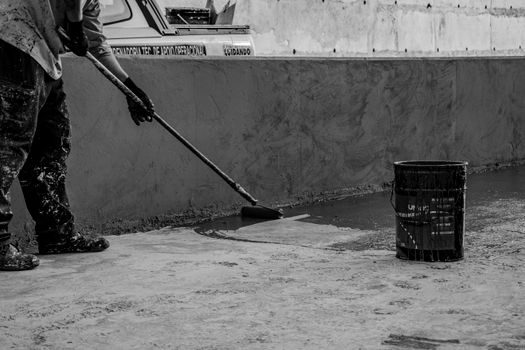
Coverage is the second cost lever and the one engineers under-spec the most. Smooth, steel-trowelled surfaces accept 0.20–0.25 kg/m² in a single pass; rough, broomed, or formed concrete jumps to 0.30–0.50 kg/m² because of surface texture and wastage; vertical formwork face coatings run 0.15–0.25 kg/m² [S3]. A 200 L drum (≈200 kg for water-based emulsion) at US$1.50/kg lands at roughly US$300 per drum, and a 20,000 m² warehouse slab at 0.25 kg/m² consumes 5,000 kg or 25 drums — US$7,500 of compound before freight, pump rental, and surface-prep labour [S3].
Bulk IBC totes (1,000 L) drop the unit price roughly 10–18% versus drums and cut drum-disposal cost; they are the right format above ~6,000 kg of monthly throughput, but require a closed transfer pump to avoid skin formation and skin-blocked spray nozzles [S3]. The release-agent side of the same spec chain has a parallel cost structure, and the concrete release agent 2026 price breakdown walks through the chemistry-vs-coverage trade-off for formwork-facing applications that often sit one step before curing in the pour sequence.
Selection Criteria: Substrate, Climate, Compliance
Pick a chemistry by four gates. Gate 1: substrate finish — smooth trowelled floors take water-based acrylic; rough-formed structural concrete or pavements can take wax-resin or solvent-based for tougher film build. Gate 2: climate — high-ambient-evaporation sites (low-RH, wind, direct sun) need higher solids loading or a second coat; white-pigmented grades reflect solar heat and reduce thermal-stress cracking on mass pours. Gate 3: subsequent finish compatibility — if a floor hardener, densifier, or topping is to be applied, the compound must be "removable" or "dissipating," otherwise the film blocks penetration [S1].
Gate 4: standards and chloride content. ACI 308R-01 is the dominant curing-method reference; the chloride-content ceiling is normally below 0.2% by mass of compound for reinforced concrete, and many procurement specs (port authorities, bridge authorities) reject any compound without a mill certificate showing this value [S2]. For projects adjacent to a steel-rebar cage or a post-tensioned tendon, specify a chloride-free, removable compound and check the SDS before placing the order.
Comparison: Four Common Chemistry Options on Six Decision Criteria
The four chemistries most commonly bid in 2026 line up as follows on the criteria a buyer actually scores. Water-based acrylic emulsion: cost US$1.20–2.50/kg, coverage 0.20–0.25 kg/m², VOC low, removable yes, chloride-free typically yes, typical use warehouse slabs, highways, airport aprons [S3]. Wax-resin hybrid: cost US$1.80–3.20/kg, coverage 0.20–0.30 kg/m², VOC low–medium, removable often yes, chloride-free typically yes, typical use white-pigmented reflective curing, bridge decks, mass pours [S3].
Solvent-based bitumen-modified: cost US$3.50–5.00/kg, coverage 0.20–0.30 kg/m², VOC high, removable rarely, chloride-free varies, typical use oil-resistant decks, bond-breaker applications, early-rain scenarios [S3]. Water-based sodium-silicate "densifier-cure" hybrids: cost US$1.50–2.80/kg, coverage 0.15–0.25 kg/m², VOC low, removable no (permanent), chloride-free yes, typical use polished-concrete floors where densify + cure is combined [S3]. Where the slab will later be cut, polished, or receive a topping, the first and fourth classes win; where it will be exposed long-term to oil or weather, the second and third win.
Trade, Tariff and Sourcing Signals in 2026
China's customs HS-code lookup for "concrete-curing-compound" returned no matches under the standard 3824 / 3214 / 3402 probes as of 2026-05-03, which means the product is typically declared under Chapter 38 "chemical preparations not elsewhere specified" or Chapter 32 coating headings; duty rate depends on declared heading and country of origin [S5]. This is the same documentation friction that catches first-time importers, and the freight forwarder's HS pick can swing landed cost 3–8% on the duty line alone [S5].
For readers still choosing between adding a curing compound or relying on special cement and water-fog curing, the special cement vs curing compound trade-off lays out when each method earns its line item. On a related cost lever, concrete fiber 2026 price and dosage economics covers the reinforcement side of the same slab, where macro-synthetic and steel fibre dosages shift both the mix-water demand and the curing-compound coverage rate.
Failure Modes, Limits and What "Cheap" Hides
Three failure modes drive most field disputes. First, under-application: a single coat at 0.15 kg/m² on a windy day is below the 0.20–0.25 kg/m² manufacturer minimum and produces a discontinuous film, with map-cracking appearing within 28 days [S3]. Second, wrong chemistry for the next trade: a non-removable solvent-based film under a subsequent floor hardener or epoxy topping causes delamination, and the cost of grinding the film off runs US$2–5/m² — more than the curing-compound saving [S1][S3].
Third, chloride contamination: a sub-US$1.20/kg drum of unclear origin is a red flag, because the only way to land at that price is to skip the chloride-content certificate and the mill QC trail; reinforced-concrete and pre-stressed-concrete specs should reject such offers outright [S2]. VOC is a fourth hidden cost in solvent-based grades: many 2026 indoor and tunnel pours are now specifying water-based emulsion purely to avoid the ventilation cost of solvent fumes in confined pours. A 55-gallon drum of the concrete curing compound family is the workhorse pack size on most job sites, and the application sequence lines up after the concrete admixture dosing and before any concrete fiber surface broadcast.
Trackable signals to watch into late 2026: bulk IBC tote pricing in Southeast Asia (currently -12% versus 200 L drum, widening would push more mid-tier contractors to bulk), and any HS-code clarification on Chapter 38 vs 32 declarations that could compress duty exposure for Chinese-origin curing compound landed at US/EU ports [S5].