Specifying concrete fiber for an industrial facility in 2026 is a three-variable decision: structural duty (joint spacing, slab thickness, load class), environmental exposure (chemicals, thermal cycling, FOD-sensitive aerospace lines), and constructability (finishability, pumpability, shotcrete rebound). Steel, polypropylene, and basalt fiber families each cover part of this map and overlap at the margins, which is where EPDs and crack-width data do the actual tie-breaking [S4][S2][S3].
The global concrete reinforcing fiber market reached an estimated USD 2.73 billion in 2025 and is projected to hit USD 5.22 billion by 2033, an 8.7% CAGR from 2026 to 2033 across PE, PP, steel, and basalt chemistries [S3]. That growth tracks the same thing industrial specifiers are seeing on RFQs: a steady replacement of light mesh in slab-on-ground and composite steel-deck pours with engineered fibers, and a parallel move from rebar to fiber in heavy-duty industrial pavements [S4][S2].
Steel Fibers for Slab-on-Grade and Heavy-Duty Industrial Floors
Steel fibers remain the default for slab-on-ground where rebar or mesh would otherwise be used, because they raise the slab's post-crack flexural capacity and let joint spacing widen without visible cracking or curl [S4]. Concrete Fiber Solutions lists its CFS 100-2 deformed-steel fiber as a slab-on-grade option with extended joint spacing, reduced visible cracking, and minimal curling compared to rebar or mesh, plus a manufacturer claim of "lowest EPD" within the steel-fiber product line [S4]. For composite steel deck, the same supplier points to its CFS 150-5 fibers as a replacement for welded wire mesh, which is the use case TenaBrix also targets in its composite-steel-deck project solution [S2].
Steel fibers dominate where the failure mode is impact, abrasion, or forklift dynamic loading rather than fire. They are also the workhorse for industrial pavements, ports, and military hardstands; the trade-off is finishability, since high-aspect-ratio hooked-end fibers need correct timing on the float pass or they will protrude. A general rule of thumb in the industry is to size dosage by required equivalent flexural strength ratio (Re,3) per project specification; typical industrial dosages fall in the 20 to 40 kg/m³ band for 30/50 hooked-end fibers, but engineers should always verify against the project's structural design rather than the supplier's marketing copy.
Synthetic Fibers: Microfiber, Fibrillated PP, and Twisted Macros
TenaBrix breaks its synthetic line into polypropylene microfiber, polypropylene macrofiber, polypropylene fibrillated fiber, and twisted macro synthetic fiber, applied to industrial floors, highways, bridges, precast, shotcrete, composite steel deck, agricultural slabs, and tunnel segments [S2]. The functional split is well established: microfibers (single-filament PP, typically 6 to 50 mm) primarily control plastic-shrinkage cracking in the first 24 hours, while macrofibers and fibrillated networks contribute to post-crack toughness and can substitute for light mesh in many slab and shotcrete applications [S2].
For industrial facilities, the key exposure-driven choice is whether the fiber needs to survive a fire rating, a chemical washdown, or a USDA food-zone environment. Polypropylene fibers have a low melting point (around 160 to 170 °C), which is actually a feature in tunnel and high-rise fire engineering because the melting leaves a pathway for pressure release; for USDA / cGMP / F&B floors this melt behaviour is generally irrelevant, but chemical compatibility of the carrier or any surface treatment still has to be reviewed against CIP chemicals [S2][S1]. Twisted-bundle macrofibers, by contrast, behave closer to a miniature rebar and are sized for slab replacement, not just crack control.
Application-Driven Selection: Aerospace, F&B, Pharma, and Manufacturing
Industrial flooring specifiers in New England handle aerospace, F&B, pharma, automotive, and general manufacturing lines, and each one tightens the fiber conversation [S1]. Aerospace and FOD-sensitive floors prioritize seamless surfaces and crack control so debris cannot lift; F&B and pharmaceutical lines chase USDA / cGMP compliance, thermal-shock tolerance, chemical resistance, and slip resistance; manufacturing plants focus on forklift and heavy-machinery traffic, and automotive facilities add fluid-resistance to that list [S1].
Those service conditions cascade straight back into the fiber pick. For a slab-on-grade in a general manufacturing bay, a 30/50 hooked-end steel at 25 to 35 kg/m³ typically replaces light mesh, and the same slab can take a 0.6 to 0.9 kg/m³ PP microfiber dose to control early-age plastic-shrinkage cracking [S4][S2]. For an aerospace floor where FOD risk rules out surface fiber exposure, a micro-synthetic blend with tight float discipline usually outperforms steel on finishability, while a separate dosage plan for any structural joints is still required. The F&B and pharma case is dominated by the coating system, not the fiber, but the underlying slab still needs shrinkage control, and that's where fibrillated PP at 3 to 6 kg/m³ is common [S2].
Comparison of the Three Main Fiber Families Against Industrial Criteria
Head-to-head on the criteria industrial buyers actually score: steel fibers lead on flexural / post-crack strength, abrasion resistance, and impact tolerance; they are heavy, can corrode at the surface if the cover is inadequate, and are the hardest to finish to a tight tolerance. Synthetic macro and twisted-bundle fibers sit in the middle on strength but are non-corrosive, easier to pump, finish-friendly, and ship at a fraction of the weight; their weakness is temperature ceiling and a lower Re,3 than steel at equivalent dosage. Fibrillated PP networks are cheap crack-control, not structural reinforcement, and are best specified alongside rather than instead of a structural fiber [S4][S2][S3].
On cost-per-kg the ranking is the inverse: PP microfiber is the cheapest per kilogram, fibrillated PP macro sits above it, twisted macro and basalt occupy the mid-to-premium tier, and steel sits at the top of the table on raw material cost but often at the bottom on installed cost because it removes mesh labour. EPDs are now part of the same comparison: Concrete Fiber Solutions claims the "lowest EPD" inside its steel-fiber range, and polypropylene fibers carry a long-documented carbon advantage over steel on a per-kg basis, which is what is pushing the 8.7% CAGR through 2033 in the global market forecast [S4][S3].
Mix-Design, Standards, and Specification Discipline
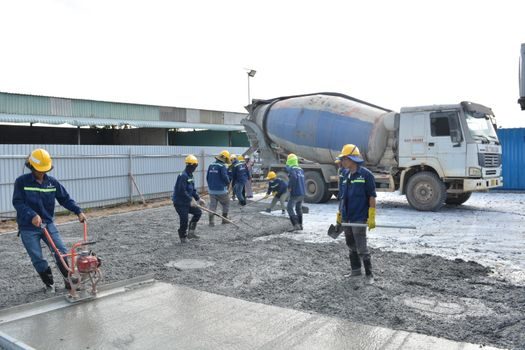
ACI 360 and ACI 544 are the two specification frameworks most US industrial floor designers reach for; ACI 360 covers slabs-on-ground and now includes fiber-reinforced concrete as a recognised option, while ACI 544 covers fiber-reinforced concrete in general. The actual binding values — fiber type, dosage, aspect ratio, Re,3 residual strength, and crack-width limit — should be written into the project spec rather than left as a "submittal per supplier" line, because that is where the variability between suppliers hides. A typical industrial spec for a slab-on-grade with extended joints calls out fiber type and aspect ratio, minimum Re,3, maximum allowable crack width at the surface (commonly 0.3 to 0.5 mm for industrial floors), and a finishing sequence that the fiber supplier has to sign off on [S4][S2].
For chemical, food, and pharmaceutical exposure the fiber is a sub-system of the coating spec, and a concrete admixture plan is usually run in parallel to control shrinkage and water demand. For composite steel decks the fiber interacts with the concrete vibrator sequence because the deck profile traps air; over-vibration pulls fibers to the bottom and leaves the top under-reinforced, under-vibration leaves voids around the fiber bundles. The right place to start the conversation is a trial pour with the exact concrete batching plant recipe and the project's intended concrete curing compound, because that combination — not the fiber data sheet — is what sets the actual crack-width and curl outcome.
Limits, Failure Modes, and Common Mistakes
The three failure modes I see on industrial fiber pours are predictable: wrong fiber for the exposure (PP in a high-temperature process area, steel in a corrosion-prone slab with insufficient cover), wrong dosage for the structural claim (a 4 kg/m³ PP macro claimed to replace mesh, which it does not), and a finishing pass that pulls fibers to the surface. The first shows up as a slab that meets the spec sheet but fails in service; the second as a slab that cracks wider than the spec allowed; the third as a floor that looks hairy and trips QA on a concrete groove-cutter joint at the day's end. None of those failures are fiber-technology problems; they are specification and supervision problems [S4][S2][S1].
The practical watch-list for the next RFQ cycle: tighter EPD reporting on steel fibers to compete with the synthetics on embodied carbon, more twisted-bundle macro entries as a true mesh-replacement for medium-duty industrial slabs, and continued growth of basalt as a high-temperature alternative for foundries and process areas. The credible next step for any industrial floor project is a 2 m × 2 m trial panel using the same concrete fiber system proposed for production, with joint spacing and curing compound matched to the spec, before any buy-out decision is signed [S3][S4][S2]. For projects that also need cutting or trenching in fiber-reinforced slabs, the same trial should trial the concrete groove-cutter on the panel so the joint geometry matches what the crew will run on the slab.
See also our earlier report, Copper Material Selection for Electronics: Grade, Form, Spec Map.