
Residential FRC specification in 2026 is decided at the structural-element level: ground-supported slabs, foundation walls, and exterior flatwork each carry different fiber-dosage floors per ACI 332.1R-18 "Guide to Residential Concrete Construction" [S5].
Five fiber families compete in the U.S. residential segment — polypropylene (PP), polyethylene (PE), macro-synthetic (polyolefin blend), steel, and basalt — with the global concrete reinforcing fiber market segmented across exactly these chemistries [S2].
Fiber Family Comparison on the Four Decision Criteria That Matter
Specifying fiber without a written criterion set is the most common residential failure; the same four parameters — tensile modulus, crack-control mechanism, dosage band, and unit cost — separate the five families cleanly [S2].
PP fiber (modulus ~3.5–5 GPa) is monofilament or fibrillated, dosed at 0.6–0.9 kg/m³ strictly for plastic-shrinkage control, and is the lowest-cost option; macro-synthetic polyolefin fibers (modulus ~10–15 GPa) replace light welded-wire mesh at 3.0–6.0 kg/m³ and deliver post-crack residual strength. Steel fiber (modulus 200 GPa) at 20–40 kg/m³ replaces rebar in slab-on-ground per ACI 360, but requires Rust stain control and slump adjustment. Basalt fiber (modulus 80–90 GPa) sits between macro-synthetic and steel on cost and is specified where alkali resistance and non-corroding reinforcement are both required [S2].
Structural Element Drives the Fiber Type, Not the Other Way Around
ACI 332.1R-18 treats residential concrete as a category distinct from ACI 318 structural building code, and explicitly allows fiber reinforcement as a substitute for conventional shrinkage-temperature steel in one- and two-family dwellings when dosage and residual strength are documented [S5].
For slab-on-ground (driveways, garage floors, basement slabs), macro-synthetic at 3.0–4.5 kg/m³ or steel at 20–30 kg/m³ is the standard pair, with PP at 0.6–0.9 kg/m³ added only as a secondary crack-control layer. Foundation walls in ICF (insulated concrete form) construction — common in regions like southeastern Minnesota and Central Texas — typically use PP 0.6 kg/m³ plus conventional rebar because the ICF form itself supplies most crack control [S4][S3].
Who Fiber-Reinforced Concrete Is For — and Who Should Walk Away
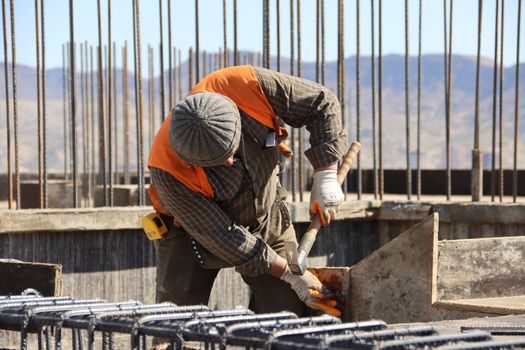
FRC is the right answer for residential pours where crack-width control, impact resistance, and reduced rebar labor offset the fiber material premium — typically slabs over 50 m², ICF walls, and decorative concrete where random cracking cannot be hidden [S5].
FRC is not the right answer for small residential footings (under 0.5 m thick), thin overlays under 50 mm, or any element where structural design software requires rebar development length — those elements still need conventional reinforcement. For purely decorative stamped work, the fiber is wasted cost: a concrete curing compound and proper joint spacing control 90% of the outcome, not the fiber [S3].
Dosage, Mix-Water Adjustment, and the Real Cost Premium
Dosage is not a "more is better" parameter; residential FRC has a saturation point beyond which workability collapses and finishing quality degrades, typically 6.0 kg/m³ for macro-synthetic and 50 kg/m³ for steel [S2].
Mix-water demand rises with fiber dosage: macro-synthetic pulls 5–10 L/m³ extra water, steel pulls 0–3 L/m³, so water-cement ratio must be re-validated whenever dosage moves. Slump loss with macro-synthetic is the single most common field complaint, and a mid-range water reducer from the concrete admixture line is standard practice. Material cost premium in 2026 sits at roughly $4–8/m² for PP, $8–15/m² for macro-synthetic, and $20–35/m² for steel-fiber residential slabs — the trade is labor savings (eliminated mesh placement) versus material upcharge, and that math decides the specification [S2].
Standards, Sustainability, and a Verifiable Requirement

ACI 332.1R-18 Chapter 6 on slabs-on-ground lists fiber dosage and acceptance criteria; ACI 360 covers slabs on ground more broadly; ASTM C1116 is the standard classification for fiber-reinforced concrete; and ASTM C1399 (residual strength) is the lab test that validates post-crack performance for the macrosynthetic and steel families used in homes [S5].
On the sustainability axis, residential FRC can be paired with supplementary cementitious materials (slag, fly ash, silica fume) to lower embodied carbon, and emerging systems such as Vicon's nano-engineered UHPC mixes explicitly include fiber selection and dosage as part of the proprietary formulation process — a sign that fiber specification is moving from the jobsite into the mix-design stage [S1]. The market itself tracks four fiber chemistries (PE, PP, steel, basalt) and three application buckets (infrastructure, building & construction, industrial), so residential demand is captured inside the building & construction segment [S2].
Selection Workflow That Engineers Can Reuse on the Next Project
Step one: classify the pour (slab-on-ground, foundation wall, flatwork, decorative). Step two: pick the fiber family that matches structural need — PP for plastic shrinkage only, macro-synthetic for crack-width and rebar substitution, steel for impact and load-transfer, basalt for corrosion-sensitive cases. Step three: set dosage to the ACI 332.1R-18 or ACI 360 floor for that element, then validate residual strength with ASTM C1399 [S5].
Step four: adjust water demand and slump-loss expectations with the concrete admixture package, run a trial batch, and finish with a concrete vibrator pass tuned to the higher paste friction that fibers introduce. A residential FRC spec written to this four-step template travels between jurisdictions without rework and lines up with the fiber chemistries tracked in the 2026 market segmentation [S2].
Track the 2026 ACI 332 committee activity and the next revision of ASTM C1116 for any tightening of residual-strength acceptance criteria; the residential FRC specification is currently stable but the lab-test thresholds are the most likely change vector. For high-rise transitions, the dry-mix mortar spec map for prefabricated building joints and the related Dry-Mix Mortar Selection for High-Rise: Strength, Shrinkage, Pump Grade piece cover what changes when fiber selection has to scale vertically beyond residential pours.