Specifying dry-mix mortar for prefabricated construction is a joint-and-substrate problem, not a brand problem: the right grade is determined by the type of precast element, joint width, factory vs. site cure, and the local relative humidity on the day of installation.
WACKER's academy programme lists "special applications of dry-mix mortars" alongside its foundational dispersible-powder chemistry course, indicating that binder-modified and polymer-modified grades (C2-class tile adhesive, P III-class render, and flexible skim coats) form the working set that engineers will actually meet on a PC project [S1][S4].
Which dry-mix mortar type fits which PC joint
The EN 12004 tile-adhesive classes map cleanly onto prefabricated element interfaces: C1 (normal cementitious, ≥0.5 N/mm² tensile after 28 d) suits standard precast concrete walls in dry interior zones, C2 TE (improved, slip-resistant, ≥1.0 N/mm²) is the working grade for fair-faced precast façades and panel-to-panel vertical seams, and the additional S1 designation (deformable, ≥2.5 mm and <5 mm transverse deformation) is required where the precast element is exposed to thermal cycling or sits on a long-span façade [S1]. KG-Mix's product tree in Malaysia lists the same working set — skim, texture/render, joint adhesive, tile adhesive, tile grout, and a latex-additive variant — confirming this is the regional menu, not a one-market exception [S2].
For horizontal floor-screed interfaces between precast hollow-core planks, a factory-blended ready-mix concrete or CT-C30-F5 cementitious screed at a w/c ≤0.55 remains the default; thin-bed dry-mix screeds from 3 mm to 10 mm are usable only on dimensionally stable precast decks, not on composite timber-concrete floors.
Selection criteria: substrate, joint width, climate
Three decision gates select the grade, in this order: (1) substrate absorption — old precast (≥28 d, water-saturated SSD) needs a polymer-modified C2 TE adhesive with ≥30 min open time, while steam-cured factory-fresh elements need a primer plus a low-modulus C2 TE S1 to absorb shrinkage movement; (2) joint width — 2–5 mm joints are filled with C2 TE (≤0.5 mm aggregate), 5–15 mm with C2 TE S1 or a render-grade P III, and 15–30 mm with a thixotropic patch mortar or backer-rod-plus-sealant approach; (3) ambient on the day — below 5 °C or above 35 °C, only winter-grade or summer-grade formulations should be ordered, with the bag temperature held above 5 °C to prevent premature hydration [S1][S3].
Anti-sag (T) and extended open time (E) designations are non-negotiable for vertical precast seams; a non-sag C2 TE holds ≥0.5 mm slip after 20 min on a vertical test plate, which is what precast façade installers actually measure on site.
Polymer modification: why the redispersible powder dose matters

The C2 jump from C1 (≥0.5 N/mm²) to C2 (≥1.0 N/mm²) tensile adhesion is delivered by redispersible polymer powder (RDP) in the 3–8 % organic-binder range, as the WACKER fundamentals seminar covers under the VINNAPAS® powder umbrella [S4]. Practical on-site effects: 4 % RDP roughly doubles adhesion on smooth, dense precast concrete; 6–8 % RDP adds water resistance to EN 12004 R-class ("water-resistant") for wet zones, balconies, and swimming-pool decks built on precast elements.
Premixers such as BH Mortar Industrial (ISO 9001:2008) build dry-mortar production lines from 3 TPH laboratory units through 20–100 TPH industrial plants with twin-shaft mixers, three-cylinder sand dryers, and cement silos, indicating that the bagged premix seen on a PC jobsite can be made under tightly controlled dosing (typical RDP tolerance ±0.3 %) rather than field-blended [S3].
Failure modes engineers actually see on PC jobs
Four failure modes account for most rework on prefabricated interfaces: (1) cohesive failure in the substrate — usually a weak laitance on steam-cured precast, fixed by mechanical scabbling or primer; (2) adhesive failure at the interface — a C1 adhesive on a non-absorbent precast face, fixable only by stepping up to C2 TE; (3) shear failure on wide joints under thermal movement — a C2 TE without the S1 deformable class bridging a 4–6 mm thermal gap, fixable by moving to C2 TE S1 or adding a movement bead; (4) efflorescence on fair-faced precast from wet-cure mortars with high alkali content — fixable by switching to a low-alkali, polymer-modified thin-bed grade and protecting the joint for 24 h. [S1]
For a parallel spec track on field equipment that supports dry-mix placement on a precast yard, see the chain conveyor selection map for apparel distribution — the same duty-class logic (light/medium/heavy, dust-tight, inclined run) applies when moving 25 kg bags or 1 t big-bags from silo to mixing station.
Storage, shelf life, and site logistics
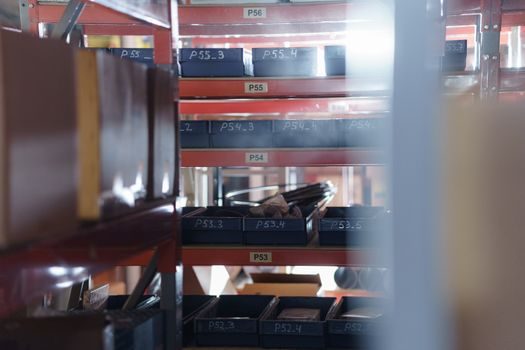
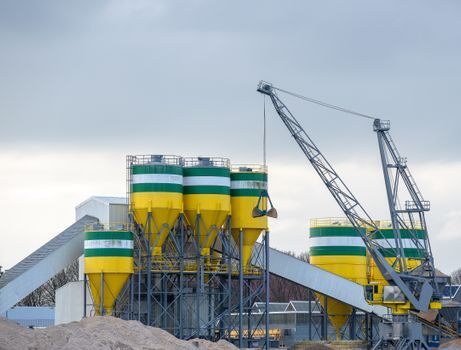
Dry-mix mortar is hygroscopic by design; unopened bags on a timber pallet, stored under cover at <75 % RH and 5–30 °C, hold 12 months from the date of manufacture. Once a bag is opened, contents should be used within 24 h; partially used bags absorb CO₂ and moisture, lose workability, and the early-hydration lumps will not break down in the mixer. Bulk silos of 30–100 t, as supplied on the BH Mortar 20–100 TPH lines, are specified where daily consumption exceeds 8–10 t of a single grade, because they eliminate bag handling and reduce per-ton dosing error [S3].
Site silos must be vented and fitted with dust collectors during pneumatic fill, and the silo base must be frost-insulated in winter; frozen premix that has been allowed to thaw and re-hydrate loses a measurable share of its 28-day strength and should be discarded.
Standards and documentation on the delivery ticket
Each delivery ticket should carry the EN 12004 class (C1, C2, C2 TE, C2 TE S1, plus R where applicable), the EN 12002 deformable class for S1/S2, the batch number, manufacture date, and shelf-life expiry. For fair-faced precast, request a factory certificate showing 28-day tensile adhesion ≥1.0 N/mm², open time ≥30 min, and slip ≤0.5 mm, plus a Declaration of Performance under the Construction Products Regulation. For tile adhesive used on PC, the slip (T) test result is the single field-relevant number, because it predicts behaviour on a vertical precast panel better than any marketing-claim about "high bond" [S1][S2].
For an adjacent read on a closely related spec challenge, the cold-storage dry-mix mortar selection guide covers the sub-zero branch of the same selection tree and is the natural reference for cold-warehouse PC envelopes built with the same joint geometry but at -25 °C internal service.
Decision snapshot: a 60-second spec card
Use C1 for dry interior non-moving joints, C2 TE for vertical PC façade seams, C2 TE S1 for joints >5 mm or joints exposed to thermal movement, and C2 TE S1 R for wet zones and exterior precast balconies. Keep dry-mix off any precast element with standing water, below 5 °C, or above 35 °C without a winter/summer grade. Order in bulk silo (30–100 t) for projects >8 t/day, in 25 kg bags otherwise, and demand the EN 12004 class plus a 28-day adhesion certificate on every delivery ticket. Verify the next two data points on site: a pull-off adhesion test ≥1.0 N/mm² at 28 days, and a slip test ≤0.5 mm — these two numbers are the only ones that correlate with field failure rates on PC joints. [S2]
The underlying component specifications are covered under dry type transformer.