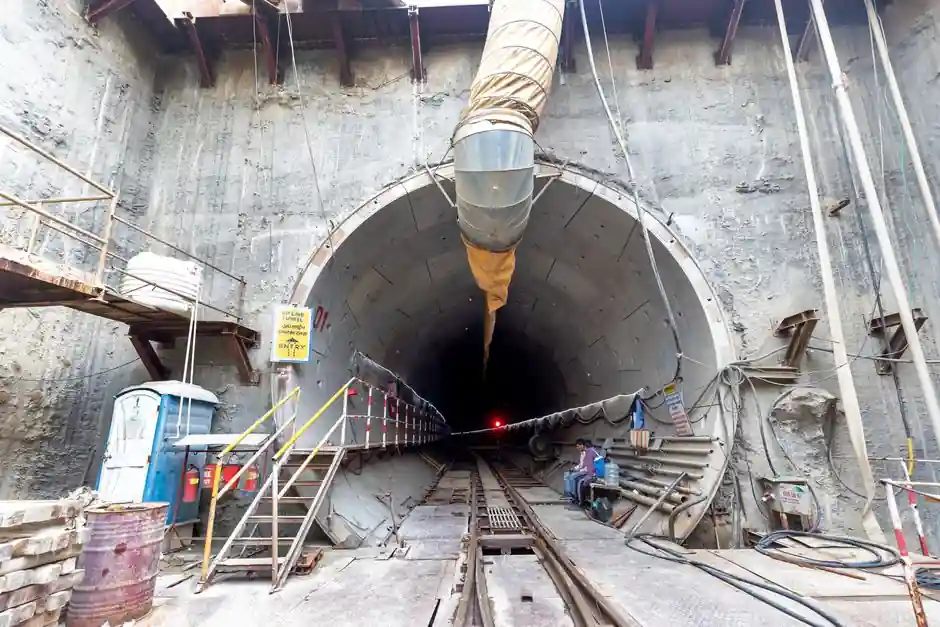
Concrete groove cutter selection for tunnel work is governed by three coupled variables: rock or concrete uniaxial compressive strength (UCS), admissible vibration at the face, and the required slot depth/width for cable ducts, drainage grooves, or predetermined breaking lines [S1][S4].
Walk-behind and self-propelled diamond-blade saws cover shallow utility cuts in shotcrete and low-to-medium strength rock, while excavator-mounted rock milling cutters and combination shears cover deep profiling and demolition where low vibration and narrow kerfs are specified [S1][S4]. Selection in hard rock (typically above 80-120 MPa UCS) increasingly shifts from blade cutting to rotary milling or drill-and-blast with controlled perimeter pre-cuts, as established by current tunneling practice [S2][S4].
Rock and Concrete Strength Bands Drive Cutter Class
Stable rock with medium UCS, generally up to about 80-120 MPa depending on jointing and abrasiveness, allows predictable feed rates for transverse and longitudinal drum cutters and is the natural envelope for rock milling cutter attachments on excavators [S4]. Below this band, in shotcrete linings and C25-C40 structural concrete, diamond-blade walk-behind saws remain the most economical choice for cable duct and drainage groove cutting, with typical blade diameters of 350-800 mm and cut depths of 110-320 mm per pass. Above the 120 MPa threshold, UCS climbs into the range where TBM disc cutters and drill-and-blast dominate heading, and groove cutting reverts to percussive or controlled-splitting methods [S2].
For tunnel fit-out, the practical cut envelope is narrower: drainage grooves in the invert usually run 30-80 mm wide by 40-100 mm deep; cable trough slots run 50-150 mm wide by 60-120 mm deep. These geometries fall inside the operating window of a 14-25 kW electric or 9-18 HP petrol walk-behind saw with a 450-600 mm diamond blade, making blade selection the first decision node before machine class is even raised.
Vibration, Noise, and the Low-Vibration Mandate in Urban Tunnels
Rock milling cutters generate continuous cutting forces through chip formation with rotating milling heads and carbide chisels, producing significantly reduced vibration compared with percussive breakers, which is the reason they are specified in urban rock breakout and tunnel projects near sensitive structures [S4]. For inner-city metro, utility shafts, and refurbishment inside operating rail tunnels, peak particle velocity (PPV) limits at adjacent structures are commonly set in the 5-25 mm/s range, and a hydraulic milling head at steady feed typically holds the operator station well below the threshold a hydraulic breaker would exceed within the first few seconds of strike.
Darda's own product literature states that on projects with complex geology or sensitive surroundings, the rock milling cutter is often combined with rock and concrete splitters or concrete demolition shears to execute cuts, slotting, and sharply defined separations in a controlled and efficient manner, supporting compliance with locally specified noise, dust, and vibration limits [S4]. For a tunnel crew, that combination sequence (mill a defined slot, then split along the pre-cut line) is the textbook way to convert a high-vibration demolition step into a low-vibration, predictable operation.
Cutting Kinematics: Drum, Wheel, and Chain Compared for Tunnel Slots
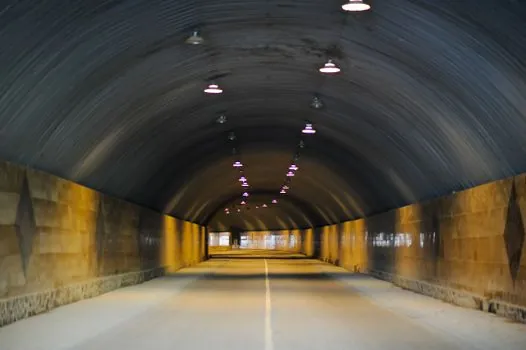
Three kinematic variants compete in tunnel slot work, and the right one depends on slot width, depth, and rock mass behaviour [S4]. Transverse drum cutters give high area coverage and good profiling on tunnel faces and bench walls, while longitudinal drum cutters support trenching and narrow profiles with comparable torque and lower lateral overcut. Cutting wheel cutters create narrow, deep slots suited to trenches, foundation strips, and the creation of predetermined breaking lines inside tunnels, with typical wheel widths ranging from slim kerfs for crack initiation to wider geometries for service trenches. Chain and niche cutters address narrow openings and niches where drum geometry cannot physically enter.
On the ground, the choice reduces to a 4-axis comparison. Wheel cutters win on kerf width and slot depth for cable duct pre-cuts and drainage grooves in sound rock. Transverse drums win on area productivity for wall profiling and overbreak removal. Longitudinal drums win on narrow trench geometry with minimal overcut. Chain cutters win only where access excludes the other three, accepting lower advance rate as the trade-off. For pre-splitting along a designed break line, wheel cutters plus hydraulic splitters are the documented low-vibration sequence [S1][S4].
Wet vs Dry Cutting, Dust Control, and Shotcrete Compatibility
Wet diamond-blade cutting remains the default inside tunnels because water suppression keeps respirable crystalline silica below occupational exposure limits and extends blade life on abrasive aggregate, which matters in fiber-reinforced shotcrete-lined headings where dry cutting accelerates segment wear and dust loading on the ventilation system. Recent work on the shotcrete-rock interface by Zhong et al. (2026) confirms that the macroscopic undulating morphology of surrounding rock after blasting drives adhesion strength of fiber-reinforced shotcrete to a peak of 1.834 MPa at a PZD (profile zone density) of 4-5, with an optimal PZD range of 2-5 for hard surrounding rock [S3].
That finding is directly relevant to groove cutter selection: when a contractor saw-cuts a drainage groove or cable duct into a recently shotcreted invert, the cutter is removing material from a composite with a known bond strength ceiling, and aggressive dry cutting that locally overheats the interface can delaminate the shotcrete from the blasted rock profile. Wet cutting with controlled feed rate protects the 2-5 PZD bond window and keeps the integrity of the lining intact [S3].
Power, Hydraulics, and Carrier Matching

Hydraulic milling and splitting tools require sufficient flow and stable pressure for constant torque at the cutting head, with thermal management from adequate fines removal and optional water misting used to keep tool temperature within a stable range and prevent pick glazing [S4]. A 1.5-3.0 kW electric walk-behind saw is the workhorse for plumbing and electrical channel cuts; a 20-40 kW hydraulic rock milling head typically pairs with a 20-35 ton excavator carrier on tunnel heading and bench work. In tight shield-tail cross-sections, smaller 5-15 kW electric cutters and hand-held diamond chainsaws take over, accepting lower advance rate for access.
For the fit-out crew running cable and drainage grooves behind the TBM, the realistic spec window is a 7.5-15 kW electric saw with a 350-450 mm blade for the bulk of work, stepping up to an 18-25 kW saw with a 600-800 mm blade for deeper invert channels, with the deeper cuts often done in two passes to control blade deflection and segment temperature. Selection in this band is a duty-cycle decision more than a power decision.
Fit-Out Use Cases: Cable Ducts, Drainage, and Pre-Split Lines
Multi cutters and combination shears support openings for installations, cable ducts, or drainage grooves, and this is exactly the fit-out work where a tunnel crew sizes a concrete groove cutter for production rather than for break-out force [S1]. For invert drainage grooves, a 450 mm blade at 100-120 mm depth gives the right geometry in a single pass on C30-C40 shotcrete. For cable troughs, a wider 25-40 mm blade stack on the same saw gives 50-100 mm width without multiple passes. For pre-split lines along a designed break line ahead of a hydraulic splitter, a cutting wheel of 80-150 mm width running at 200-400 mm depth creates the weakness plane that lets the splitter work with low vibration [S1][S4].
For plumbing and electrical channels in tunnel fit-out, the concrete groove cutter specs for plumbing channel cutting and concrete groove cutter specs for electrical conduit routing maps sit directly upstream of this selection, and the rotary drill side of the rotary drilling rig specs for tunneling: 2026 selection map covers the heading-side equipment that feeds into the fit-out phase.
Limitations, Failure Modes, and What Not to Specify
Do not specify a walk-behind diamond saw for hard rock above ~120 MPa UCS: pick wear rate explodes, cut time per metre climbs past 30 minutes, and segment replacement cost erases the productivity gain. Do not specify a hydraulic breaker for invert groove work where vibration limits apply: PPV will exceed the urban or rail-adjacent threshold within seconds. Do not specify dry cutting on fiber-reinforced shotcrete without local exhaust ventilation and water suppression: the shotcrete-rock interface PZD window of 2-5 documented by Zhong et al. (2026) is the adhesion band you are trying to preserve, and thermal or mechanical damage from uncontrolled dry cutting pushes the interface below that range and initiates delamination [S3].
Track the next two signals: (1) revisions to the 80-120 MPa UCS band used by milling-cutter OEMs as the predictable feed-rate envelope, and (2) any tightening of vibration limits in urban metro specifications that would push more fit-out work from breakers onto milling and saw combinations.
Component reference pages worth checking: construction tools, and marble cutter.