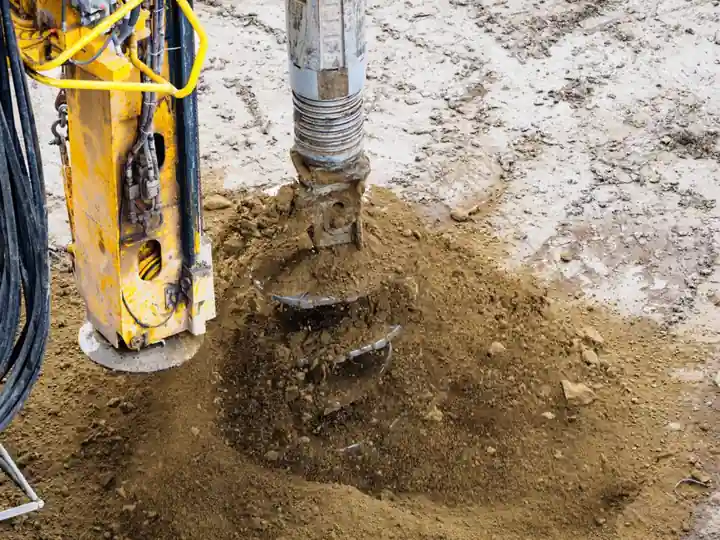
Tunneling rotary drilling rigs in 2026 are compact, crawler-mounted hydraulic or DTH units sized to the drift cross-section, with hole diameters of 90-125 mm and economic drilling depths up to 30 m in rock hardness f=6-20 [S5].
The selection logic differs from open-pit or oilfield rotary work: tunneling demands narrow-body chassis, electric or dual-mode power for ventilated headings, and rock-bolting or longhole-drilling variants in the same machine class. Underground rigs adopt compact, explosion-proof structures for narrow roadways, used for prospecting and tunneling drilling, while crawler chassis is the mainstream format for rugged, muddy headings [S4].
What "rotary drilling" means inside a tunnel heading
Rotary drilling in tunneling uses a rotating drill bit to break through rock and soil layers, and is widely used for deep holes, especially in hard rock, with continuous, efficient cutting suited to long tunnel sections [S1]. The method is one of four primary approaches in underground construction, alongside percussion, rotary-percussive (DTH/top-hammer), and TBM excavation [S1][S2]. The general rotary-drilling principle traces to oil and gas well construction, where a bit is rotated at depth to cut formation; the same kinematic principle scaled to drill-and-blast headings drives the rotary blasthole and longhole machines used in tunnels today [S2]. For a primer on the platform family, see the rotary drilling rig reference page.
Cross-section and chassis constraints
Tunnel headings impose hard envelope limits that rule out most surface blasthole rigs: drift cross-sections often fall in the 2 m wide x 2.5 m high range for narrow rock-bolting headings, requiring a low-profile, narrow-track machine [S5]. Casagrande's C3 XP-2 typifies the compact hydraulic crawler format developed specifically for tunnel excavation and underground consolidation works, with a low center of gravity for cycle mobility [S3]. For comparison, KAISHAN's KSQ31 in-the-hole longhole rig measures 5525 x 2375 x 2975 mm (L x W x H) at 10,000 kg, with 355 mm ground clearance and 20 degrees gradeability, sized for production drift faces rather than the tightest bolt headings [S5].
Power and duty class for underground headings
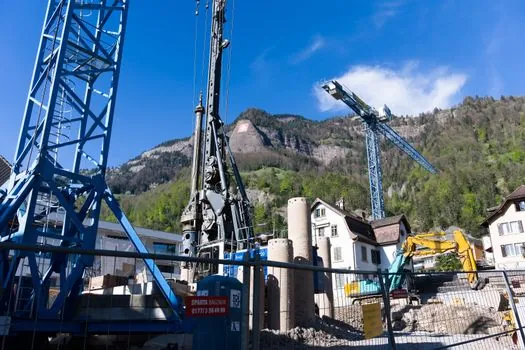
Underground power options are split between diesel-hydraulic and electric: diesel-hydraulic units cover headings with sufficient ventilation, while explosion-proof electric variants are mandatory in gassy underground coal mines [S4]. The KSQ31 ships with a Yuchai 4DKC4G2-80 diesel at 58 kW, with a 380 V / 55 kW Y250M-4 electric motor alternative, star/delta starting, and an 80 m cable reel for heading re-positioning [S5]. Light rigs drill shallow blast holes within 30 m, medium units reach 30-80 m, and heavy-duty mining drill rigs handle deep large-diameter boreholes for large-scale mining exploitation; tunneling production drifts usually sit in the light-to-medium class [S4].
Drilling parameters: diameter, depth, rotation, feed
On a typical underground longhole rig, the operating envelope is 90-125 mm hole diameter, 30 m economic drilling depth, f=6-20 rock hardness, 10-25 bar air pressure, 10-22 m3/min air consumption, 76 mm drill rod (1.2 m per rod, 24+1 in the magazine), 0-120 rpm rotation, 1900 Nm rotation torque, and a 1355 mm feed stroke with 25 kN maximum lifting force [S5]. Once set up, the unit drills parallel holes up to 3052 mm wide, with a maximum extraction face of 7942 mm wide x 4925 mm high, a geometry that maps directly to sublevel open-stope and ring-drilling patterns in hard-rock tunnels [S5]. A parallel rotary drilling rig selection guide for mining covers the heavier 80 m+ torque class that tunneling typically does not need.
Rotary vs DTH vs percussion in tunneling
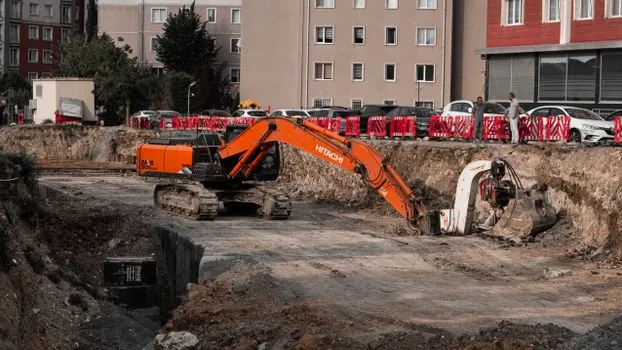
Rotary drilling is preferred for soft overburden and continuous long-hole patterns; DTH (down-the-hole) rigs rely on bottom-hammer impact for fast hard-rock drilling, with the hammer delivering percussive energy directly behind the bit; percussion drilling uses surface-mounted reciprocating mechanisms [S1][S4]. In practice, the rock-bolting and longhole production rigs offered for tunnel headings are predominantly DTH-hydraulic, while rotary units dominate soft-ground cover and pre-grouting holes [S4][S5]. Compared with demolition or road-build applications covered in the rotary drilling rig spec map for demolition projects and the road-construction rotary drilling spec map, tunneling rigs are smaller, narrower, and almost always crawler-mounted with on-board electric drive.
Selection criteria checklist for a tunnel rig
A tunnel selection decision should be run against six criteria: (1) drift cross-section versus machine envelope, with KSQ31-class 2375 mm width requiring >2.5 m heading clearance; (2) rock hardness band (f=6-20 covers most sedimentary and moderately metamorphosed formations); (3) hole diameter, with 90-125 mm matching standard 76 mm drill rods and standard bit inventories; (4) economic depth per set-up, usually 30 m in production drifts; (5) power class and ventilation, dictating diesel vs electric; (6) dust and safety controls, including wet dust removal and rockfall protection on the operator's cabin [S5]. Hanfa's HF-DD4 high-performance hydraulic tunneling rock drill rig and the HF-DD1 low-profile face drilling rig illustrate the split between high-clearance production and ultra-low-bolt-heading units [S4].
Limitations and failure modes
Tunnel rotary/DTH rigs are not interchangeable with surface blasthole machines: their narrow chassis and short feed stroke cap hole depth at 30 m economic / 80 m absolute in the light-to-medium class, and their 1900 Nm torque ceiling rules out the larger 165-250 mm blasthole work common in open pits [S4][S5]. Wet dust removal is the only dust-control mode in the standard KSQ31 configuration, which limits use in headings where water management is constrained [S5]. Heading ventilation, not bit capacity, usually sets the real upper bound on diesel-hydraulic deployment, which is why most new European and Chinese metro headings specify the 380 V electric variant with 80 m cable reel [S5].
Standards and sourcing references
No single ISO or IEC standard governs tunnel rotary rig selection; instead, procurement is driven by project geotech reports, the heading's air-quality and ventilation class, and manufacturer-published duty ratings. Public 2026 manufacturer data for the machine class includes Casagrande C3 XP-2 (compact hydraulic crawler, tunnel excavation and underground consolidation) [S3], KAISHAN KSQ31 (90-125 mm, 30 m, 58 kW diesel / 55 kW electric, 10,000 kg) [S5], and Hanfa's HF-DD4 / HF-DD1 hydraulic tunneling rock drill rigs (underground crawler, low-profile face, narrow-chassis bolt headings) [S4].
Two trackable signals to watch through the remainder of 2026: electrification of mid-class (30-80 m) underground rigs as European metro and Chinese rail projects tighten ventilation rules, and a broadening of the 90-125 mm / f=6-20 duty band into 130-150 mm diameters for larger rail and hydropower tunnel sections. Procurement teams should re-verify the rock hardness band and heading cross-section against the OEM data sheet before locking a rig class [S3][S4][S5].
The underlying component specifications are covered under rotary encoder, and rotary hammer.