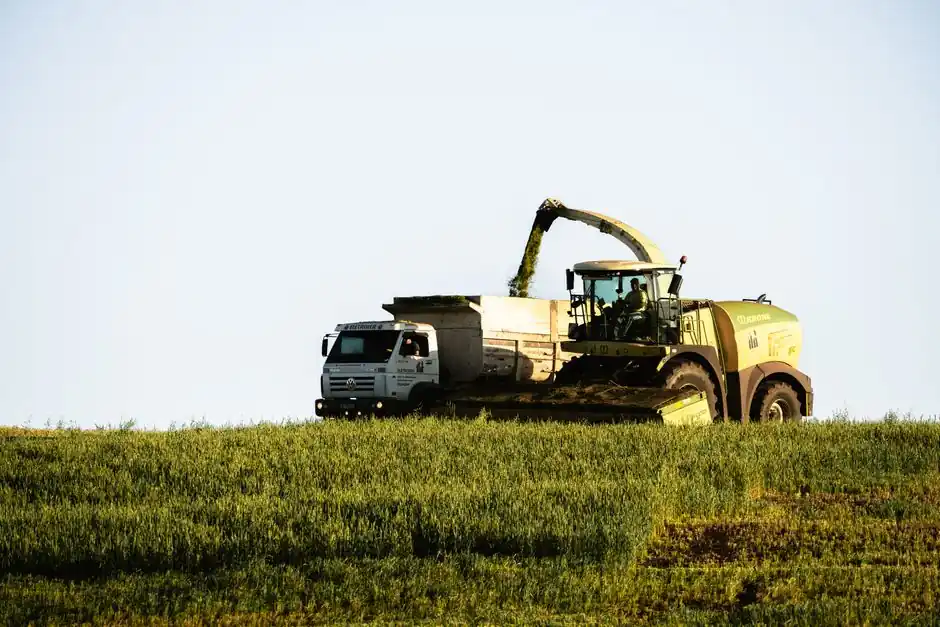
Self-loading concrete mixer trucks in the 1.2–6.5 m³ drum range on 4x4 chassis dominate the farm and rural-agriculture segment, with small dedicated rural-build units typically priced near $16,000 [S1][S4].
For larger field-scale pours, conventional drum trucks up to 10 cubic yards (≈7.6 m³) per load remain the workhorse, and SANY's over-10 m³ platform reaches 12 m³ with GPS monitoring [S2][S3].
Why farm duty is its own selection problem
Agricultural concrete work breaks into two regimes: continuous rural infrastructure (canal lining, irrigation channels, livestock pads, grain-bin pads, dairy parlour floors) and one-shot field pours (gate post bases, fence strainer footings, culvert headwalls, farm road crossings). The first regime rewards a small self-loading unit that can relocate between scattered pour points without a batching-plant return trip, the second regime often tolerates a delivered ready-mix truck if a plant sits within hauling distance [S1][S4].
Soft-soil access is the deciding physics problem. A standard 6x4 linehaul tractor can high-centre on a cultivated field or rutted track; specifying a straight (non-drop) front axle plus high-mounted radiator and cooling module is the recognised severe-duty pattern for off-highway agricultural haulage, where payloads reach 80,000+ lb [S5]. The same logic drives the dominance of 4x4 self-loading mixers in the 1.2–6.5 m³ class: a compact wheelbase, high approach angle, and a single driven front axle that keeps the truck moving where a 6x4 ready-mix truck would bog down [S4][S5].
Drum capacity vs daily output: matching the box to the pour
Modern conventional mixer trucks carry roughly 10 cubic yards (≈7.6 m³) per load, up from the 2-yard (≈1.5 m³) machines of earlier decades, a 5x capacity jump that directly cuts the number of return trips to the batch plant [S3]. For farm duty, this matters less than matching drum size to the daily volume the crew can place before initial set, because returned loads of waste concrete are pure cost on a remote site [S1][S4].
Self-loading mixer models segment cleanly by drum volume. Yaweh's published range runs 1.5 m³ (4x4, small sites), 3.2 m³ (4x4, medium projects) and 5.5 m³ (4x4, large/high-volume pours), and the broader family spans 1.2–6.5 m³ [S4]. Wenming's rural-construction small-mixer line covers WM-1200 through WM-6500, mirroring the same 1.2–6.5 m³ envelope at a $16,000 price point for the base configuration [S1]. A practical rule for farm crews: 1.5 m³ covers up to ~10 m³/day (gate posts, fence footings, single dairy-pad pours); 3.2 m³ fits 20–40 m³/day (canal lining, livestock buildings); 5.5 m³ and above is justified only when the pour rate and crew size can consume a full drum before slump loss crosses the placement threshold [S4].
Chassis, driveline, and ground clearance for soft soil
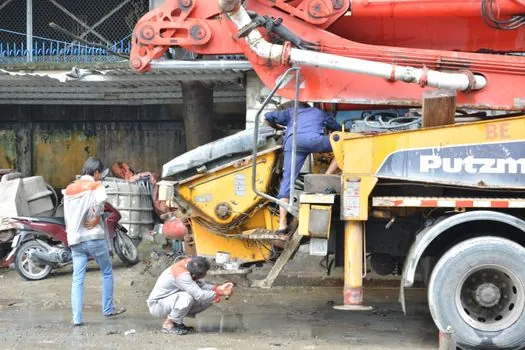
Off-highway agricultural and construction hauling is governed by three chassis parameters: front-axle type, bumper approach angle, and cooling-module ride height. Severe-duty vocational trucks use a straight front axle (not a deep-drop highway axle) to maximise clearance under the oil pan, a swept-back steel bumper for high approach angle, and frame-rail-mounted radiators to keep cooling fins above mud and crop stubble [S5].
Self-loading agricultural mixers apply the same logic in a smaller package. The 4x4 format pairs a driven front axle with a compact wheelbase so the truck can turn inside a farm gate and climb a wet field entrance. A 360° rotating drum is the standard discharge configuration, letting the operator place concrete without re-positioning the truck in tight livestock-pad or canal-edge work [S4]. For a broader perspective on how 4x4 self-loading units differ from ready-mix drum trucks in the same spec class, the comparison maps cleanly onto the engineering concrete mixer truck reference.
Selection criteria: small self-loader vs mid-size drum truck vs large ready-mix
Three platform options cover the agricultural concrete buyer, and the right pick is set by daily volume, haul distance, and ground condition rather than price alone. A simple 4-criterion comparison: [S2]
Platform A, small self-loading 4x4 (1.2–3.2 m³ drum, ~$16,000 entry): best for ≤20 m³/day on soft or remote sites; one operator handles loading, mixing and discharge; no batching-plant return trip needed; weak point is drum volume ceiling and highway speed when the truck must also move between fields [S1][S4].
Platform B, mid-size self-loading 4x4 (3.2–5.5 m³ drum): best for 20–60 m³/day on mixed terrain; retains the single-operator advantage and 360° discharge; higher acquisition cost is offset by fewer drum cycles per shift; weak point is still chassis GVWr limits for very long farm-to-farm transits [S4].
Platform C, conventional drum truck up to 10–12 m³ on a 6x4 or severe-duty vocational chassis: best for ≥60 m³/day within hauling distance of a batch plant, large continuous pours such as grain-bin pads or silage clamp floors; integrates GPS vehicle monitoring and video on 12 m³ units; weak point is reliance on the plant and limited off-road mobility, so a support dump truck or loader is needed to position the truck on soft ground [S2][S3][S5].
Use cases specific to agriculture
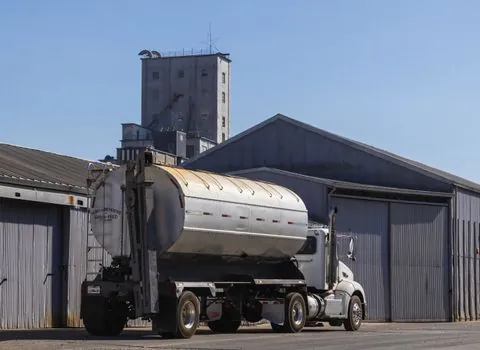
Rural housing and small farm buildings are the dominant application, with self-loading 1.5–3.2 m³ units the most common match because the truck must move between foundation, slab, and column pours on the same site [S1][S4]. Canal and irrigation works favour 3.2–5.5 m³ self-loaders because the pour points trace a linear alignment and a single 4x4 truck can feed a small placing crew continuously without truck-mixer changeover [S1][S4].
Remote sites where a batching plant is impractical, including mountain pasture infrastructure, island livestock stations, and new-field development, push the decision firmly toward self-loading 4x4 mixers: they carry the raw material, mix on site, and discharge into formwork without any dependency on delivered ready-mix [S4]. For very large one-shot agricultural pours (silage clamps, anaerobic digester tanks, large grain-store floors), the published 10 m³ (≈7.6 m³) class of ready-mix drum truck remains the throughput benchmark, and 12 m³ GPS-monitored units extend that for major projects [S2][S3]. A practical field reference for matching drum volume to placement rate is documented in the concrete mixer truck selection guide.
Limitations, failure modes, and what not to buy
Self-loading mixers are not a substitute for a large ready-mix truck on a 100+ m³/day pour: drum cycle time caps placement rate, and a single drum cannot sustain continuous feed to a large placing crew. Equally, a 12 m³ ready-mix drum truck is the wrong tool for a remote field with no plant within hauling distance: the concrete will exceed the placement window before arrival, and any access delay shows up as cold jointing and rejected loads [S2][S3][S4].
Soft-soil entrapment is the most common farm-duty failure mode. A deep-drop front axle, low-slung radiator, or long wheelbase linehaul chassis will high-centre on a wet cultivated field even if the GVWr is adequate; the recognised fix is a straight front axle, high-mounted cooling module, and swept-back vocational bumper, the same severe-duty pattern applied to agricultural haul tractors [S5]. Maintenance access also matters: long-hood heavy-haul layouts with a massive cooling module are easier to service in a farm workshop than cramped cab-over designs, which is one reason severe-duty vocational chassis dominate agricultural applications over 50,000 lb GVWr [S5].
Standards, sourcing, and verifiable signals
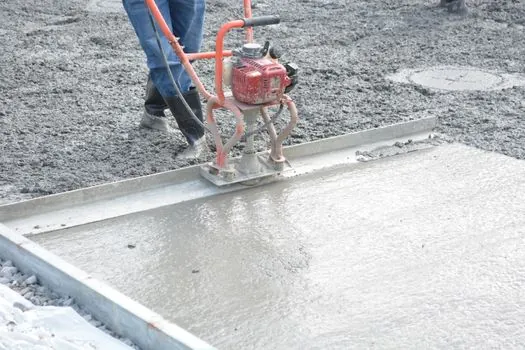
No single ISO or EN standard governs concrete-mixer-truck drum capacity or agricultural chassis selection; the dominant quality signal in the self-loading segment is ISO 9001 manufacturer certification, which Yaweh explicitly holds for its mixer-truck production [S4]. Drum volume, rotation speed, and discharge geometry are vendor-specified rather than standard-mandated, so buyers should match the vendor data sheet against daily output rather than assume a regulatory floor [S4].
For a farm operation in 2026, three verifiable signals separate a sound purchase from a bad one: a documented 4x4 driveline with a straight (non-drop) front axle for soft-soil access [S4][S5]; a published drum capacity within the 1.2–6.5 m³ self-loading envelope, matched to ≤60 m³/day placement rate [S1][S4]; and, for larger operations, a 10–12 m³ drum-truck platform with GPS fleet monitoring if the batching plant is within hauling range [S2][S3]. For more on matching a power mixer or stationary sand mixer to a farm concrete yard, the references cover drum and pan geometry trade-offs. A related decision path on agricultural castings, useful when specifying mixer wear parts and drum liners, is mapped in this hot-box core shooter selection for agriculture machinery castings guide.