
A quarry or open-pit mine that pours its own shotcrete, drainage concrete, or haul-road slabs needs a concrete mixer truck sized to the pit, not the urban ready-mix route, and the working envelope changes everything from drum geometry to chassis reinforcement [S2].
Published guidance from 28 May 2026 frames fleet selection around operating weight, bucket or drum capacity, and site reach, with the explicit warning that under- or over-sized machines inflate fuel burn per cubic meter, lengthen cycle times, and raise safety risk on difficult terrain [S1]. On the mining side, supplier data dated 2 May 2026 confirms a standard capacity band of 2-8 m³, mine-safety chassis configuration, and customization on tank structure, discharge system, and color, targeting mine roads, tunnel support, and underground backfill [S2].
Quarry duty cycle and what it changes on the truck
Quarry haul roads run at 8-15% grade with abrasive limestone or granite fines, and a drum rated for 6 m³ of urban-ready-mix will often be down-rated to 4.5-5 m³ effective payload once aggregate size and slope are factored in [S1]. Site observations compiled in 2026 indicate that mixing-tank structure, discharge geometry, and chassis reinforcement are the three parameters that move first when a standard road mixer is re-rated for quarry service [S2]. Buyers should treat the headline 2-8 m³ figure as a nameplate window, not a guaranteed payload, and confirm effective volumetric capacity with the OEM against local aggregate bulk density and maximum pour rate.
Selection criteria that actually move the spec
Fleet planners in 2026 should rank the following five criteria before opening a quote sheet, drawn from current mining-mixer supplier documentation and 2026 fleet-selection guidance: (1) effective drum capacity in cubic meters after aggregate-size derating, typically 2-8 m³ nameplate [S2]; (2) chassis classification, with mine-safety or KA-qualification options for underground-adjacent sites [S2]; (3) haul distance and gradient, where every 10% of added slope cuts effective payload by 5-8% on standard rear-discharge drums [S1]; (4) mixing and discharge system design, where hydraulic-drive drums with optimized tank geometry maintain slump over longer haul [S2]; (5) parts and field-service coverage, since remote quarry sites cannot tolerate multi-week parts lead times [S1].
Standard road mixer vs mining-safety mixer vs hybrid-electric
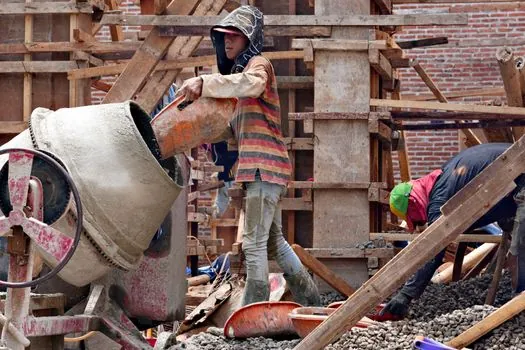
Three configurations now compete for quarry concrete supply, and the right pick depends on whether the truck runs inside the pit, on the rim road, or in a tunnel [S2]. A standard road-going concrete mixer truck is the lowest-cost option and suits quarry perimeter road slabs where gradients stay under 6% and the haul is under 30 minutes, but it lacks the reinforced chassis and KA safety documentation that most mine operators require for in-pit work [S1][S2]. A mining-safety mixer truck, as catalogued by Jialian Heavy Machinery in 2026, adds a reinforced chassis, mining-safety configuration, and supports for tunnel support, underground backfill, and heavy-duty mine-road applications, with capacity still in the 2-8 m³ band [S2]. The hybrid-electric variant introduced on 22 April 2026 by Chaney Enterprises runs the drum fully on electric power under the plant, eliminating engine idle during loading and cutting on-site noise, a useful feature for quarry-adjacent communities and underground ventilation constraints [S3].
Quarry use cases and the trucks they fit
Haul-road slab pours in open-pit limestone quarries typically pair a 6-8 m³ mining-safety mixer with a 6x6 or 8x4 reinforced chassis, since aggregate abrasion and 10-15% grades dominate the wear and slip risk profile [S1][S2]. Tunnel portal concrete and underground backfill jobs in hard-rock mines need the smaller 2-4 m³ end of the range to clear tunnel cross-section limits and ventilation curves, with the KA mining-safety option flagged on the quote [S2]. Quarry-edge infrastructure such as crusher foundations, settling ponds, and retaining walls can run a standard road mixer if the haul stays on sealed or hard-packed surface, with hybrid-electric loading preferred where pit-rim noise restrictions bind [S1][S3]. Where concrete must be pumped rather than discharged, a separate concrete pump truck typically takes over from the mixer at the pour face, so the drum truck only needs to optimize haul and slump retention, not placement reach [S1].
Limitations, failure modes, and what to verify before signing

Mining-safety mixer documentation published in 2026 flags that effective capacity, not nameplate capacity, governs real throughput, and buyers should request a project-specific derating sheet before order [S2]. Hybrid-electric drum drives demonstrated in 2026 still rely on the chassis engine for road travel, so emissions and fuel-burn benefits apply to loading and yard movement, not the full duty cycle [S3]. Fleet planners should also confirm that any quoted KA mining-safety qualification matches the local mine authority's accepted list, since documents are jurisdiction-specific and re-certification adds 4-8 weeks [S2]. For broader context on matching equipment to ground conditions, the 2026 selection framework for road maintenance automatic levels covers similar logic on grade tolerance and site geometry, and is worth reading alongside any mixer-truck procurement: see Automatic Level Selection for Road Maintenance: 2026 spec map. Buyers also preparing shotcrete or road-base work should cross-check the drum truck against the related Mining Concrete Mixer Truck Selection: 2026 Spec Map for underground and heavy-haul sizing rules, and against Shield machine selection for urban infrastructure: a 2026 spec map when the project mixes tunnelling and surface concrete supply.
Track these three signals before the next procurement cycle: (1) hybrid-electric mixer retrofits beyond the 2026 Chaney launch, with concrete fuel-burn and noise data per drum cycle; (2) KA mining-safety certificate harmonization across major mining jurisdictions, which would cut the 4-8 week re-certification penalty; (3) OEM release of quarry-specific effective-payload derating curves, replacing the current 2-8 m³ nameplate window with site-rated figures.
For the relevant spec sheets and selection criteria, see truck mounted concrete pump.