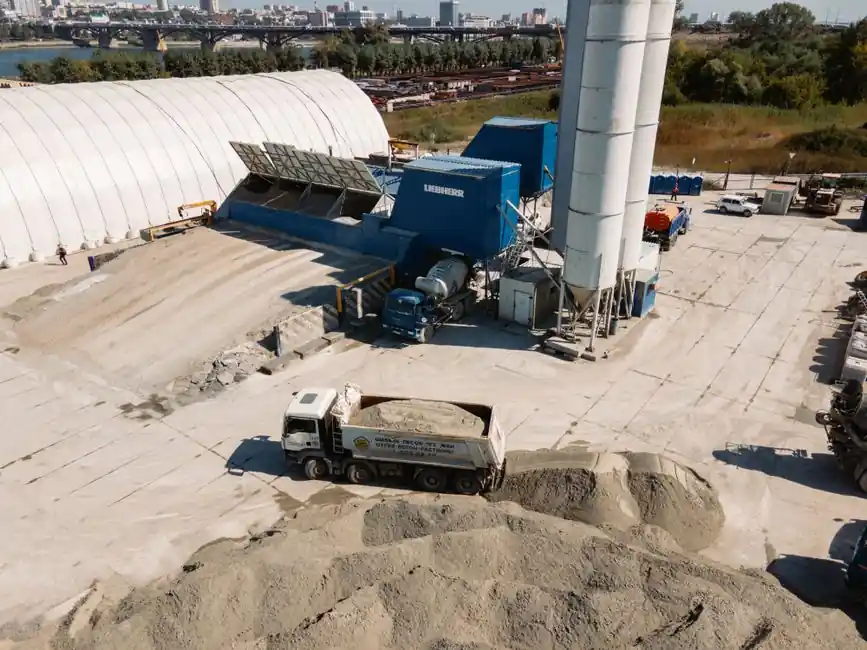
Tunneling concrete delivery almost never uses the 9.2 m³ (12 yd³) rear-discharge drum that dominates highway work; 2 to 8 m³ mining-safety mixer trucks with reinforced frames and a tunnel-rated chassis are the working envelope, per Jialian Heavy Machinery product data (2026-06) [S2].
Specifying the wrong class is the most common mistake: a standard 10 m³ ready-mix truck will not fit a 4 m heading profile, will overload the temporary invert, and cannot keep the mix agitated through a 1.5 km single-bore drive without a re-mix at the face [S1][S2].
What "tunneling" changes in the truck spec
Tunneling drives three requirements that road construction does not: a hard envelope on truck height and width, a continuous concrete supply over a 0.5 to 4 km single-lane haul, and shotcrete or wet-mix spraying at the face rather than pour-and-vibrate from above [S2][S3].
Mining-safety mixer trucks are typically built on a 4x2 or 6x4 mining chassis with a KA mining-safety qualification option, mixed capacity from 2 to 8 m³, and a reinforced tank and discharge structure sized for low-headroom galleries and rough muck-haul roads [S2]. Standard ready-mix trucks run 6.9 to 9.2 m³ (9 to 12 yd³) drums at a 72,000 to 74,000 lb gross vehicle weight, and they will not clear a standard rail-mounted or rubber-tyred service tunnel without dismantling the mixing hood [S1].
Capacity band, not single number: 3 / 5 / 8 m³ tiers
Concrete mixer truck capacity for tunnel work sorts into three working tiers: a 3 m³ class (CMT3) with a 5.05 m³ geometric tank and a 116 hp Euro-IV diesel, a 5 m³ class (CMT5) with a 7.25 m³ geometric tank and a 130 hp engine, and an 8 m³ class (CMT8) on a 6x4 chassis with a 13.3 m³ geometric tank and a 350 hp Stage-VI engine [S4].
Unloading residue rate tightens as the truck scales: 0.8% or less on the 3 to 6 m³ CMT3 to CMT6 series and 0.5% or less on the 8 to 12 m³ CMT8 to CMT12 series, an important factor when every cubic meter of shotcrete rebound is being scraped off the invert [S4]. For narrow headings, the CMT3 at 6,300 mm long, 2,300 mm wide, 3,300 mm tall is the only class that clears most single-track rail-mounted headings without boom detachment [S4].
Chassis and hydraulic system choice for tunnel duty
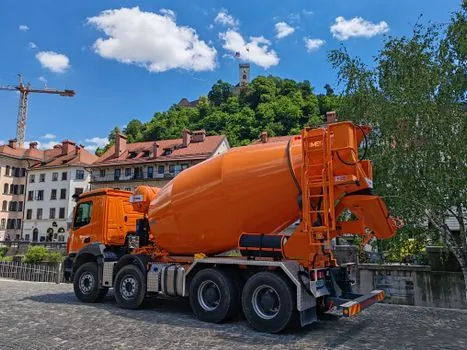
Smaller tunnel units (CMT3 to CMT6) use a 4x2 left-hand-drive chassis on AUMAN, DFAC, or T-KING frames with recirculating-ball steering, air-pressure brakes, and a pneumatic 150 L water tank; the larger 8 to 12 m³ series move to 6x4 chassis from FOTON, SHACMAN, SINOTRUK, DONGFENG, FAW, JAC, HINO, MITSUBISHI, or ISUZU, with dual-circuit air brakes, imported ZF8098 hydraulic steering, and a 450 L pneumatic water tank [S4].
Hydraulics on the larger units are PMH P90 or ARK piston pumps with PMH M90 or ARK hydraulic motors and PMB6.5sp or PMB7.1sp Italian reducers, paired with an 18 L heat radiator to keep the hydraulic oil cool through long, low-speed uphill hauls out of a portal [S4]. A standard concrete concrete mixer truck on a road-spec chassis will cook its hydraulic oil inside 200 m of an inclined gallery in summer ventilation conditions.
Pump-equipped mixers vs trailer pumps for tunnel work
For long pumping distances inside the bore, a concrete pump truck or trailer-mounted pump fed by the mixer truck is the conservative choice, because a truck-mounted concrete pump combines a boom and a pipeline system in a single unit, but it still depends on a separate mixer drum to feed it continuously [S3].
A concrete mixer pump truck integrates the mixing drum and the hydraulic pumping system on one chassis, with loading, mixing, pumping, and placement handled by the same vehicle, and it is widely used for tunnel linings, foundations, and high-rise floors where the placement point is far from the truck [S3]. Compared across four criteria for tunnel work: a standard 10 m³ highway mixer is the cheapest unit but fails on envelope and invert load; a 2 to 8 m³ mining-safety truck matches the heading and survives rough roads but still needs a separate pump for long lining pours; a concrete mixer pump truck cuts one vehicle from the train but costs more upfront and is harder to service underground; a trailer pump plus mining mixer is the most flexible pairing for variable heading profiles but needs more operators [S1][S2][S3].
Practical selection criteria for a tunnel project
Four criteria drive the actual order: heading cross-section and curve radius, drive length and gradient, shotcrete vs structural-lining duty, and local mining-safety qualification. EPDAS, in its 2026-06 application notes, lists long-distance tunneling alongside expressway, bridge, and commercial complex work as a primary application for the 3 to 12 m³ class, which confirms the envelope but not the chassis type [S4].
AMIX Systems recommends matching chassis configuration to the job-site access constraints, with rear-discharge, front-discharge, and semi-trailer mounted systems each giving specific advantages depending on access and operational preference [S1]. For tunnel work the rear-discharge semi-trailer is usually excluded because of curve radius; the working fleet is a fleet of small front-discharge or short rear-discharge 4x2 mining chassis supplemented by one or two pump-equipped units for the final lining [S1][S2].
Limitations, failure modes, and what to track
Two failure modes dominate tunnel concrete delivery: drum agitation loss on long single-bore drives (the standard 10 m³ drum will slump out before the face if the haul exceeds roughly 30 minutes without a re-mix station) and invert overload from highway-class GVW on temporary road decks. The mining-safety class addresses both with smaller capacity and reinforced structure, but it cannot match the 3.5 m³/min feeding speed of the CMT8 to CMT12 series used on open road work [S2][S4].
Watch two signals over the next 12 months: confirmed KA mining-safety certification on the chassis and matching water-tank capacity for shotcrete accelerators (the CMT3 to CMT6 class ships with a 150 L tank, which is borderline for wet-mix shotcrete at 8 m³/h). For broader fleet decisions on open-road versus mining chassis, the parallel Concrete Mixer Truck Selection for Road Construction: 2026 Spec Map covers the highway envelope in detail.