
Concrete mixer trucks and rear-loader garbage trucks share a vocational-truck chassis class, but their working envelopes diverge sharply: a concrete mixer truck is engineered to keep a rotating drum at 0-14 rpm with a continuous concrete slump, while a landfill hauler must run a sealed compaction body at 1:3-1:6 compression ratio, handle leachate, and survive repeated tipper cycles on unpaved haul roads [S3].
Specifying a mixer drum for landfill solid-waste duty is a category error that procurement teams keep making because the chassis, cab, and axle ratings look interchangeable on paper. The hydraulic, sealing, and structural requirements are not interchangeable, and the failure modes (drum contamination, abrasion, leachate corrosion, illegal over-axle loading) are not theoretical [S1][S2][S3].
Definition and Scope: Mixer Drum vs. Landfill Hauler
A concrete mixer truck mounts a rotating inclined drum, typically 6-12 CBM, driven by a dedicated PTO hydraulic pump and gearbox; the drum carries wet concrete at a 0-14 rpm working speed, with charge/discharge through a single folding chute [S1]. A rear-loader garbage truck, the dominant landfill-collection platform, mounts a sealed rectangular compaction body of 3-18 CBM, a rear hydraulic hopper, a multi-stage scraper/pusher packer, and a bottom leachate tank; compression ratio runs 1:3-1:6, doubling or tripling the effective payload over an open body [S3].
The two vehicles are not drop-in alternatives. The mixer drum cannot compact, cannot seal against leachate, and cannot be tipped for discharge at a working face. The rear-loader body cannot rotate to keep a load fluid, and its packer hydraulics are sized for dry MSW, not aggregate. Selecting between them is a duty-cycle decision, not a chassis decision [S1][S3].
Selection Criteria: Chassis, Axle Load, and Tire Rating
Vocational landfill trucks routinely run at the maximum legal axle load, because waste is dense (compacted MSW reaches roughly 400-600 kg/m3 in a 1:5 packer) and haul distances are short. Concrete mixers sit in the same heavy-vocational axle class: loaded weights carry the loads per axle at the maximum legal limits, which is why both platforms share a 6x4 or 8x4 tri-drive configuration [S2].
For a landfill hauler, the governing chassis spec is not drum volume but: (1) front axle rating of 7.5-9.0 t for a 6x4, 8.0-10.0 t for an 8x4, paired with rear bogie ratings of 26-32 t; (2) GVW headroom for cover material, leachate, and a full compaction cycle; (3) tire load range L or M with cut-chip-resistant tread for haul-road abuse; and (4) ground clearance of 280-320 mm to clear working-face ruts and tipping-floor lips [S2][S3].
Who It Is For vs. Who It Is Not For
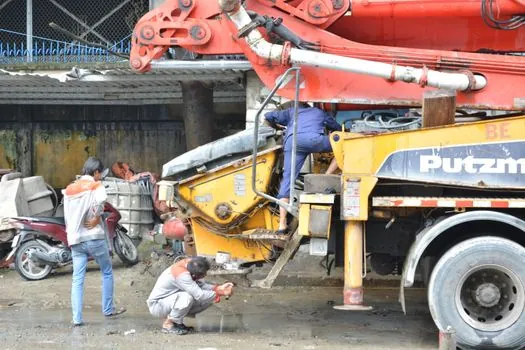
Spec a concrete mixer truck only when the working face is a concrete batch plant, the load is wet aggregate that must stay agitated, and discharge is into a chute or pump hopper. Mixer drums are also wrong for ash, sludge, or sticky industrial waste, because drum cleaning between loads is uneconomic and the agitator hydraulics are not sized for high-viscosity material [S1].
Spec a rear-loader or dump truck platform when the duty is: municipal solid waste collection, transfer-station feed, light construction debris, or cover-material spreading at a working face. A dump truck is the right tool for daily cover (soil, sand, crushed aggregate) where no compaction is wanted, and for ash or contaminated soils where the body must tip clean. The rear loader is the right tool when you need sealed transport, high volumetric efficiency, and a 2-3x payload advantage over an open body [S3].
Comparison of Main Options on Four Decision Criteria
Three platforms compete for landfill truck work; the right pick depends on what you are hauling and how the body must discharge.
1. Concrete mixer truck. Best for wet, fluid, time-sensitive loads that must stay homogeneous. Poor fit for dry MSW, leachate exposure, and any duty requiring sealed containment. Drum rotation is a constant parasitic load, which penalizes fuel economy on a haul road [S1].
2. Rear-loader garbage compactor. Best for sealed MSW collection at 1:3-1:6 compaction, 3-18 CBM body sizes, single-operator loading, and zero-leachate transport. Limited to relatively dry, compressible waste; not suited for large boulders, liquid sludge, or hot ash [S3].
3. Dump truck. Best for cover material, ash, contaminated soil, demolition debris, and any load that wants a clean gravity tip. Open-top variants are common in quarry and landfill cover duty; sealed variants exist for hazardous or odorous payloads. No compaction, so volumetric efficiency is the lowest of the three, but tip-cycle time is the shortest [S2][S3].
On the four deciding criteria (compaction, sealing, body-cleaning time, tip-cycle cost), the rear loader scores 3/4, the dump truck scores 2/4 (strong on cleaning and tip cost, weak on compaction and sealing), and the mixer drum scores 1/4. On aggregate-haul or cover-spread duty, that ranking inverts [S1][S2][S3].
Real Use Cases and Failure Modes
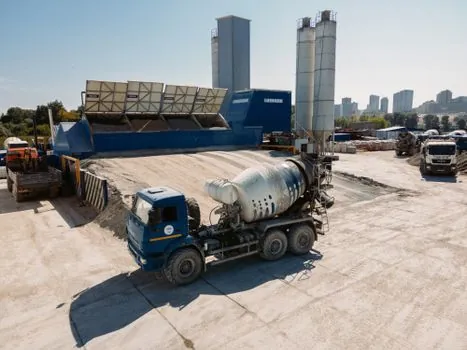
The most common misuse is sending a mixer drum to a small-civilian landfill with mixed construction waste: the drum fills with rebar, plastic, and soil, the agitator stalls, and the only recovery is a manual excavation through the manhole, which costs more than the drum. The second most common misuse is running a rear-loader packer on demolition debris with long rebar or concrete chunks: the packer cylinder stalls, the scraper bends, and the body is out of service for weeks. Both failures trace back to specifying the platform before specifying the duty [S1][S3].
For a working-face cover operation, a dump truck with a 6x4 chassis, 8-10 CBM steel body, 8-10 mm floor plate, and 490 MPa yield side panels is the standard fit; it tips a spreader load in 20-30 seconds, returns to the stockpile, and runs at the legal axle limit without drama. For MSW collection into a transfer station, a rear loader with 10-14 CBM body, 1:4-1:5 compaction, fully sealed tailgate, and a 6,000-8,000 kg rated packer cylinder is the standard fit [S2][S3].
Limitations, Constraints, and Sourcing
No industry standard is named here as governing these specific vocational body ratings; the relevant chassis and axle ratings are typically national road-traffic regulations (per-axle limits, GVW caps, brake performance), and the relevant body ratings are manufacturer-published. For hazardous or leachate-bearing waste, the sealing and corrosion requirements move into EPA, EU Waste Framework Directive, or equivalent local environmental compliance territory, which is outside the chassis spec sheet and must be specified separately [S3].
For a related cross-sector vocational spec example, see the Shield machine selection for urban infrastructure: a 2026 spec map article, which covers a similar chassis-and-auxiliary pairing problem in tunnel work. Another useful adjacent reference is the Mining Fire Hydrant Selection: 2026 Spec Map for Haul Roads, Process Plants and piece, where the haul-road environment overlaps the landfill haul-road duty cycle.
Trackable signals for the next procurement cycle: (1) any 2026 municipal tender specifying 1:5 or higher compaction with sealed leachate tanks, which would push rear-loader demand and constrain open-body dump truck orders; (2) any aggregate-supply chain disruption that diverts mixer trucks from concrete duty to general haul, which would expose how few of them are actually landfill-capable; (3) tightening per-axle load enforcement, which favors higher-tare 8x4 chassis over 6x4 across both rear-loader and dump-truck platforms [S2][S3].
The underlying component specifications are covered under concrete pump truck.