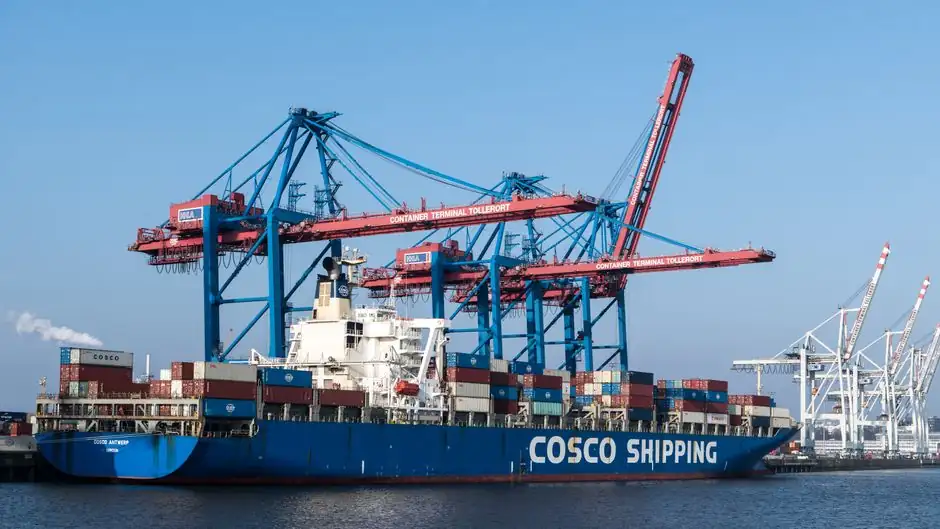
Port-grade concrete delivery starts at the loading tower, not the drum: a modern rapid loadout cycle is 120 s/truck with ±0.1% static batch weighing accuracy, and the surge bin above the weigh hopper typically holds 200–272 t of cement or blended material [S1]. A concrete mixer truck staged under that tower is part of a much larger cycle whose bottleneck is the queue at the weigh hopper, not the drum's mix speed.
At the Heysham Port £10 million redevelopment completed in May 2026, contractor Kiernan placed more than 4,500 m³ of readymix between April 2025 and May 2026, including 3,600 m³ of Strike early-strength concrete dosed with 20–30 kg of steel fibres per cubic metre, all dispatched in 30+ deliveries from a single Lancaster RMX plant, with same-day traffic-ready strength gain [S5]. That is the throughput a port-spec concrete pump truck and its mixer supply chain must keep up with on a working quay.
What "port duty" actually changes on a mixer truck
Yard duty is short-wheelbase, low-speed, high-stop work: a standard 4x2 terminal tractor runs at 25–35 mph top speed with a 110–116 in wheelbase and a hydraulic fifth wheel that cuts a trailer swap from 10 minutes to about 30 seconds, lifting yard productivity by roughly 300% versus a manual fifth-wheel OTR tractor [S3]. A port mixer truck has to thread the same tight lanes, so rear-axle steering, sloped drum access, and a low centre of gravity matter more than a highway cruise ratio.
Off-road axle ratings are not highway ratings: a terminal tractor is commonly rated to move 30,000–45,000 kg in a single pull, well above the legal highway weight-to-axle envelope, because the work is done on private terminal pavement [S3]. The mixer's subframe, tag axle, and brake package should be specced to those off-road axle loads, and the drum should be sized to fully load the chassis without spilling out the legal payload envelope once it leaves the gate.
Drum capacity for port and terminal work sits at 6–10 m³ nominal, paired with a water tank sized to keep the drum above the 50–80 mm slump target on a 30–60 minute quayside queue. Mixers in the 8 m³ class are the practical sweet spot when feeding a truck-mounted concrete pump boom on a wharf apron, because two drums can keep a 36 m boom fed at peak placement without queuing.
Loading tower, weigh hopper, and the 120-second cycle
Batch-weigh loadouts have been standard in bulk cement and iron-ore dispatch since the 1960s, and current OEM systems hold ±0.1% static accuracy on the weigh hopper with hydraulic surge-bin gates feeding 200–272 t of live buffer above the truck [S1]. A port operator who specs a 6–10 m³ concrete mixer truck without a matching 120 s loadout cycle is leaving roughly 30–60 truck-shifts per year of theoretical capacity on the table per bay.
The four hydraulically actuated double-bladed gates on the surge bin control batch flow into the weigh hopper, which then dumps into the mixer truck's charging hopper in one drop [S1]. The truck's hopper geometry, chute height, and rear-deck splash guard must be matched to that single-drop profile or the operator loses dust control, which is the real regulatory driver behind the loadout spec, not the throughput claim.
Dust-free loadout is now a design requirement, not a marketing line, on port cement, ore, and coal towers [S1]. Concrete mixers take a hard hit on that envelope because wet mix plus dry cement dust at the charging interface is the worst combination: a sealed charging hopper, integrated dust skirt, and an admixture pre-dose line at the loadout point keep the drum from acting as a secondary dust source.
Concrete mix design for the terminal environment
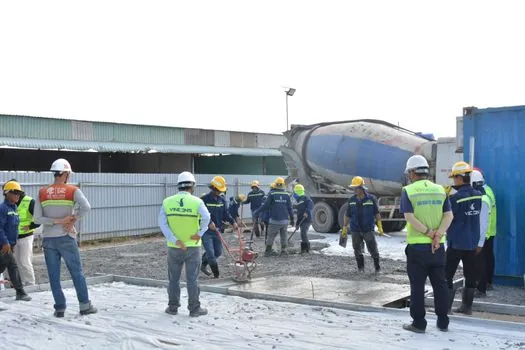
Strike early-strength concrete at Heysham reached trackable strength within 24–48 hours, versus the 28 days a standard CEM I mix needs to reach full strength, and was used in 3,600 m³ of the 4,500 m³ total pour across heavily trafficked aprons [S5]. A mixer truck moving that spec needs a drum that can deliver a consistent 80–120 mm slump at the placement end, not at the plant, so drum rotation, fin pitch, and charge/discharge speed all matter.
Steel-fibre dosing at 20–30 kg/m³ removes the need for traditional mesh in heavily trafficked port slabs, and the mix must keep those fibres uniformly suspended from plant to pour [S5]. A drum that runs too fast in the first 5 minutes will segregate fibres, while a drum that idles on a quayside queue will let them sink, so drum speed governors and standard 2–6 rpm mixing / 6–15 rpm discharge windows are practical baseline settings.
Holcim at Heysham dispatched the whole programme through a digital Holcim+ ordering and live-tracking platform, which is the operational layer the mixer truck has to feed [S5]. Onboard telematics, drum rotation counters, and water-meter logs that can export to that platform are no longer optional on a port-spec unit, because the dispatch and the quality trace need to be the same record.
Comparing port-spec mixer truck options by duty cycle
Selection on a port or terminal job usually comes down to four criteria, and the table below shows how the main configurations line up. A 6 m³ 4x2 standard-cab mixer on a tag-axle chassis is the lightest, cheapest option and fits inner-city terminals with tight turning radii. An 8 m³ 4x2 with a low-deck cab and reinforced drum bearings covers most quayside work and matches a 36 m boom pump. A 10 m³ 6x4 chassis is the heavy choice for high-throughput bulk-cement quays but pays a turning-radius penalty. A 6–8 m³ electric or hybrid chassis is now being specified for confined terminal air-quality envelopes, with the trade-off of battery mass cutting legal payload by 1–2 t. [S3]
On the four most-cited decision criteria, the standard 6 m³ 4x2 is the lowest capex and the shortest wheelbase but lowest per-trip payload, the 8 m³ 4x2 is the best balance of payload and yard speed, the 10 m³ 6x4 leads on per-trip payload and best matches a 120 s loadout cycle, and the electric 6–8 m³ chassis leads on emissions and noise but trails on range and refit cost.
Yard logistics, terminal tractors, and placement chain

The terminal tractor spec that ferries raw materials around a port also has to clear paths for a fully loaded mixer truck, so lane widths, gate widths, and the 110–116 in wheelbase envelope of a standard 4x2 terminal tractor set the mixer truck's manoeuvrability envelope [S3]. If the existing yard was designed around 4x2 tractor-trailer combinations, an 8 m³ mixer on a 6x4 chassis will not fit the same gate geometry, even though it carries more concrete per trip.
Placement is normally a two-machine chain: the mixer feeds a truck-mounted concrete pump on the apron, which then drives the boom over the slab. The mixer's discharge rate has to match the pump's effective placing rate; a 36 m boom at peak places roughly 60–80 m³/h, and a single 8 m³ drum cannot keep that rate on its own, so the spec should assume 2–3 mixers in rotation per pump for sustained pours.
SANY Marine's July 2026 South American port-equipment order underlines that port operators are buying concrete, port, and material-handling machinery as a single integrated package rather than as separate line items [S4]. A mixer-truck tender that does not include the loadout, the pump, and the yard-tractor interfaces in one spec is at risk of being undercut on a total-cost-of-ownership basis even if the truck price alone is competitive.
Standards, sourcing, and what to verify on the data sheet
Verified published reference points on 2026-08-26: Manxing batch-weighing loadout at ±0.1% static accuracy and 120 s cycle [S1]; Heysham 4,500 m³ readymix with 3,600 m³ of Strike early-strength and 20–30 kg/m³ steel fibre dosing, delivered April 2025 to May 2026 [S5]; terminal tractor 4x2 at 110–116 in wheelbase, 30,000–45,000 kg single-pull rating, 25–35 mph top speed, 300% productivity gain from a hydraulic fifth wheel [S3].
Operator-side tracking signals to watch next: published 2026 OEM delivery numbers for electric 6–8 m³ port mixers, and any port tender that bundles a 120 s batch-weigh loadout with a 36 m boom pump in a single spec, mirroring the integrated purchasing pattern SANY Marine announced in July 2026 [S4]. The 4,500 m³ Heysham programme shows that 30+ deliveries from a single RMX plant is now a realistic upper bound for a one-year port project.
Background reading: Tunneling Concrete Mixer Truck Selection: 2026 Spec Map.