Standard on-highway concrete mixer trucks cap at 6.9 to 9.2 m³ (9 to 12 yd³) of drum volume, with fully loaded weights of 72,000 to 74,000 lbs [S1], numbers that already push close to legal gross-vehicle limits on paved roads and become unworkable on mine haul routes, tunnel portals, and wet-muddy declines.
Mining buyers in 2026 are therefore specifying a different class of vehicle: lower-capacity (2 to 8 m³), heavy-duty chassis with 4WD, KA mining-safety qualification, and either self-loading on-board batching or short-wheelbase transit geometry, depending on whether the site is remote open-pit, underground support, or quarry infrastructure [S2][S4].
Why standard transit mixers fail in mine service
Standard rear-discharge transit mixers are designed for batch-plant-to-jobsite haul distances under about 90 minutes; mine roads routinely exceed that, and any slump loss or aggregate segregation in the drum is a structural risk in ground-support concrete [S1][S3].
Hauling pre-mixed concrete down narrow shafts is impractical: roads are rough, transit times are long, and quality degrades [S2]. For tunnel work, the practical constraint is the 3 m wide rural-road / low-clearance envelope, where a 45 ft front-discharge highway mixer simply will not enter the site [S1][S5].
For buyers in this position the relevant machine class is the concrete mixer truck configured for mine duty, not the highway-rated unit sold for urban ready-mix delivery.
Capacity selection: 2 to 8 m³, not 10 yd³
For mine applications, Jialian Heavy Machinery publishes a 2 to 8 m³ mixer capacity range with mine-specific chassis, tank, and discharge configuration, targeted at mine roads, tunnel support, chamber pouring, and underground backfilling [S4].
This 2 to 8 m³ window lines up with the mining dump truck envelope used on underground haulage: anything larger exceeds the practical axle load on a decline and forces multi-axle chassis that cannot turn inside a typical mine heading. The trade-off is real: small capacity means more trips, but every trip arrives with slump within spec.
Buyers should treat drum geometric volume and rated mixing capacity as two different numbers, since the rotating drum needs freeboard for agitation, which knocks roughly 10 to 15% off the geometric figure in practice [S3].
Three machine classes compared on mine-site decision criteria
Across the 2026 small-project and remote-site guidance, three concrete-mixer classes are repeatedly contrasted for mine and remote-infrastructure work [S2][S4][S5].
Self-loading concrete mixer truck (1.5 to 4.0 m³ per batch): integrates a loader bucket, weighing scale, mixing drum, and 4WD chassis in one frame. Daily output reaches 100 to 200 m³ of concrete with 1 to 2 operators, and the four-wheel-drive system climbs steep muddy ramps under load [S2][S5]. Top road speed is only 30 to 40 km/h, so this class is wrong for any mine logistics chain longer than about 10 km of on-highway transit [S5].
Mini short-wheelbase transit mixer (2.0 to 6.0 m³): a compact 2-axle chassis with tight turning radius and low clearance for urban alleys or narrow mine access roads. It depends entirely on a nearby batch plant and has no on-board raw-material mixing, so it is only useful where a batching plant is inside the mine concession [S5].
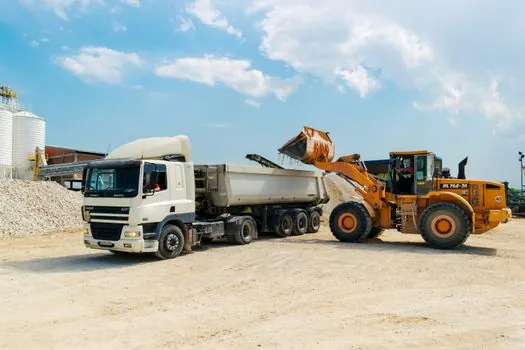
Standard rear-discharge highway mixer (6.9 to 9.2 m³, 72,000 to 74,000 lbs GVW): still the right answer for open-pit mine road building where haul distance is short, road is paved, and a ready-mix plant sits at the pit rim [S1].
On four decision criteria the comparison is sharp. Capacity: self-loader 1.5 to 4.0 m³, mini transit 2.0 to 6.0 m³, highway 6.9 to 9.2 m³. Off-road mobility: self-loader high (4WD), mini transit low, highway very low. Crew needed: self-loader 1 to 2 workers, mini transit 3 to 4 plus plant crew, highway 3 to 4 plus plant crew. Reliance on external batch plant: self-loader none, mini transit full, highway full [S2][S3][S5].
Drive and chassis requirements specific to mine haul roads
Self-loading mixers for mining projects use a four-wheel-drive system that climbs steep muddy ramps and holds continuous operation in heavy rain, a configuration standard highway rear-discharge chassis cannot replicate [S2].
Braking must hold a full load on a wet decline: wet disc brakes are the cited baseline because they retain stopping power on slippery slopes where dry drum-brake systems fade [S2].
For underground routes the cab needs a certified rollover protection structure plus bright LED work lights, since rock-fall and low-light conditions are the two dominant injury vectors cited for mine concrete delivery [S2].
Safety qualification: KA and mining-specific certification
Chinese-market mine-mixer suppliers explicitly offer a KA mining safety qualification option on applicable mining-safety chassis, which is the regulatory marker for equipment permitted inside state-administered mine workings [S4].
For non-Chinese mine jurisdictions, the equivalent requirement is for the chassis to carry mine-type approval from the local authority (e.g. MSHA in the U.S., MDG 41 in Australia, or the relevant Eurasian Customs Union mine-safety certificate), and the supplier should be asked to provide that paperwork before shipping rather than at commissioning [S4].
Buyers should also verify the mixer carries mine-duty options for dry-material mixing, a useful feature when the site has aggregate stockpiles but no water infrastructure [S4].
Operating cost signals from 2026 fleet data
Oil-price sensitivity in 2026 has lifted total operating cost for construction, utility, mining, and field-service fleets, which is pushing buyers toward smaller, lighter, single-operator machines that cut diesel and labour in parallel rather than chasing per-trip drum volume [S5].
The self-loader economics line up with that shift: cutting two workers from a small-project crew saves substantial monthly overhead, and self-loading on-board batching removes the ready-mix short-load and standing-time penalties that apply to small-volume mine orders [S5].
For mine concrete supply specifically, the truck-mounted concrete pump pairing is the next decision downstream: a 2 to 4 m³ self-loader feeding a small boom pump is the configuration appearing most often in 2026 remote-mine procurement guides [S2].
Who this spec is for, and who it is not for
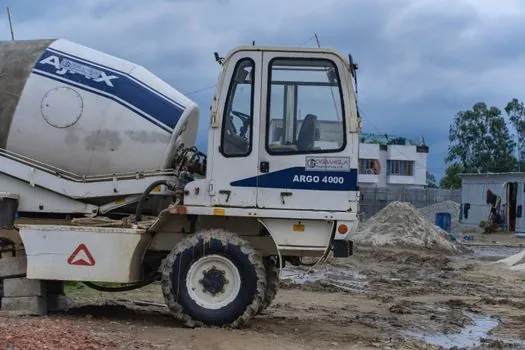
Self-loading 4WD mixers (1.5 to 4.0 m³) are for remote-mine, rural-road, and small-infrastructure buyers who lack a nearby batch plant and need one or two operators to run the pour [S2][S5].
Mini short-wheelbase transit mixers (2.0 to 6.0 m³) are for mine-access roads and urban-alley sites that already sit next to a batching plant and only need a tight, low-clearance hauler [S5].
Standard 6.9 to 9.2 m³ rear-discharge mixers are for open-pit or quarry work with paved internal roads and a pit-rim batch plant, and they are the wrong choice for any tunnel portal, steep decline, or unstabilized mine road [S1][S3].
For buyers cross-checking related heavy-equipment selection, the shield machine selection for urban infrastructure spec map covers the adjacent tunnelling-equipment decision tree, and the gear selection for material handling spec map applies to the aggregate-feed and weigh-batch subsystems that feed these mine mixers.
Trackable signals to watch over the next two quarters: suppliers extending the 2 to 8 m³ mine-mixer line into articulated 6×6 chassis for deeper declines, and KA-type approvals being bundled as standard rather than optional on export builds [S4]. A second signal is whether 2026 oil-price pressure pushes more open-pit buyers to downsize from 9.2 m³ highway drums to 6 m³ mine-rated chassis on short-haul pit-rim work [S5].