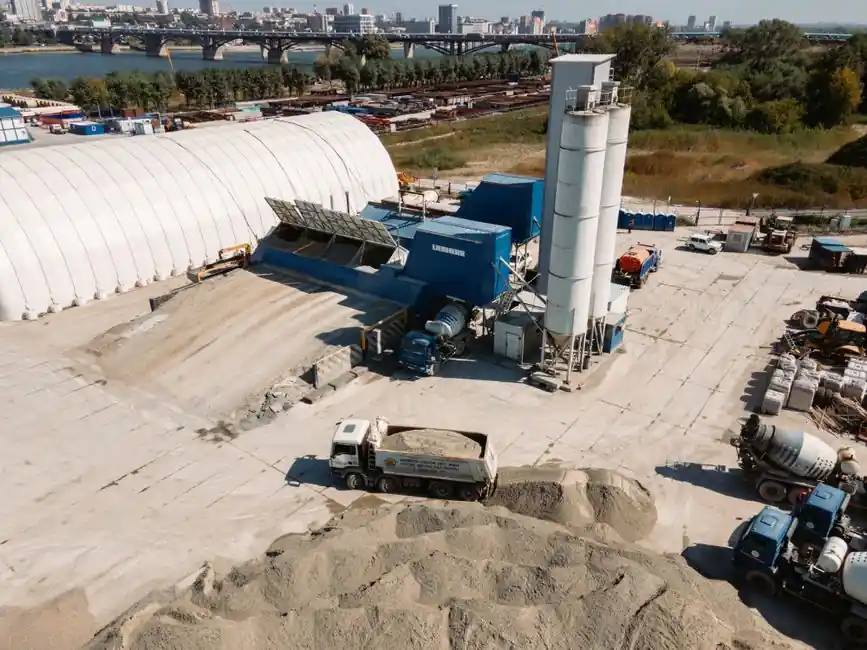
On a concrete pump truck boom, the hinge bend pipe is the highest-wear elbow in the delivery line because it changes flow direction while the boom itself rotates [S1][S2].
Coarse aggregate is centrifugally driven into the outer radius of the bend, so wall thinning concentrates in one zone rather than spreading evenly across the pipe ID [S2]. Long-distance and high-rise pumping multiplies that effect through higher pressure, longer cycle counts, and more aggressive mix designs [S2].
Hinge Bend Pipe Function and Wear Zone
Each major boom hinge carries a bend pipe that redirects concrete flow, seals a moving joint between two boom sections, and sits in the highest-velocity, highest-impact zone of the delivery line [S1]. Because flow accelerates around the curve, abrasive paste and aggregate continuously grind the outer wall until the section thins, leaks, or bursts [S1][S2]. Visual inspection of the outside surface is not enough; internal thinning at the outer radius can be well advanced before any external symptom appears [S2].
Standard elbows are treated as consumables, replaced on failure, but each unplanned change-out costs labor, crane time, and pour downtime, and a leak at height is a safety and quality hazard [S1]. A Max-Life hinge bend pipe targets the three failure mechanisms at once: outer-curve abrasion, local erosion from poor internal geometry, and fatigue at flanges or clamp interfaces from repeated boom movement [S1].
Why Long-Distance Pumping Accelerates Wear
Greater delivery distance, higher lift elevation, sustained boom motion, and continuous cycle time all raise the operating burden on the delivery pipeline [S2]. Under those conditions, a conventional single-material elbow typically thins at the outer curve well before scheduled service intervals [S2]. Crushed stone, coarse aggregate gradation, high sand content, and lower slump mixes further accelerate inner-wall abrasion, so the same elbow that lasts one season on a short boom can fail in weeks on a long-distance pour [S2].
For OEM pump truck builders and fleet owners, the practical effect is that elbow replacement frequency is governed less by hours and more by aggregate, pressure, and geometry, which is why hinge-bend spec'ing is treated as a wear-engineering decision, not a commodity pipe choice [S2].
Dual-Layer and Composite Construction
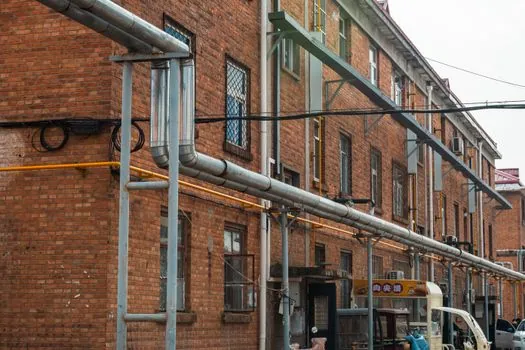
Max-Life hinge bend pipes use a dual-layer build: a hardened, wear-resistant inner wall focused on the outer-radius high-velocity zone, bonded to a ductile steel outer shell that absorbs bending, vibration, and clamp loads without becoming brittle [S1]. Flange and clamp ends are reinforced so repeated tightening and pressure pulses do not ovalize the seat or crack the weld [S1].
Material selection on a concrete pump truck hinge elbow typically pairs a high-chrome or high-hardness wear alloy inner sleeve with a Q345 / equivalent low-alloy structural outer shell, balancing inner hardness against outer toughness [S1][S4]. The inner layer is concentrated where abrasive action is most intense, while the outer layer shields the wear surface and carries the mechanical load back into the boom structure [S1].
Internal Geometry: Bend Radius and ID Consistency
Bend radius is a controlled variable, not a fixed dimension: too tight raises local velocity and pressure loss, too wide may not fit the boom layout, so Max-Life elbows use a radius tuned to both flow and packaging [S1]. Consistent inner diameter through the bend avoids step changes that create local acceleration, turbulence, and impact zones, which are the precursor to pitting and through-wall erosion [S1][S2].
The practical spec checklist for a truck-mounted concrete pump hinge elbow therefore includes nominal DN (commonly DN125 on 5-inch boom systems), bend angle (commonly 90 degrees at major hinges, 45 degrees at secondary folds), wall thickness on the outer radius, and inner-sleeve hardness in HRC, not just generic "wear-resistant steel" [S1][S4].
Standard Elbow vs Dual-Layer Max-Life vs Welded Field Repair
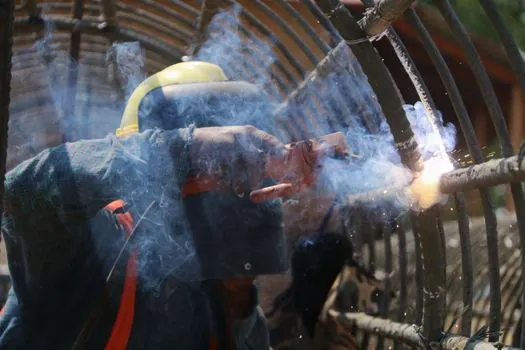
Three options dominate the replacement decision: standard single-material elbows, dual-layer Max-Life composite elbows, and field weld-in repair sections cut from straight pipe [S1][S3].
On replacement interval, a standard elbow is the shortest, a Max-Life dual-layer elbow is typically several times longer because wear is distributed across a hardened inner sleeve, and a field weld-in patch is only as good as the welder and the parent pipe, with visible "cheap repair" signs flagged by experienced pump inspectors [S3]. On pressure and impact rating, dual-layer construction handles both inner abrasion and outer structural load simultaneously, while a welded patch concentrates fatigue at the heat-affected zone [S1][S3]. On cost per cubic meter pumped, Max-Life elbows carry higher unit cost but lower cost-per-volume because the interval between boom-down replacements is longer [S1]. On safety and resale, high-quality factory-built elbows preserve boom integrity; SCHWING America inspectors Mike and Jerry Anderson specifically call out visible prior repairs as a marker that reduces both reliability and resale value [S3].
Replacement Procedure and Inspection Points
Field replacement of a worn hinge bend pipe follows a defined sequence: isolate and depressurize the boom, unclamp the hinge joint, drop the worn elbow out, compare it against a thickness template, and install the new elbow with new seals and freshly torqued clamp bolts [S1][S3]. Where the wear is local rather than full-circumference, the damaged section can be cut out and a new piece of pipe welded in, provided the welder is qualified on the specific parent material and the heat-affected zone is then re-inspected [S3].
On concrete mixer truck fleet operations, the same dual-layer wear logic is increasingly applied to drum-related wear parts, where drum RPM and mix design together drive service life, as covered in Concrete Mixer Truck Drum RPM: Mixing vs Agitation Specs. For pump-truck owners, the inspection cadence that catches hinge-bend wear before failure is a thickness check at the outer radius every 20,000 to 30,000 cubic meters pumped, adjusted upward for abrasive mix designs and long-distance pours [S1][S2].
Failure Modes, Limits, and Sourcing Signals
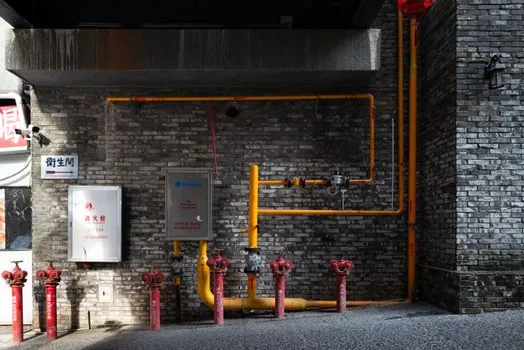
The three dominant failure modes on a hinge bend pipe are outer-curve thinning, local erosion at geometry transitions, and flange or clamp fatigue from boom motion, and each mode points to a different fix: harder inner sleeve, smoother internal radius, or reinforced end geometry [S1][S2]. A Max-Life elbow addresses all three in one part, which is why the construction is moving from optional upgrade to default OEM spec on long-reach booms [S1][S2].
Trackable signals to watch over the next quarter: OEM datasheets publishing inner-sleeve HRC values rather than generic "wear-resistant" claims, and wear-part suppliers such as Relcasting expanding dual-layer hinge-bend catalogs beyond DN125 to cover DN150 and DN180 long-reach boom geometries [S4]. On the fleet side, the next data point to capture is cost-per-cubic-meter pumped on dual-layer versus standard elbows, since that ratio, not list price, decides whether a Max-Life hinge bend pipe pays back on a given boom configuration [S1][S3].