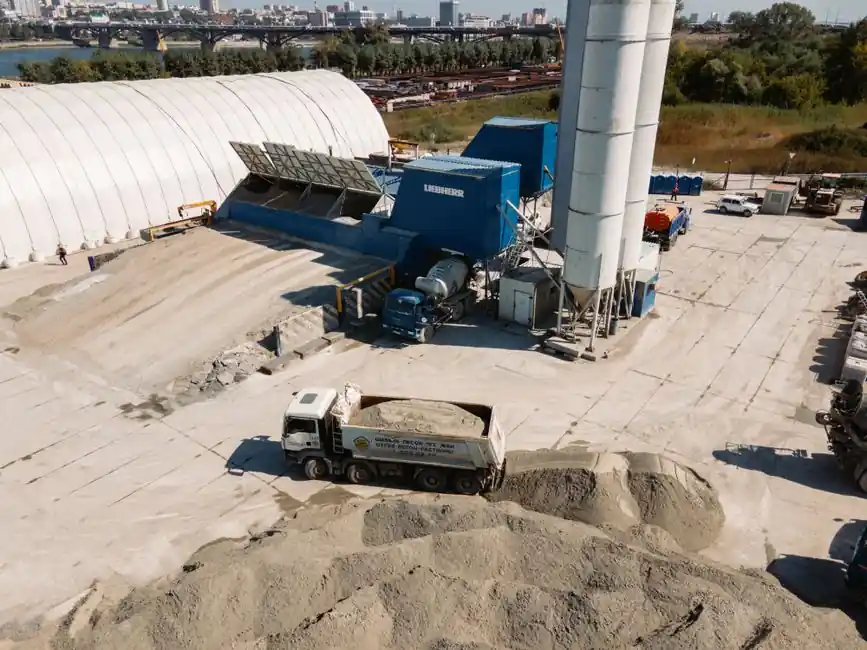
Forestry road concrete delivery in 2026 spec sheets centres on three hard numbers: drum volume 6 to 10 m³, GVWR between 30,000 and 66,000 lb (13.6 to 29.9 t), and at least one steerable tag or pusher axle to spread the load on soft logging spurs [S5].
Standard road-ready concrete mixer trucks sold through US dealer networks in August 2026 list rear-discharge drums from 8 to 12 m³, water tanks of 125 to 150 gal (473 to 568 L), and chassis ratings of 64,000 to 66,000 lb GVWR on tandem, tri-axle, or quad-axle air suspensions [S1][S5]. Forestry operation generally steps the volume down and the drivetrain up.
Drivetrain and axle layout for soft-haul-road forestry work
Forestry access roads are typically unsurfaced, with subgrade CBR often below 5% during spring thaw, so a tandem-rear-drive chassis is borderline and a 6x6 with a single or dual steerable tag is the practical floor for loaded 8-10 m³ drum operation [S5].
Production forestry haul tractors frequently use 6x6 with a pusher/tag lift axle: a 2017 Peterbilt 567 concrete mixer example is configured quad-axle with a steerable pusher plus a steerable tag, GVWR 66,000 lb (29.9 t), FAWR 20,000 lb, IAWR 22,000 lb, RAWR 22,000 lb, lift-axle GAWR 8,000 lb, on air ride with inter-axle differential lock and a chassis-mounted PTO driving the drum hydraulic pump [S5]. That layout keeps the loaded axle load under roughly 9,000 lb per tyre on 11R22.5 rears and roughly 8,500 lb per tyre on 215/75R17.5 lift-axle tyres, a useful benchmark for low-bearing-capacity spur roads.
Single-rear-drive and tag-axle combinations drop into urban ready-mix duty: a 2015 Freightliner 114SD with Detroit DD13 12.8 L, Allison 4500, tandem-axle, full diff lock, spring-over-walking-beam suspension, GVWR 66,000 lb, 20,000 lb front and 46,000 lb rear, 227 in (5,765 mm) wheelbase, and a Con-Tech 10.5 cu.yd (8.0 m³) rear-discharge drum with 125 gal water tank, suits flat-grade urban pours but is the wrong tool on a wet skid trail [S5].
Drum volume, engine power, and PTO sizing
For forestry 6-10 m³ rear-discharge drums, a chassis engine in the 350 to 450 hp (260 to 336 kW) class paired with a 10 to 13 L heavy-duty diesel and an Allison or automated manual transmission is the current production spec envelope [S5].
Forestry-applied mixer chassis in 2026 dealer data run Paccar PX-9 8.9 L six-cylinder diesels at 2017 vintage, Mack MP7-395C 10.8 L at 395 hp (295 kW) on a 2023 Mack Terrapro, and Detroit DD13 12.8 L on a 2015 Freightliner 114SD, all driving through automatic transmissions (Allison 4500 RDS or 21M16 family) to a chassis PTO and drum hydraulic pump [S5]. A rule of thumb that holds in the data: 1 m³ of drum capacity needs roughly 30 to 40 hp (22 to 30 kW) at the drum hydraulic motor when the chute is fully extended, so a 10 m³ forestry drum wants a 300 to 400 hp chassis with a 100 to 130 hp hydraulic pump at typical 2,000 to 2,400 rpm pump speed. Mixer drum rotation is normally held between 2 and 6 rpm in mixing mode and 6 to 15 rpm in agitation mode to keep washout below roughly 1% on a 90-minute haul.
Larger 10 to 12 m³ production drums such as the SANY 12 m³ unit with GPS-based vehicle monitoring and video telematics suit plantation-scale forestry base camps with hardstand access, not green-field cut-block spurs [S1].
Ground clearance, tyres, and approach/departure geometry
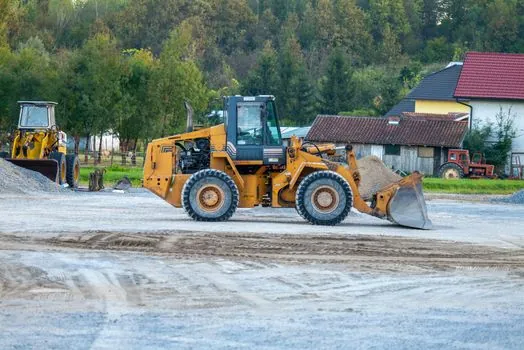
Forestry-spec mixers need at least 280 to 320 mm ground clearance under the rear axle, 14.00R20 or 16.00R20 off-road pattern tyres, and approach angles above 25 degrees to clear windrowed slash and culvert crossings. [S5]
Production 11R22.5 and 425/65R22.5 fitments on Peterbilt and Mack forestry chassis sit at roughly 260 mm ground clearance and roughly 22 degree approach, which is borderline on rutted spur roads after rain [S5]. For dedicated forestry builds, 16.00R20 single super-single off-road fitments, a transfer case with low-range under 2.5:1, and a rear-axle diff lock are the three changes that most often separate a forestry duty cycle from a paved-road duty cycle. Dump truck platforms share the same tyre and clearance logic and are a useful baseline when sizing chassis components.
Water, additive, and chute options for remote pours
Forestry pours are typically remote, so a self-fill water system, a 150 to 300 gal (568 to 1,135 L) onboard tank, and fold-down chute extensions are non-negotiable; smaller skid-steer-mounted mixers (5 ft³ struck, 10 gpm minimum hydraulic, 395 lb dry weight) cover last-50-metre work, not mainline delivery [S6].
Standard rear-discharge forestry drums in the data carry 125 to 150 gal water tanks with in-cab and rear-drum controls and three steel chute extensions folding to roughly 3 m horizontal reach, sufficient for culvert-side pours but not for bridge-approach pours where a 60 ft vertical reach conveyor (Putzmeister TB110 on a 2023 Mack Terrapro, 106 ft horizontal, 60 ft vertical, four outriggers) is the appropriate truck-mounted concrete pump match [S5]. Hydration control in cold weather requires either an insulated drum jacket or an engine-coolant heat-exchanger loop; production drums in the 2026 dealer channel list neither as standard, so it is a build-sheet option.
Chassis selection, sourcing, and 2026 dealer pricing band
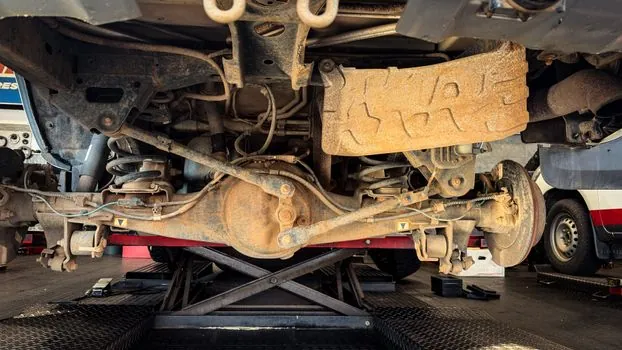
Used forestry-class mixer chassis on US dealer platforms in August 2026 list from roughly $989 for high-hour retirement units to $361,538 for low-hour 2023-vintage Mack and Peterbilt builds, with mid-tier 2015 to 2018 quad-axle units in the $75,000 to $150,000 band. [S3]
Auction and dealer inventory pages show ready-mix and pump-truck categories mixed with forestry and logging equipment, with current listings pulled from New York, Tennessee, Oklahoma, Missouri, and Pennsylvania [S2][S3][S5]. Buyers should weight three filters when selecting from this pool: GVWR above 60,000 lb with a steerable tag or pusher, drum capacity at or below 10 m³ to keep axle loads within forestry road limits, and engine displacement of 10 L or more paired with an automated manual or torque-converter automatic for sustained low-speed off-road work [S5].
Agriculture-spec mixers run on softer loading and tighter turning, and a side-by-side read against the agriculture spec map clarifies the differences in tyre choice and drum RPM band. Forestry mixing also overlaps with landfill-drum failure modes on the abrasion side, which the MSW duty note documents for transfer-tunnel and ash-road service.