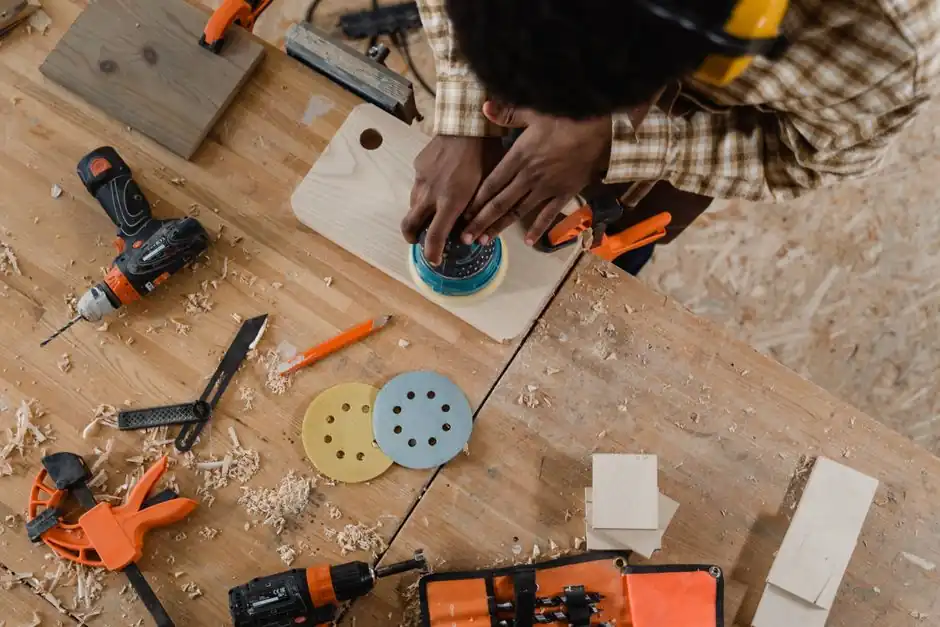
Concrete sanding is not one tool, it is a chain of machine class plus abrasive specification plus dust extraction, and the right combination depends on area, hardness, and required finish [S1].
The decision applies to three audiences: flooring contractors polishing 50 to 5,000 sq ft slabs, general contractors smoothing form-line offsets on walls and stairs, and specifiers writing Division 03 finishing language who need to fix tool, grit, and PPE in the submittal package [S2][S3].
Machine classes by area and tolerance band
For detail work on edges, form offsets, and small patches below roughly 50 sq ft, a 5- or 6-inch random-orbit sander running at 6,000 to 12,000 OPM is the baseline, because the random orbit motion prevents the directional swirls that a belt sander leaves on cementitious surfaces [S1].
For mid-range slabs of roughly 50 to 1,500 sq ft, a walk-behind planetary grinder with three or four rotating heads, 16 to 24 inches in diameter, delivers the cut rate needed to reach a 100 to 400 grit polish in two to four passes, and the counter-rotating heads cancel the torque that a single-disc machine transfers to the operator [S1].
For slabs above 1,500 sq ft, ride-on or remote-controlled planetary grinders with 24 to 32-inch head coverage are common, because pass overlap and consistent down-pressure become the limiting variables rather than abrasive life; under-speccing here is the most common cause of tiger-striping on polished concrete.
Abrasive bond, grit sequence, and concrete hardness
Hard concrete (above roughly 6,000 psi compressive, dense with granite or quartz aggregate) wants a soft-bond diamond matrix so the abrasive wears and exposes fresh diamonds; soft concrete (below 4,000 psi, limestone or porous aggregate) wants a hard bond to keep the diamonds from sinking into the paste and glazing over [S1].
A standard polish sequence runs 16 to 20 grit metal bond for stock removal, 30 to 40 grit for scratch elimination, then 80, 150, and 200 grit metal bond, transitioning to 100, 200, 400, 800, and 1,500 grit resin bond for the final clarity, with a densifier applied between 200 and 400 grit to harden the surface before the resin steps [S1].
Skipping grits, for example jumping 16 to 80, leaves deep scratches that the next step cannot remove in a single pass, doubling labour and diamond consumption; experienced polishers treat the 30 to 80 grit range as the cost-driving step on a real job.
Dust extraction and PPE thresholds
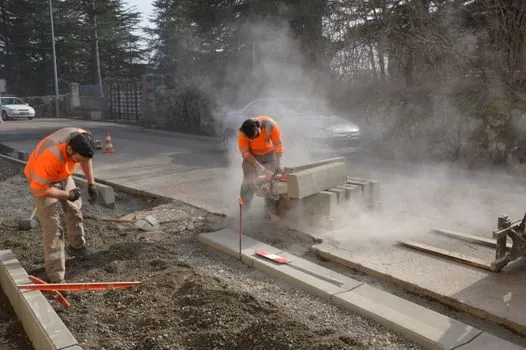
Concrete dust contains respirable crystalline silica, and the regulatory threshold for an 8-hour time-weighted exposure is 0.025 mg/m³ as the action level under OSHA 1926.1153, which a dry sander without integrated extraction will exceed within minutes on a typical slab. [S2]
Tool-integrated dust shrouds connected to a HEPA-rated vacuum with at least 250 CFM airflow are the standard fix for 5- to 7-inch hand sanders; for walk-behind grinders, a 3-phase dust collector rated 600 to 1,200 CFM with auto pulse-clean is the spec floor on occupied or indoor sites [S1].
PPE on every dry concrete sanding task: P100 or HEPA half-mask respirator (or PAPR for full-shift work), sealed safety goggles rather than open glasses, hearing protection above roughly 85 dBA, and a Tyvek-style coverall because clothing contamination becomes a secondary silica source during cleanup.
Where standard specs set the finishing language
Division 03 specifications, including SRP 03300 (Cast-in-Place Concrete, revised 04/26) and Olivenhain MWD 03000 (General Concrete Construction), anchor the surface finish in formwork class and ACI 301 rather than in sander selection, which is why the sander spec is usually a delegated-design submittal under Section 033000 [S2][S3].
For a sander submittal that survives review, list machine class and head diameter, abrasive bond hardness with rationale tied to the mix design, full grit sequence, integrated dust extraction airflow, and a sample panel of at least 100 sq ft cured for 28 days [S2].
Form-side tolerances from ACI 347 drive the first-cut aggressiveness: Class I forms (steel, ply form, or 3/4-inch plywood) typically need only light 16 to 30 grit honing, while Class II forms (tongue-and-groove boards) leave ridges that justify a 16-grit metal-bond first pass and may add a full day to the schedule [S3].
Comparison: orbital vs walk-behind vs ride-on

On a criteria-based comparison, a 5-inch random-orbit sander wins on cost (USD 100 to 400 tool) and edge access but loses on area rate (roughly 20 to 40 sq ft per pass); a 20-inch walk-behind planetary grinder covers 200 to 400 sq ft per pass at a tool cost of USD 4,000 to 12,000, and a 30-inch ride-on unit covers 600+ sq ft per pass but needs a 480V three-phase supply and a 1,000 CFM dust collector [S1].
For finish quality, hand sanders cannot match the flatness of a planetary head on a flat slab; on stairs, curbs, and wall-to-floor transitions, the hand sander is the only viable option and the spec should accept a lower finish class in those zones rather than pushing the walk-behind where it cannot reach.
When sanding is the wrong answer
Sanding is not a substitute for proper concrete placement and curing; a surface that was troweled too early or walked on before initial set has laitance and weakness in the top 1/16 to 1/8 inch, and grinding exposes a porous, weak layer that will dust and spall regardless of densifier or sealer [S1].
Post-finish service interval and what to track
A correctly densified, sealed, and burnished concrete floor carries a 2 to 3 year re-seal interval under typical commercial foot traffic, and harsh chloride-based deicers must be excluded from the maintenance spec because they attack the polished surface and re-open the capillary structure the densifier closed [S1].
Two trackable signals for spec compliance on a delivered floor: gloss meter reading at 60° (target 50 to 80 GU for a standard polished floor, 80+ for high-hone) and a single-pass Mohs hardness rating of 6 to 7 after densification, both measurable on the 100 sq ft mockup before full release [S2].
For a concrete vibrator or concrete admixture decision feeding into the finishing spec, tighter placement control upstream usually reduces the grinding passes required downstream, which is the most reliable way to keep the sander spec honest.
See also our earlier report, Power Mixer Selection for Tunnel Construction: Spec Map.