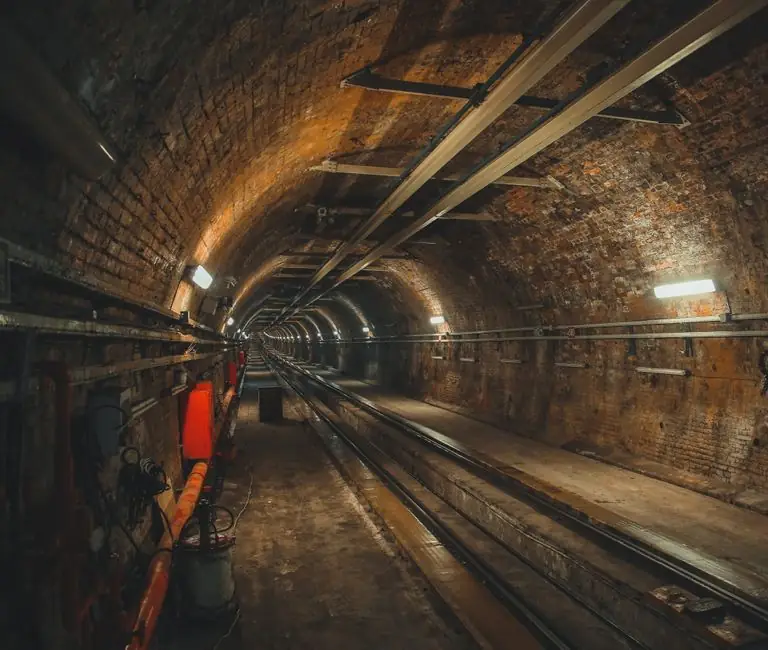
Tunnel-boring and NATM drives mix shotcrete, backfill grout, and segmental lining concrete on-site, and the wrong mixer package is one of the fastest ways to lose a heading cycle. A twin-shaft compulsory mixer delivering 30-60 m3/h is the typical backbone of a segmental lining pour station, while a colloid or high-shear mixer handles cement-bentonite grout for the annular void and tail-skin backfill [S3].
Drives specified under the British Tunnelling Society (BTS) framework must treat the TBM power supply as an essential service per clause 4.5.6 of BS EN 16191, meaning the mixer's motor feed, silo vibrators, and PLC panels sit on a backed-up circuit with documented ride-through [S1]. Underground envelopes add two non-negotiable constraints: a low silhouette so the unit clears the segment erector's swept path, and dust capture sized to respirable crystalline silica PELs enforced under OSHA 29 CFR 1926.1153 [S2].
Mixer Types Matched to Tunnel Duties
Compulsory twin-shaft horizontal mixers are the workhorse for wet-mix shotcrete and segmental concrete, with batch sizes typically 1.0-4.5 m3 and cycle times under 90 s when fed by a weigh-belt aggregate system. Drum mixers, which rely on gravity-driven folding of the charge, suit small-section cross-passages and drainage adits where output demand drops below 10 m3/h, but their slower homogenisation is a poor fit for low w/c shotcrete where unmixed pockets directly translate to rebound [S3].
For backfill grout (cement, bentonite, sand, water, and often fly-ash or slag) and for the cement-bentonite slurry that stabilises the TBM tail skin, a colloid or paddle mixer running at 600-1,200 rpm with a rotor-stator gap under 5 mm is the typical industry choice; a conventional gravity mixer cannot break down bentonite gels to the spec'd Marsh funnel viscosity. A continuous auger mixer like the SPEC MIX PA4000 footprint class (1.9 m x 2.4 m, empty weight 907 kg) handles preblended cementitious products on the back-of-deck or in the invert where batch plant concrete is uneconomic, fed by silo rather than by weigh hopper [S2].
Footprint, Power, and Headroom Constraints
Underground cross-sections rarely give a mixer the floor area it wants, so envelope is the first gate. The PA4000 occupies 1.9 m x 2.4 m at 907 kg empty and scales to 6,350 kg when charged, a useful reference point when a contractor is checking whether a low-profile batch plant can be slung through a 4 m diameter segmental erector reach [S2]. Larger twin-shaft rigs in the 2-3 m3 output class need a 3.5-4.5 m headroom envelope, a footprint that pushes designers toward paddle or planetary units in tight TBM back-up decks [S3].
Power source drives the next decision. The PA4000 ships as either a 13 hp gas unit or a 7 hp electric motor on 220 V single-phase at 30 A, which is workable for a small crew station but wholly inadequate as the primary concrete source for a heading. Twin-shaft shotcrete plants in real tunnel drives are almost always 400-690 V three-phase electric, fed off the TBM's essential-service bus per BS EN 16191 clause 4.5.6, with a diesel standby generator carrying the headline loads if grid power is lost [S1][S2].
Output, Cycle Time, and Heading Integration
A 10 m diameter EPB or slurry TBM advancing 8-12 m/day will consume roughly 150-250 m3 of segmental concrete and 20-40 m3 of annulus grout per ring set, depending on ring length and overcut. A single 2 m3 twin-shaft batch mixer at a 60-75 s cycle can sustain 90-110 m3/h in steady state, which is more than enough for the segment supply but creates a bottleneck if the same unit is asked to also feed the grout line. The standard mitigation is a dedicated colloid mixer on the grout circuit, sized for 15-30 m3/h, sharing only the silo and water ring with the concrete mixer [S3].
Continuous mixers change that arithmetic. A D2W-class continuous auger unit runs as a constant-throughput device rather than a batcher, so its m3/h maps directly onto grout or preblended mortar demand without batching latency. The trade-off is homogeneity at low flow: a continuous mixer running below 30% of its rated throughput suffers residence-time variation and grout viscosity drift, which is why most tunnel specifications cap the minimum turn-down to roughly 1:3 of nameplate [S2].
Dust, Silica, and the OSHA PEL Gate
Respirable crystalline silica is the binding health constraint on every dry-material handling step around the mixer. OSHA's construction standard for crystalline silica (29 CFR 1926.1153) sets a PEL of 50 micrograms per cubic meter as an 8-hour TWA, with an action level at 25 micrograms per cubic meter, and over 840,000 US construction workers are estimated to be exposed above that PEL across more than 600,000 workplaces [S2]. For tunnel crews that figure is amplified: the heading is a confined space, the ventilation circuit is the only dilution path, and aggregate tipping at the mixer is one of the highest-emission steps in the whole drive.
Mixer specification should therefore call for an integrated shroud or enclosure on the auger intake, a dust collector at the bag-break station, and a positive-pressure operator cab with HEPA intake, the same package that suppliers like SPEC MIX list as standard accessories on the PA-series power auger range. A power mixer selected without a matched dust envelope will, on most jurisdictions, fail the silica gate before the first bucket is tipped [S2].
Selection Criteria Comparison: Three Mixer Classes for Tunnel Use
Side-by-side, the three classes behave very differently on the criteria that drive a heading. A twin-shaft compulsory mixer scores on output (often 60-120 m3/h), homogeneity at low w/c, and lining-concrete durability, but loses on footprint, capital cost, and the need for a weigh-belt aggregate feed. A colloid or high-shear paddle mixer wins on grout viscosity control and bentonite activation, and is compact, but its shear-rated seals and rotor-stator wear parts are a maintenance line item every 400-800 operating hours. A continuous auger or preblended mortar mixer wins on mobility, low headroom, and dust-friendly sealed-bag feed, but its output ceiling and minimum turn-down ratio make it a poor primary concrete source [S2][S3].
For most tunnel drives the realistic package is a twin-shaft compulsory mixer as the segmental-lining concrete source, a separate colloid mixer dedicated to annulus grout and contact grout, and a small continuous auger unit at the invert for patch mortar and preblended dry-sprayed concrete (DSC) top-ups. That three-tier stack keeps each unit inside its duty envelope and lets the heading run without a mixer being asked to do a job it was never designed for [S3].
Standards, Compliance, and Site Integration
BS EN 16191 clause 4.5.6 is the binding clause for TBM essential-service power and applies upstream of the mixer's motor contactor; the mixer spec must therefore list its inrush, running, and locked-rotor currents so the switchgear engineer can size the essential-service bus correctly. The BTS Specification for Tunnelling (fourth edition) further requires the guidance system, which on a modern TBM is co-located with the mixer station PLC, to be error-tolerant, to log and display alarms, and to retain data through power loss including remote backup, a set of requirements that drives the choice of PLC and UPS over the mixer's own controls [S1].
For the materials side, the same BTS specification treats mix-water, aggregate, and cement handling as a controlled process, so any mixer package needs a documented mix-design verification trail, not just a nameplate output. On a tunnel drive the concrete mixer truck and remixer that runs between the heading's batch plant and the segment feeder is a second selection problem in its own right, and the truck's drum speed and agitating tolerance must match the mixer's discharge slump window, not the headline output figure [S3].
For a deeper read on how power-mixer spec maps onto masonry rather than tunnel pours, this power-mixer spec map for masonry walks the same auger-vs-paddle-vs-continuous decision tree. A separate cut at the dust side, written for chemical plants but applicable to tunnel heading air quality, is in this dust detector spec map. Where the heading needs primary muck handling to feed the batch plant, a sand mixer selection on the aggregate reclaim side is the upstream gate that determines whether the compulsory mixer's weigh belt sees consistent grading.