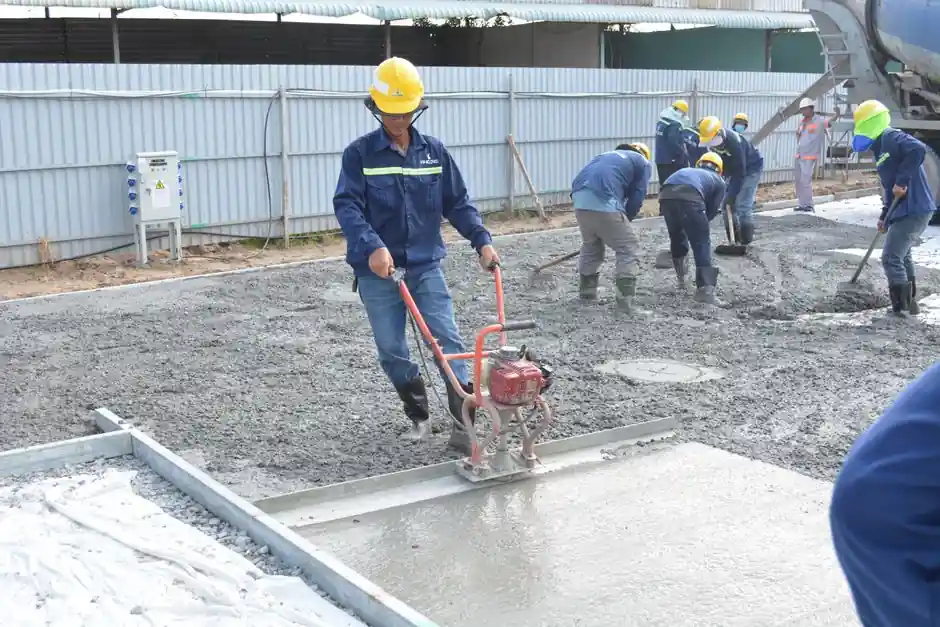
For road maintenance work, the default pick is an internal (immersion) concrete vibrator with a head diameter of 1.5–2.5 in, an output of 8,000–14,000 VPM, and a shaft length matched to the slab or patch depth, because full-depth patches and thin-bonded overlays are the two pour geometries crews hit most often [S2][S4].
Properly vibrated concrete drops entrapped air from 5–20% of fresh volume to under 2%, which is associated with a 5–15% gain in compressive strength and a measurable improvement in rebar bond [S2]. For a county or DOT patch crew that means fewer bug holes (1/8–1 in surface voids), fewer cold joints between batches, and lower lifecycle repair cost on the same panel.
Why internal vibrators dominate road-pour consolidation
Internal vibrators insert directly into the fresh mix and are credited with the majority of on-site consolidation work, with effective compaction radius of 3–10 in depending on head size and 8,000–14,000 VPM output typical across the class [S2][S4]. For a 6 in thick full-depth patch, a 1 in head covers up to 6 in of depth; a 2 in head covers up to 18 in, which is the relevant range for most pavement-base and kerb pours [S2].
The mechanism is mechanical, not magical: an eccentric mass in the head rotates at high frequency, the cement paste temporarily liquefies, and air bubbles rise and escape while aggregate settles [S4]. Operators are trained to watch for a steady surface sheen, cessation of rising bubbles, and a tonal change as the poker is withdrawn; those three signals are the practical acceptance criteria for "this lift is consolidated" [S4]. Road crews using an internal concrete vibrator routinely hit 200–400 yd³ per shift on continuous pours when shaft and head sizing are matched to depth.
Head diameter, shaft length, VPM: the three numbers that decide the job
Selection is driven by four job parameters: component thickness, reinforcement ratio (rebar mat density), concrete consistency (slump), and required surface quality, with frequency and amplitude chosen together to avoid segregation [S4]. For road maintenance, the dominant geometry is a 6–12 in slab on a prepared base, often with light rebar or dowel baskets, which sets the following decision table:
Pour depth under 6 in, no rebar: 1 in head, 3–7 ft shaft, 8,000–12,000 VPM. Pour depth 6–12 in, light mesh or dowels: 1.5 in head, 7–14 ft shaft, 10,000–14,000 VPM. Full-depth patch 12–18 in, rebar mat: 2–2.5 in head, 14–21 ft shaft, 10,000–14,000 VPM [S2][S5]. A 2 in head on a 14 ft shaft, like the configuration on the Milwaukee MX FUEL Concrete Vibrator, is rated to consolidate up to 45 yd³ on a single battery charge with a cordless platform that removes trip hazards from the pour zone [S5].
Shaft length on cordless platforms is now specified up to 21 ft to reach the center of wide patches and small bridge decks without walking the head through the mix, which is a meaningful safety and quality gain for overnight lane-closure work [S5]. Compatibility with third-party heads, e.g. Oztec accessories on the MX FUEL back, lets a crew reuse their existing poker inventory instead of buying a new shaft for every brand [S5].
External and surface vibrators: when they fit a road job, and when they don't

External (form) vibrators clamp to the outside of formwork and deliver 500–10,000 lb of centrifugal force, so they suit tall wall forms, columns, and precast moulds where internal access is blocked by congested rebar or thin cross-sections [S2]. For most road maintenance, an external vibrator is the wrong tool: there is no closed form to clamp to, and the energy is wasted into the sub-base rather than the fresh concrete.
Surface vibrators (vibrating screeds and pan vibrators) ride on top of the slab and are the right answer for floors, pavements, sidewalks, and thin floor slabs, where they level and compact shallow concrete in a single pass [S1]. For a 4–6 in bonded overlay or a thin patch, a vibrating screed is often the primary tool, and a follow-up pass with a small internal poker is the standard practice to consolidate around dowel bars and patch edges.
Vibrating tables are a precast-shop tool and do not apply to in-situ road work, but they are worth listing for completeness because some maintenance yards run small precast programs (manhole risers, kerb sections) alongside the paving crew [S1]. The point of this road-roller-adjacent decision is that vibrator type, like roller type, is set by geometry, not by brand preference.
Power source: electric, pneumatic, hydraulic, or cordless
Four drive options are in production: electric (including high-frequency with integrated frequency conversion), pneumatic, hydraulic, and battery/cordless [S4]. Electric high-frequency internal vibrators are the workhorse for cast-in-place work, but they require stable supply and residual current protection to keep frequency and amplitude from drifting under load [S4].
Pneumatic internal vibrators are specified in damp or hazardous environments and need a compressor sized to the air consumption and hose cross-section; start-up behaviour is highly sensitive to air quality [S4]. Hydraulic internal vibrators deliver the highest power density and suit continuous compaction on large pours where a hydraulic power pack is already on site. Battery platforms like the MX FUEL Concrete Vibrator consolidate up to 45 yd³ per charge with a 2 in head and 14 ft shaft and use a built-in POWERSTATE brushless motor to drive a 2.5 in head at over 10,000 VPM, with REDLINK PLUS overload protection on the tool electronics [S5].
For night-shift lane closures on a state route, a cordless platform removes generator noise, extension-cord trip hazards, and exhaust from the pour zone, which is the actual productivity gain the OEM is selling, not raw VPM [S5]. For a remote maintenance yard with no reliable grid, a pneumatic or hydraulic drive is the more honest choice.
Selection criteria for road crews: slump, rebar density, and hourly output
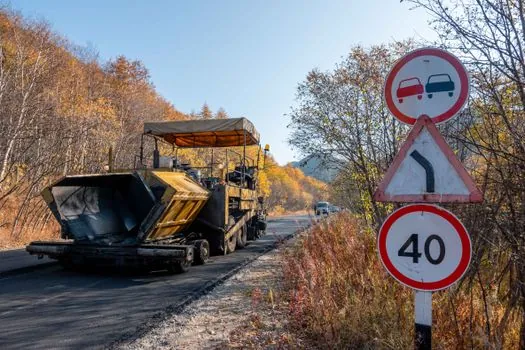
For a 200 yd³ overnight patch on an interstate, evaluate slump, rebar density, formwork dimensions, and required hourly output before choosing the head and shaft [S3]. A low-slump mix (under 3 in) needs higher amplitude to flow, while a high-slump mix (over 6 in) consolidates easily but segregates if over-vibrated, so the matching of frequency, amplitude, and insertion time is the operator's core skill [S3][S4].
Reinforcement density changes the answer: a 2 in head will not fit between closely spaced #5 bars on 4 in centres, and forcing it lifts the mat and creates cover loss, which is exactly the failure mode that lets water and de-icing salts reach the rebar and start the corrosion cycle that spalls the panel from within [S3]. In that geometry, a 1–1.5 in head on a high-frequency electric drive is the correct pick, and the crew should plan for more insertion points, not a bigger head.
Hourly output sets the count of units: a single 2 in head on a 14 ft shaft is rated in the 25–35 yd³/hr range on continuous duty; a three-operator team with three vibrators covers the same 200 yd³ in roughly 2 hr of active placement, which lines up with a typical 4 hr lane-closure window including setup and cure [S2][S5]. Crews buying more concrete tool capacity than they can staff waste money on idle motors; crews under-buying force over-vibration at each insertion point, which drives segregation at the surface.
Failure modes: what goes wrong when selection is wrong
Under-vibration shows up as honeycombing (exposed aggregate where mortar failed to fill), bug holes (1/8–1 in surface voids), and cold joints (weak horizontal planes where successive lifts failed to bond), with patch costs of $15–50+ per square foot on the finished face [S2]. On a road panel, each of those defects is also a water entry point, and water entry is the start of the freeze-thaw and rebar-corrosion cycle that takes the panel out of service 5–10 years early.
Over-vibration shows up as segregation, where the coarse aggregate settles and a laitance-rich layer rises to the finished surface, weakening the wearing course and increasing permeability [S3]. The fix is not more power; the fix is a smaller head, lower amplitude, or shorter insertion time at each point, with rebar spacing as the binding constraint [S3][S4].
Wrong tool for geometry is the third failure mode: using an external vibrator on an open slab wastes energy into the sub-base; using a surface screed on a 12 in full-depth patch leaves the bottom of the lift unconsolidated, which fails under the first heavy load. When in doubt, an internal poker is the safer default for road maintenance, sized to depth and rebar spacing, and the same rule applies to small precast elements poured in the maintenance yard [S4].
Maintenance and acceptance criteria that keep a road job on spec
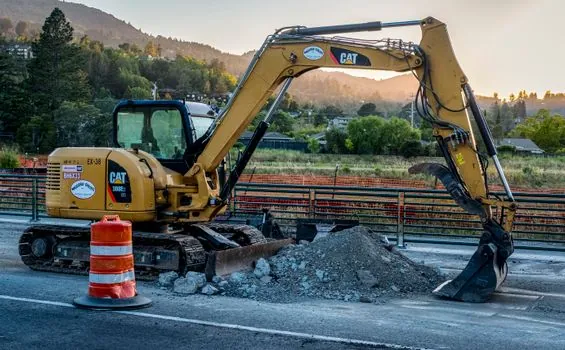
Before each shift, check the head for wear, verify couplings are secure, and inspect the hose for kinks or leaks; during the pour, monitor temperature, vibration behaviour, and abnormal noise; after the pour, clean the head and hose, inspect bearings and seals, and log hours for preventive replacement [S4]. A worn head runs at lower amplitude without warning, which is the most common cause of under-consolidated patches on a job that "looked right" at the surface.
Acceptance on the pour is operator-driven: steady surface sheen, no rising bubbles, and a tonal change on withdrawal are the three signals that the lift is consolidated, and crews should treat those signals as the field equivalent of an ACI 309 checklist, not as folklore [S2][S4]. When those signals are absent after 10–15 seconds at a point, the answer is a second insertion nearby, not a longer hold at the same spot, which would risk segregation [S3][S4].
The next signal to track is the cordless-versus-corded split on night-shift contracts: as more DOTs write cordless-equipment language into lane-closure specifications to reduce trip and exhaust hazards in the work zone, expect 2 in head, 14 ft shaft, 45 yd³-per-charge-class cordless platforms to become the default rather than the premium option for road maintenance vibrator fleets [S5]. For a related cross-industry read on spec-driven equipment selection, the AS/RS selection guide for pharma distribution shows the same head-versus-throughput decision pattern in a different industry, and a bearing manufacturing equipment selection guide walks through matching drive type to duty cycle in the same spec-first style.