
An internal poker vibrator running 8,000 to 14,000 VPM with a 1 to 2.5 inch head consolidates 5-20% entrapped air in fresh concrete down to 1-2%, the volume band where cement-concrete reaches its full design compressive strength [S2]. Head diameter, shaft length, and VPM are the three numbers that drive every selection decision on a real pour site.
Four machine families cover the field: internal (immersion/poker), external (form-mounted), surface (vibrating screed), and vibrating table [S2]. Internal units handle the majority of slab, column, wall, and foundation work; external and screed units take over where geometry, reinforcement congestion, or finish requirements block internal access. For a background on the material these machines are meant to compact, see the cement-concrete reference page.
Internal (poker) vibrator: the workhorse
An internal concrete vibrator, also called a poker or needle, is a vibrating head on a flexible shaft driven by a separate power unit, inserted vertically into fresh concrete to consolidate the mix from the inside [S3]. The two physical parameters that decide whether a pour consolidates properly are amplitude, the throw distance of the head from its rest position, and frequency, the cycles per minute (VPM); amplitude moves larger aggregate, while frequency liquefies the sand-cement mortar so air can migrate upward [S3].
Standard models span 1-2.5 HP electric or 1.5-6 HP gas power units, with head diameters from 1 to 2.5 inches and shaft lengths from 3 to 21 feet [S2]. A practical rule is that the 1 inch head suits pours up to 6 inches deep, while the 2 inch head suits pours up to 18 inches deep [S2]. Effective radius of action tracks head size, ranging 3-10 inches, which sets the spacing between insertions; the standard pattern is to space insertions at roughly 1.5 times the radius of action so the vibration zones overlap.
When to switch off the poker and pick another type
External (form) vibrators clamp or bolt to the outside of formwork and push 500 to 10,000 lb of centrifugal force through the form wall, making them the correct choice for thin walls, precast molds, tall column forms, and architectural concrete where congested rebar blocks internal access [S2]. Surface vibrators, including vibrating screeds and pan units, are applied to the top of the pour and are the right pick for floors, pavements, sidewalks, and thin slabs where the depth is too shallow for a poker to operate without surfacing [S2]. Vibrating tables cover the precast and lab-sample end of the market, where the entire form sits on a vibrating platform.
For pours that exceed the practical reach of a poker or where depth changes sharply within one form, the concrete-vibrator page lists the typical shaft-length and head-diameter combinations used in commercial work. Adding a chemical concrete-admixture such as a high-range water reducer tightens the mix and lets a slightly smaller head cover the same depth, useful on heavily reinforced pours where a 2.5 inch head will not fit between bars.
Power source: electric, gas, battery, or high-frequency
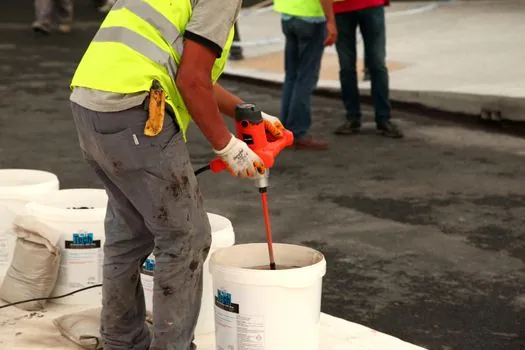
Mains-electric pokers (110-230 V) remain the cheapest and most common on indoor pours; a 110 V corded unit with a 35 mm vibrating poker and 1.5 m hose is a typical small-job package [S5]. Gas-driven units (typically Honda-style 1.5-6 HP engines) are field-portable and used where no power is available or where spark risk from electric motors is unacceptable. Pneumatic pokers run on compressed air and are standard in tunnel and precast plants with a built-air supply.
High-frequency internal vibrators (typically 12,000-17,000 VPM with built-in inverter electronics) are increasingly specified for heavily reinforced structures and highly fluid concrete, because the higher cycle speed liquefies the mortar faster and gives finer compaction around dense rebar cages [S6]. High-frequency units need either an integrated inverter in the drive motor or a separate frequency converter sized to the number of pokers it feeds; for the engineering rationale, the high-frequency explainer in the concrete-vibrator reference describes when a converter is mandatory versus optional. Battery-driven pokers now cover small-diameter (25-38 mm) work on sites where trailing cords or exhaust fumes are a problem, though continuous-pour runtime is still limited versus corded electric.
Head diameter and frequency: a side-by-side decision
Selection collapses to a small comparison once the pour geometry is fixed. The table below lines up the four operating criteria that matter on site, drawing the data from the public specs cited above [S2][S3][S6].
Internal 1 in. head, standard 8,000-10,000 VPM: pour depth up to 6 in., radius of action 3-4 in., best fit for thin slabs, footings, and small-diameter columns; weakest on deep walls where reach and amplitude are limited [S2]. Internal 1.5-2 in. head, standard 10,000-12,000 VPM: pour depth up to 12-18 in., radius of action 5-7 in., the general-purpose band for most commercial slabs, walls, and beams [S2]. Internal 2-2.5 in. head, high-frequency 12,000-14,000 VPM and above: pour depth 18 in. and beyond, radius of action 8-10 in., preferred for heavily reinforced walls, mass pours, and high-slump fluid mixes where faster cycle speed finishes the job before the mix stiffens [S6]. External form vibrator, 500-10,000 lb centrifugal force: the correct pick when internal access is blocked by rebar congestion or when the member is too thin (under about 4 in.) to take a poker [S2].
Operating technique and the failure modes you actually see
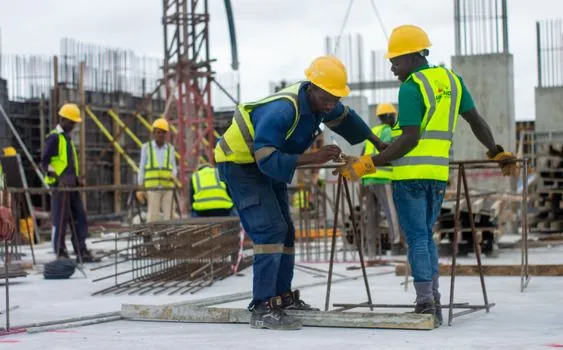
Insertion pattern is roughly 1.5 times the radius of action, pulled out slowly while the head is still running so the hole closes behind it; the poker should never rest on the rebar cage, and the tip should be reinserted 6-12 in. into the previously compacted lift to knit layers together [S3][S4]. Over-vibration separates the coarse aggregate from the mortar and brings paste to the surface, leaving a weak, sandy wearing layer; under-vibration leaves the 5-20% entrapped air in place, with visible honeycombing, bug holes 1/8 to 1 inch across, and cold joints between lifts [S2].
The visible cost of skipping vibration is concrete: bug-hole patching runs $15-50+ per square foot once the pour has cured, and the structural penalty is the 5-15% compressive-strength loss that unvibrated concrete carries versus properly vibrated concrete [S2]. For pour sites handling structural members, plain-round rebar ties and small-diameter stirrups, a 1.5 inch high-frequency head is usually the smallest unit that can pass through the cage and still deliver enough amplitude to consolidate the lift. On steel-mesh reinforced slabs for utility work, a 1 inch head at standard frequency is enough because the mesh lets the vibration travel laterally and the depth rarely exceeds 6 inches.
Buyer-side checks and sourcing signals
Three numbers on the data plate are non-negotiable when comparing quotes: head diameter in millimeters, rated VPM under load, and motor power in kW or HP at the rated voltage [S1][S2]. Shaft length and the head-to-shaft coupling should match the deepest lift on the project; ordering a 3 ft shaft for an 8 ft wall is a common, expensive mistake. Spare parts stocking, particularly replacement flexible shafts and eccentric bearings, is the differentiator between OEM and reseller supply; on jobs above about 200 m of wall, lead time on a replacement shaft is the constraint that decides the brand. For procurement teams running multi-site pours, matching all pokers to one frequency-converter model removes the spare-parts fragmentation that otherwise shows up after month six.
Two signals worth tracking into the second half of 2026: high-frequency internal units displacing standard-frequency units on civil-infrastructure tenders in Europe and East Asia, and the spread of battery-driven 25-38 mm pokers into residential foundation work where indoor exhaust rules out gas [S4][S6]. A steel strand reinforcement specification that increases rebar density will push the same pour toward a smaller, higher-frequency head; if a project has shifted to high-strength concrete with a lower slump, the same shift applies. For plant and yard equipment in adjacent workcells, a conveyor sorting line selection for retail distribution: spec-first 2026 guide covers the upstream pallet-handling side, while the aerial work platform reference covers the at-height access gear that crews use when consolidating elevated slabs.