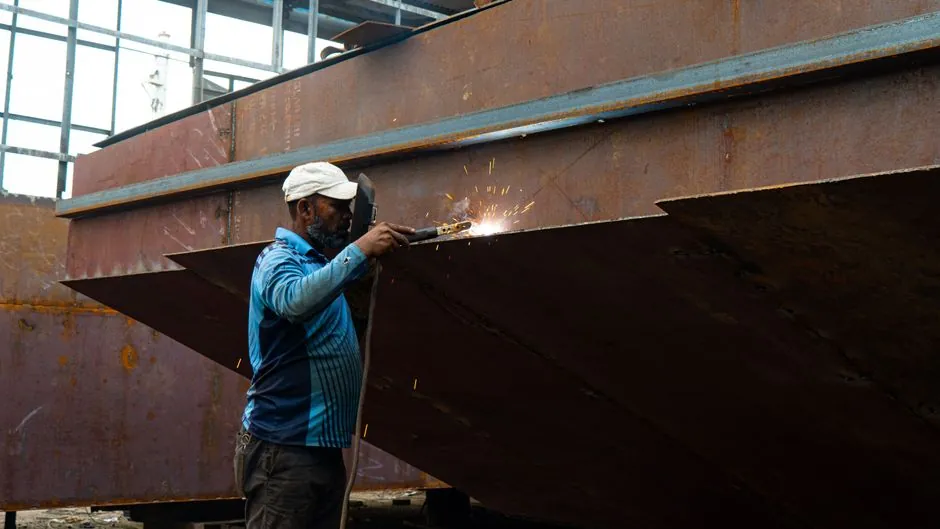
An electroslag pressure welder is a portable resistance-and-arc system that splices vertical reinforcing bars end to end in cast-in-place bridge piers, columns, and pile caps, and a related variant (ESW, or NGI-ESW) welds thick steel plate for built-up bridge girders and cross frames [S5][S1].
Both processes share a molten slag bath that heats the joint, but they differ in upset pressure and code path: rebar EPW is governed in China by JGJ 18-2012 and in the US by AWS D1.4/D1.4M, while plate ESW is governed in the US by AWS D1.5 (Bridge Welding Code) and constrained on fracture-critical members by the FHWA memorandum dated 2018-05-10 [S5][S1].
Two Distinct Processes Often Confused on Site
Electroslag pressure welding (EPW) for rebar and electroslag welding (ESW) for plate both run current through a conductive molten flux pool, but only the rebar process applies axial upset pressure to forge a bar-to-bar joint inside a flux-filled mold [S5][S9].
EPW works on vertical or inclined bars within roughly a 4:1 gradient and joins diameters typically from 16 mm up to 40 mm without a separate filler wire, producing a visible weld collar that is later ground flush before concrete placement [S9][S5]. ESW, in contrast, deposits consumable wire between water-cooled copper shoes to join plate thicknesses that historically reached 75 mm and beyond, with the modern narrow-gap variant (NGI-ESW) operating in an approximately 3/4 inch (about 19 mm) gap [S10][S8].
The heat input and resulting grain structure differ sharply: classic ESW used high heat input with oscillating wire and was linked to brittle fracture on a fracture-critical I-79 member near Pittsburgh, which is why FHWA rescinded its tolerance on main structural tension members in notice N 5040.23 dated 1977-02-16 [S1]. The NGI-ESW refinement lowered heat input, eliminated electrode oscillation, and added fixed guide and travel-speed control, restoring process acceptance for non-fracture-critical tension members in AASHTO temperature zones 1 and 2 [S1][S10].
Selection Criteria That Drive the Purchase Decision
For rebar EPW on bridge columns, four specifications must be locked before quoting: maximum bar diameter the welding head accepts (commonly 16, 20, 25, 32, 40 mm), welding current rating and duty cycle of the power source, the upset (forging) force the head can deliver, and the control sequencing of arc stage, electroslag stage, and upset stage [S5][S9].
A practical comparison of the main options a procurement engineer faces in 2026 looks like this [S5][S7][S9]:
Manual clamp, AC transformer welder, single bar range 16-32 mm: lowest cost, light head, suited to small pier columns, but operator skill drives weld-collar quality. Manual clamp, inverter DC welder, 16-40 mm range, programmable arc-to-upset timer: higher first cost, more repeatable collars, preferred on tall piers where the worker climbs with the head. Semi-automatic dual-operator rig, 25-50 mm range with hydraulic upset: best collar consistency on large-diameter bars, heavier, needs crane lifts. For plate splices in built-up girders, the option set is NGI-ESW (AWS D1.5 accepted for non-FCM), submerged arc welding (SAW) for horizontal plate, and shielded metal arc welding (SMAW) for short or field repair joints [S1][S10].
The weld-collar quality limits in JGJ 18-2012 set axial offset, bar diameter mismatch, and visible defect thresholds that the equipment must be able to hit under production rate, not just in the lab [S5].
Who Should Use EPW or ESW, and Who Should Not
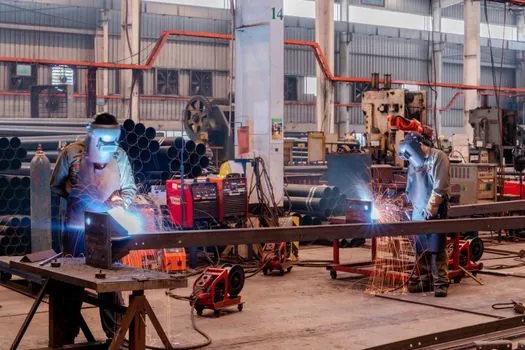
EPW is the right tool for vertical column rebar in cast-in-place concrete piers, abutment stems, and retaining walls where bars run true and the crew can stage a portable welding head at each splice [S5][S9].
It is the wrong tool on horizontal mat rebar, on bars that cannot be aligned coaxially, on stainless or epoxy-coated rebar where heat damages the coating, and on bar grades outside the qualified range of the operator and procedure [S5]. Plate ESW (NGI-ESW) is appropriate for thick built-up girder flanges and webs, stiffener splices, and heavy box-section fabrication in non-fracture-critical locations, but it is not appropriate on fracture-critical tension members, on dynamically loaded members where Charpy toughness at service temperature cannot be demonstrated, and on thin plate where the heat input distorts the section [S1][S10].
For thin plate, stainless, or in-situ field repairs on existing fracture-critical steel, TIG welder or stud welder alternatives are the correct equipment class, not a slag-bath process. For the deck-side rebar splicing that surrounds a finished column, the arc welder family still handles small bars and tack welding where EPW overhead is impractical.
Field Reality: Use Cases, Failure Modes, and Code Constraints
Bridge pier columns on Chinese high-speed rail and expressway projects were the original proving ground for the portable EPW head, and a domestic specialist such as Zhengzhou Dafang Bridge Machinery has built its product line around rebar splicing and bridge construction equipment, with documented use in highway, high-speed rail, and military projects [S4][S5].
The dominant failure modes a spec writer must price in are: off-axis bar alignment that produces an eccentric collar; insufficient upset force that traps slag inclusions; and arc-stage overstay that burns the bar end before the slag pool establishes, all of which JGJ 18-2012 and AWS D1.4 address through visual collar limits, bend tests, and tensile tests on sample splices [S5][S9]. On the plate side, the documented failure path is brittle fracture initiating at an ESW weld repair in a fracture-critical member, which is why FHWA Notice N 5040.23 banned ESW on main tension members in 1977 and why the 2018-05-10 memorandum (and its superseded 2000-03-20 memo) keeps the ban in force for FCM while allowing NGI-ESW elsewhere [S1].
For built-up girder splices, the workhorse overhead bridge crane on the deck below supports the welding head cable reel and the copper-shoe water lines, and the wider construction tools ecosystem on a bridge site (rebar cutters, benders, threading rigs for couplers) defines the throughput ceiling the welder has to match.
Standards, Sourcing, and Procurement Signals
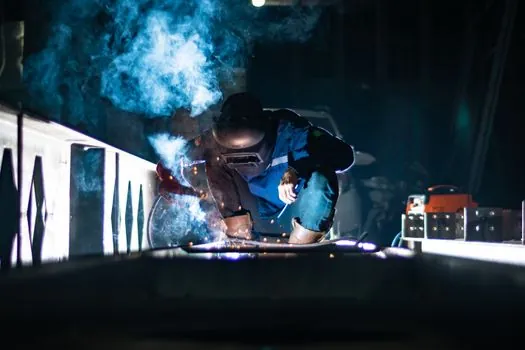
The mandatory code reference on a Chinese bridge site is JGJ 18-2012 (Specification for Welding and Acceptance of Reinforcing Steel Bars) and the test method standard JGJ/T 27; the US counterpart for rebar is AWS D1.4/D1.4M, and for plate is AWS D1.5 (Bridge Welding Code) as called out in the FHWA Bridge Welding Reference manual [S5][S2].
Six FHWA research reports (FHWA/RD-87/026, FHWA-RD-93-035, FHWA-RD-93-036, FHWA-SA-96-051, FHWA-SA-96-052, FHWA-SA-96-053) define the technical baseline for NGI-ESW, including the training manual and process operational guide that a qualified procedure must reference [S1]. Procurement language should require a current AASHTO/AWS D1.5 procedure qualification record for any plate work, and a JGJ 18-2012 or AWS D1.4 PQR for rebar work, with sample splice tests performed on the largest bar diameter the welder will see in production [S5][S1].
Trackable signals worth monitoring are FHWA memos rescinding or amending the 2018-05-10 NGI-ESW guidance, new AASHTO LRFD provisions on electroslag processes, and Chinese code revisions to JGJ 18-2012. A side reading on overhead bridge crane selection for urban infrastructure projects is useful for the deck-side lifting and head-support plan that has to be sized to the welder cable and water-cooling loads.