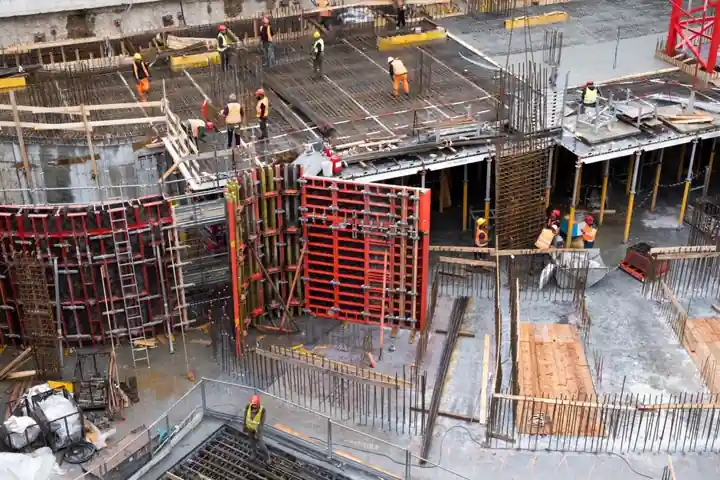
Internal (poker) vibrators are still mandatory for the vast majority of reinforced concrete placed in steel-construction projects, including footings, columns, walls, beams, and suspended slabs, with vibration required to evacuate entrapped air, encapsulate rebar, and prevent honeycombing [S3].
Selection hinges on five measurable inputs: concrete consistency (S2 to S5 slump class), rebar spacing and density, member thickness, hourly pour volume, and the power source available on site. The decision is not about brand, it is about matching head diameter, frequency, amplitude, and drive type to those five inputs [S5].
Why Vibration Still Wins Over "Self-Compacting" Hype on Steel Frames
Fresh concrete can contain up to 20% entrapped air by volume; without mechanical vibration, that air consolidates into voids around rebar and reduces both compressive strength and cover durability [S1]. Highly fluid S4 and S5 mixes marketed as "easy to place" still hold significant trapped air and will leave voids behind congested reinforcement unless vibrated, unless the mix is explicitly specified and documented as self-compacting concrete (SCC) [S3].
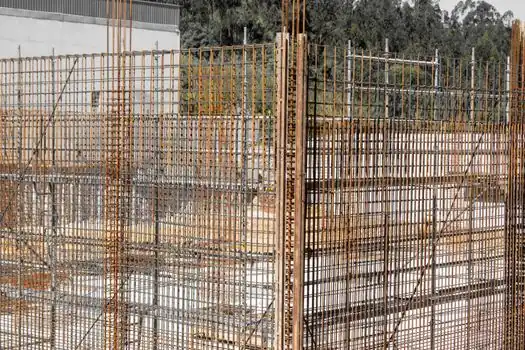
For steel-frame structures, every column-to-foundation node, every beam pocket, and every slab around metal deck profiles is a congested rebar zone. Building standards mandate minimum reinforcement spacing precisely so that a vibrator head can physically enter and consolidate the matrix, which is a quiet acknowledgement that vibration, not fluidity, is the assumed placement method [S3].
Selection Criteria: Head Diameter, Frequency, Amplitude, Drive
Head diameter is governed by rebar clear spacing: a 32 mm head is a practical baseline for typical beam and column cages, while 25 mm heads suit tightly spaced stirrups and 50 to 60 mm heads are reserved for mass pours with open reinforcement [S5]. Frequency and amplitude are not interchangeable: higher frequency (200 to 240 Hz, i.e. 12,000 to 14,400 vpm) propagates further in low-slump mixes and through congested rebar, while lower frequency with higher amplitude moves stiff mixes over shorter radii [S2][S3].
A concrete reference unit for steel-frame work is the Mikasa FXB-30K: 32 mm head diameter, 1,728 mm overall length, 11.2 kg mass, 200/240 Hz vibration frequency (12,000/14,400 vpm), 1.8 mm amplitude, 48 V three-phase supply at 4 A, with a special lightweight steel pipe and vibration-absorbing rubber at the coupling [S2]. A field rule of thumb is that the effective compaction radius is roughly 8 to 10 times the head diameter, so a 32 mm head influences roughly a 25 to 32 cm radius, and insertion points should be spaced to give overlapping coverage without leaving unvibrated "shadow" zones [S5].
Drive Type Comparison: Electric, Pneumatic, Hydraulic, Gas
Electric high-frequency internal vibrators with integrated or external frequency converters are the workhorse for cast-in-place work on steel frames, with stable frequency and amplitude as long as the supply and residual-current protection are correctly sized [S5]. A 48 V three-phase high-frequency unit at 4 A draws under 0.2 kW per head, which is why contractors run multiple units off a single portable converter on a slab pour [S2].
Pneumatic drives are preferred in damp, outdoor, or explosion-hazard environments because there is no electrical insulation to fail, but they need a compressor with enough volume and hose cross-section to keep the head at rated speed under load [S5]. Gas-powered drives, as stocked for general construction sales channels, remain an option for remote sites without grid power or air, but they add fume management and fuel logistics to the pour plan [S4]. Hydraulically driven heads offer the highest continuous power density and are a natural fit where hydraulic packs already exist on the steel-construction site, such as at rebar-cage prefabrication stations [S5].
For most steel-frame buildings and bridge substructures, electric high-frequency remains the default, with pneumatic or hydraulic reserved for site-specific constraints. Gas-driven units are a fallback, not a first choice, on indoor or enclosed pours. Selection, in practice, follows the site power map, not the head specification alone.
Steel-Pipe vs Rubber-Hose Heads: Why the Trend Has Shifted
Steel-pipe high-frequency vibrators, such as the FXB-30K type, use a special lightweight steel pipe rather than the traditional rubber hose, giving higher bending stiffness for insertion along slopes, less tangling in dense rebar cages, and a better surface finish in formwork [S2]. The trade-off is hand-arm vibration transmitted to the operator, which is mitigated on premium units by a vibration-absorbing rubber section at the coupling [S2].
Traditional rubber-hose flex-shaft drives are still common in cost-driven markets and for occasional-use contractors, with mild-steel portable heads and aftermarket spare blades sold through dealer networks [S6]. The steel-pipe construction has become the de facto choice on professional steel-frame pours because the stiffer shaft keeps the eccentric head on its true axis in a 32 mm bore, which preserves the rated amplitude (1.8 mm on the reference unit) at the working face [S2].
Operational Rules and Failure Modes to Design Out
A vibrator head should be inserted vertically and allowed to sink under its own weight, then held at depth for 5 to 15 seconds until the surface sheen appears, air bubbles stop rising, and the operator hears the characteristic "tone change" on withdrawal; pulling the head while running is the most common cause of bug holes and surface voids [S1][S5]. Avoid dragging the head horizontally through the mix, as this redistributes the mortar film rather than consolidating the body.
Failure modes on steel-frame pours are well documented: under-vibration produces honeycombing at column-beam joints, over-vibration segregates the mix in deep walls, and worn eccentric bearings collapse the amplitude to the point where the head "sounds right" but does not propagate, fooling even experienced crews [S1]. A 200 to 240 Hz head with a worn bearing can drop effective frequency below the threshold needed to fluidize stiff mixes, which is why pre-shift checks of head temperature, hose integrity, and coupling torque are non-optional on continuous-operation pours [S5]. For a deeper look at how rebar spacing and cover rules tie into placement equipment, the Steel Strand Selection for Renovation reference is a useful cross-read on reinforcement tolerances.
Matching Vibrator Choice to Member Type and Pour Scale
For typical building columns and walls on a steel frame, a 32 to 38 mm electric high-frequency head at 200/240 Hz covers most cases, with insertion points on a 40 to 50 cm grid for 200 to 300 mm wall thickness [S2][S5]. Thick raft foundations and pile caps, where member depths exceed 1 m and rebar is relatively open, justify a 50 to 60 mm head running at lower frequency but higher amplitude to move the greater concrete mass without segregation.
For heavily reinforced beam-column joints and around embedded steel plates, the 25 to 32 mm high-frequency steel-pipe head is the practical floor: smaller heads sacrifice compaction radius but can physically reach the cover zone that a 38 mm head cannot [S2][S3]. In steel-structure bridge substructures, the pour volume per hour usually dictates how many heads run in parallel, with a common rule of one 32 mm head per 5 to 10 m³/h of placement. For readers sizing related equipment on the same jobsite, the Overhead Bridge Crane Selection for Snow Removal Operations guide covers crane-side lift planning that often runs in parallel with vibrator head-count planning.
Verifiable Signals to Track After Specifying

Before signing off a vibrator spec for a steel-construction pour, confirm three measurable items: head diameter and frequency printed on the nameplate (e.g. 32 mm, 200/240 Hz), amplitude at rated voltage (1.8 mm for the reference 48 V unit), and the converter or drive rating matched to the number of heads in use [S2]. Field-prove the effective radius on the first column pour by withdrawing the head at known intervals and checking for the surface-sheen and bubble-stop cues described above [S1][S5].
Track one operational signal through the project: cumulative hours on each eccentric head, with bearings replaced at the manufacturer's published interval, because a single underperforming head on a continuous pour will quietly compromise the concrete-to-rebar bond across an entire column line.
Detailed specification references: concrete vibrator, construction tools, and cement concrete.
