
Threaded rebar couplers sized 14 mm through 40 mm are the practical choice for landscaping concrete work where lap splices waste steel and clutter the cage, with available diameters commonly listed as 14, 16, 18, 20, 22, 25, 28, 32, 36, and 40 mm [S1].
A threaded mechanical splice is rated for 100% load transmission in both static and dynamic conditions, which is what allows designers to drop the lap-length allowance and reduce total rebar tonnage on a landscape job [S1]. For outdoor structures exposed to moisture, soil chemistry, and freeze-thaw cycles, the coupler material grade and corrosion strategy matter as much as the splice strength itself.
Coupler Types Matched to Landscaping Applications
Three mechanical-splice families dominate landscape-scale work, and they trade off speed, bar-prep cost, and field tolerance differently [S3]. Standard parallel-thread couplers (rolling-end type) use 40Cr or 45# carbon steel, are the lowest-cost option, and are typically the first pick for garden walls, pergola footings, and decorative piers where bar sizes stay in the 14-32 mm range. Upsetting-end parallel-thread couplers enlarge the bar end before thread rolling, which preserves parent-bar cross-section and suits HRB500-grade rebar commonly specified in commercial landscape structures.
Cold-pressed (sleeve) couplers made from 20# or 16Mn raw stock are the third family, pressed onto the bar with a hydraulic tool rather than threaded, and are useful where bar-end threading is impractical in the field. Each type has dedicated prep equipment (thread rolling machine, upsetting machine, or pressing machine), so the choice on a landscape job should follow from which tooling the contractor already owns or can rent locally [S3].
Diameter, Material, and Load-Transfer Specs
Coupler OD roughly matches the bar plus a thread engagement length, so a 25 mm bar coupler lands near 38-42 mm OD, and a 40 mm bar coupler climbs above 60 mm OD, which is critical clearance data when formwork is tight. Standard threading length for parallel-thread couplers sits in the 100-300 mm range depending on bar diameter, dictating the coupler body length and the bar-end prep allowance [S3]. The 100% load-transfer claim applies to the threaded system specifically, meaning the splice develops the full specified tensile capacity of the parent bar under static and cyclic loading [S1].
Material selection drives both cost and corrosion behaviour. 45# carbon steel is the economy grade, 40Cr adds chromium for better hardness and wear on the thread flanks, and 16Mn (manganese steel) is the cold-pressed sleeve default. For landscape work in contact with soil, a separate corrosion decision (galvanizing, epoxy coating, or stainless coupler) is layered on top of the material choice, and plastic thread-protector caps should be specified to keep the machined threads clean between fabrication and pour [S3].
When Lap Splices Still Beat Couplers in Landscaping

Lap splices remain the right call for low-load, low-diameter landscape work like residential garden-bed borders, thin step footings, or any member carrying under roughly 12 mm equivalent rebar where coupler minimum-order quantities and per-piece pricing cannot be amortized [S1]. For one-off planter boxes or short fence-post piers, the steel tonnage saved by mechanical splicing is small in absolute terms, and the added handling (threading, torque, inspection) is real. Mechanical splices also require access to both bar ends and a clear turning radius, which is awkward in tight pier cages or where the rebar cage is preassembled flat and lowered in.
Couplers earn their premium when bar diameters exceed 12 mm, when member congestion blocks efficient lap placement, or when continuity-system rebending is specified for future deconstruction [S1]. For decorative pier-column work in public landscapes where structural redundancy matters, the predictable 100% load path of a threaded splice also simplifies the engineer's calc package.
Comparison: Threaded-Rolling vs Upsetting vs Cold-Pressed Couplers
Selection on a landscape job comes down to four criteria: bar grade, available prep equipment, minimum bar size, and corrosion exposure. Threaded-rolling couplers suit Grade HRB400 rebar, need only a thread-rolling machine, work from 14 mm upward, and accept the same coatings as the parent bar. Upsetting-end couplers require an additional upsetting pass to recover cross-section, so they target HRB500 and higher grades where thread cutting would undercut tensile capacity. Cold-pressed sleeves need a hydraulic press rather than a lathe, tolerate slightly larger field-tolerance on bar-end squareness, and use thicker sleeve walls (16Mn) that hold up better in aggressive soil chemistry. [S3]
For a typical 25 mm HRB400 bar, the threaded-rolling coupler in 45# steel is the default; the same bar in HRB500 or with seismic-detailing requirements pushes the spec toward upsetting-end or cold-pressed.
Field Installation and Inspection Notes
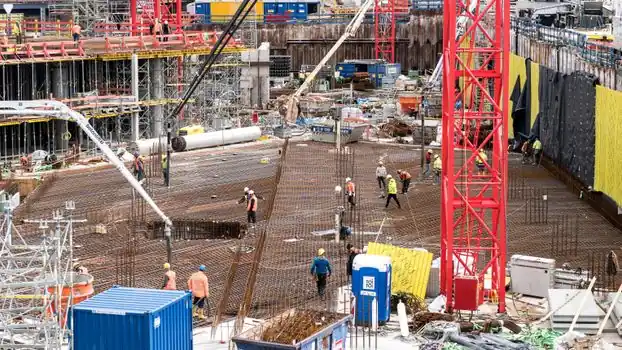
Bar-end thread quality is the dominant failure-mode variable, so a rebar thread rolling machine matched to the coupler maker's specs is non-negotiable, and thread length should be verified against the 100-300 mm engagement window for the bar size in use [S3]. Torque values on parallel-thread couplers are typically specified by the manufacturer and must be checked with a calibrated wrench; under-torqued splices slip, over-torqued ones strip the thread flanks. Plastic thread-protector caps stay on the threaded bar end from fabrication through placement, because concrete splatter or rust in the thread turns a 5-minute connection into a 30-minute re-threading job [S3].
For BIM coordination, coupler information (type, diameter, material, manufacturer) needs to transfer directly to the host bar in the model so that the rebar schedule and the coupler schedule stay in sync, a workflow limitation that Autodesk's Revit Structure forum has tracked since 2017 [S2]. On landscape projects where the engineer, the precast supplier, and the site installer all touch the model, that data continuity prevents a 32 mm standard coupler from being ordered when the drawing actually called for a 32 mm positional (bent-end) variant.
Ordering Volume and Lead Time Reality
Mill-direct couplers typically carry a minimum order quantity around 5,000 pieces with monthly supply capability in the 10,000,000-piece range, FOB Tianjin, with delivery terms FOB / CFR / CIF and typical lead time of 15 days or less after order confirmation [S1]. Landscape projects rarely burn through that volume in one job, which is why most landscape contractors buy through a regional distributor or a fab shop that stocks the common 16-32 mm sizes in 45# and 40Cr grades. Stocking distributors will also hold the matching plastic caps and torque wrenches, which removes two of the most common field-day losses.
For a useful cross-reference on how the same threaded-coupler logic applies inside mechanical-equipment foundations, see the practical walkthrough on Rebar Coupler Selection for HVAC Installation Pads and Equipment Piers, which covers the 14-40 mm size range in a heavier-load context.
Track two signals before locking the landscaping rebar package: confirm the bar grade actually delivered (HRB400 vs HRB500 changes the coupler family), and verify the thread protector caps ship with the order, because bare-thread shipment is the single most common reason field crews reject a coupler shipment on arrival.
Spec-level background on the components involved: rebar.