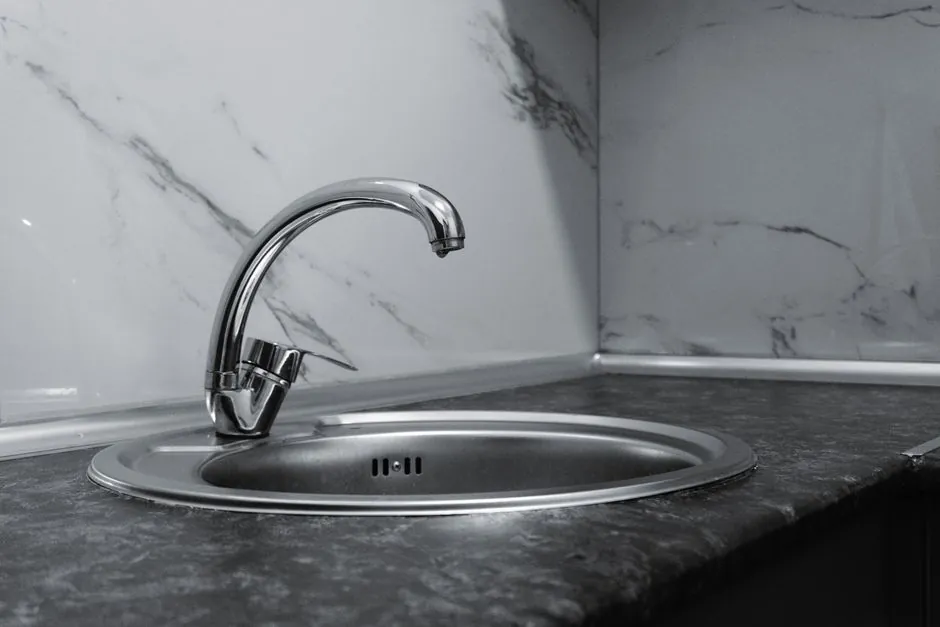
Most compression-type faucet rebuilds use a flat neoprene washer seated against a flat brass seat, and one plumber survey of 705,000 forum posts found roughly 95% of compression stems rebuilt in North America fall into that flat-washer category [S2].
The other 5%, plus most older European-pattern taps, expect a cone (beveled) washer whose slanted face matches a slightly funnel-shaped or worn-conical seat, with the flat face oriented toward the moving stem and the angled face against the fixed seat [S1][S2].
Seat Geometry Is the Deciding Variable
The cone washer exists to mate with a non-flat seat: a brass seat that has worn into a shallow cone, or one that was originally machined funnel-shaped to spread the seal over a larger ring of contact area [S1].
On a flat, machined seat the cone washer does the wrong job: it concentrates load on a narrow line instead of a ring, and it eats into the stem's available travel because the angled face takes up vertical space inside the bonnet [S2]. For a standard North American flat-seat bibb, plumbers consistently warn that "a bigger bibb washer is not better than a small flat washer" and that swapping in a beveled part "could create additional problems" with stem travel and seal life [S2].
Flat Washer: Default for 95% of North American Compression Stems
Flat plumbing washers are the OEM default for North American compression stems, typically molded from neoprene rubber and coded by a 1/4, 3/8, 1/2, 5/8, or 3/4 nominal bore followed by an S/M/R/L outside-diameter suffix [S1][S2].
Reference sizes run from 1/4S (about 16/32 in OD) up through 3/4R (28/32 in OD), with 1/4R at 9/16 in OD being the most common general-purpose bibb size, while 1/2R, 5/8R, and 3/4R are stocked only in the Regular OD because the seat population for those bores is narrow [S1]. Flat neoprene handles the cold-side service well and resists the heat-induced swelling that one plumber specifically tied to beveled neoprene on the hot side: "when you use a beveled washer on the hot side, the heat tends to swell the washer and slow down the flow" [S2].
Cone Washer: Reserved for Funnel Seats, Worn Seats, and European Taps

Specify a cone washer when the seat is demonstrably conical: a worn brass seat that has eroded into a funnel, a replacement seat that was manufactured with a tapered face, or an imported tap whose stem package is European-spec and ships with a beveled washer from the factory [S1][S2].
Mechanically, a beveled washer is a slanted ring designed to align a fastener or seal with a non-perpendicular surface, the same geometry that beveled structural washers use on sloped beams [S5]. In a faucet that geometry lets the rubber conform to a worn seat and recover a seal without pulling the seat, and one long-time plumber reports always reaching for a beveled washer "unless the movement of the stem is so restricted that a beveled one would not open fully" [S2]. In practice that means: confirm full open-travel clearance before committing to a cone.
Material and Heat-Side Failure Modes
Neoprene is the default elastomer for both flat and cone plumbing washers because it tolerates the modest temperature and chemical exposure of residential hot water, but the beveled form is more sensitive to heat-side swelling because the angled face traps more rubber in the hot zone per unit of compression [S2].
For applications beyond potable cold/hot water, a plain rubber washer is usually replaced by a bonded sealing washer (a rubber layer vulcanized to a metal carrier) or a nylon nyltite washer, both of which add chemical, moisture, and vibration resistance the elastomer alone does not provide [S5]. A plumber planning a service interval on a frequently-cycled hot-side stem should plan on a flatter, harder neoprene rather than a soft beveled one to control swell [S2].
Selection Checklist Before You Commit
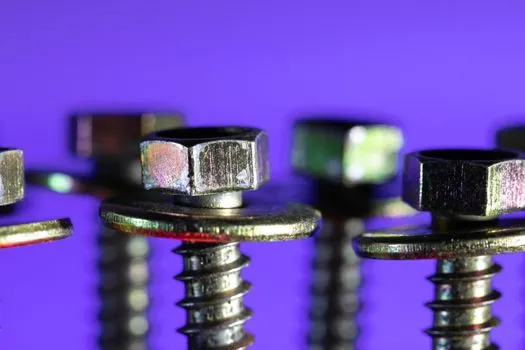
Run this four-point check before choosing flat versus cone: (1) inspect the seat face, flat means flat washer, conical or worn-funnel means cone; (2) confirm stem travel clearance by dry-fitting the new washer with the stem backed out; (3) match the bore code (1/4R, 3/8R, 1/2R, 5/8R, 3/4R) and OD suffix (S/M/R/L) to the old washer or use the life-size charts most distributors print on the package back [S1]; (4) replace the seat at the same time, because a new washer on a worn seat gives the same short life the old washer just finished [S2].
For broader spec-context on how small sealing components interact with pipe geometry and fastener selection in plant builds, the pipe fitting datasheet and expansion anchor selection guides walk through the same bore/OD/thread discipline at industrial scale. For reference geometry on parallel sealing components, the sealing washer, flat washer, and spring washer encyclopedia pages cover the bonded, plain, and load-recovery variants respectively.
Where Cone and Flat Are Both Wrong
If the seat is cracked, eroded below the sealing land, or ovaled from a bent stem, no washer geometry will save it; pull the seat and replace it before deciding flat or cone, otherwise the new washer will simply re-punch the same failure mode in a few weeks [S2].
Also avoid mixing European beveled washers with North American flat-seat stems, and avoid substituting a disc-spring (belleville) washer into a plumbing application: belleville washers are conical steel springs used to maintain bolt preload under vibration or thermal cycling, not to seal water, and the load-versus-seal trade-off is wrong for a bibb stem [S5]. Stay with the OEM washer class for the stem model, and treat cone versus flat as a seat-driven, not a preference-driven, decision [S2].
Trackable signal: when rebuilding any compression stem, photograph the seat face at 1:1 magnification before disassembly so the flat-versus-cone call is made on observed geometry, not on the part still sitting in the packaging. Second signal: log the bore code and OD suffix (e.g. 3/8R = 20/32 in OD) on the work order so the next rebuild matches by data, not by guess.