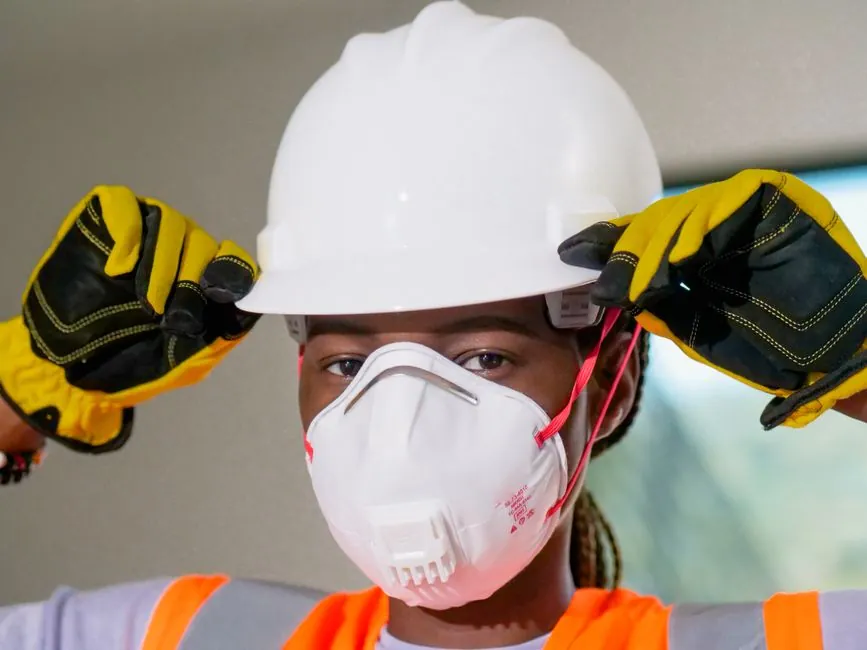
Construction respirator selection runs on two anchors: the hazard inventory (silica, wood, lead, welding fume, solvent vapor) and the OSHA-assigned protection factor (APF) the task demands, with N95 NIOSH-approved disposable respirators as the baseline for most Table 1 silica tasks and P100 filters specified where oil aerosols or higher exposure ratios exist [S1][S2].
The decision tree starts at the same place every time: identify the contaminant, measure or estimate exposure, then match a NIOSH-certified respirator class to the resulting APF. Cutting that step is the single most common compliance failure on U.S. job sites, and the federal enforcement record on 29 CFR 1926.1153 reflects it [S1][S2][S4].
Hazard Inventory Drives Filter Chemistry, Not the Other Way Around
Silica is the headline hazard: respirable crystalline silica causes silicosis, lung cancer, COPD, and kidney disease, and an estimated 2 million U.S. construction workers are exposed on the job, with 8 of every 10 workers who exceed the NIOSH REL working in construction [S2]. Concrete, masonry, tile, highway/bridge, and drywall operations each generate silica through cutting, grinding, jackhammering, abrasive blasting, and tuckpointing, and that task list is what populates the OSHA Table 1 control menu [S2].
Beyond silica, the same selection logic applies to wood dust (carpentry, sanding), lead dust (renovation, paint removal on pre-1978 stock), isocyanate vapor (spray foam, coatings), and welding fume (stainless steel, galvanized). Particulates are addressed with a filter, gases and vapors with a cartridge, and combined atmospheres with combination cartridges, which is the hazard-first branching that 3M's selection flow documents in its public respirator selection guidance [S3].
Filter Class: N95 vs P100, and Why the Letter Prefix Matters
Type 95 (N95, R95, P95) filters usually have a lower cost and lower breathing resistance than type 100 (N100, R100, P100) equivalents, which is why N95 dominates high-volume construction purchase orders [S2]. The letter prefix tells you how the filter performs around oil aerosols: N is not oil-resistant, R is somewhat oil-resistant, and P is oil-resistant (P100 in particular is the workhorse where lubricant mist, cutting fluid, or treated lumber is in play) [S2][S3].
A quick criteria-based comparison for the three filter grades a construction buyer will actually evaluate:
Filter class decision matrix (construction tasks): N95 is the lowest-cost disposable, fits OSHA Table 1 silica tasks with APF 10 (e.g. handheld masonry saw, handheld power saw for fiber-cement board, walk-behind saws, drills, grinders with dust collection), and clears the 95% filtration threshold. P100 is the upgrade to APF 10 with 99.97% filtration and oil resistance, specified when tasks generate oil mist (some lubricated cutting), when the worker has facial hair that breaks the half-face seal, or when the employer elects to derate half-face elastomeric to a higher safety margin. Half-face elastomeric with P100 cartridges (APF 10) is the standard reusable configuration for chronic silica exposure above Table 1 controls; full-face or PAPR (APF 25 to 1000) is reserved for abrasive blasting, confined-space work, or tasks Table 1 does not cover [S1][S2][S3].
Assigned Protection Factor and Respirator Class

APF is the multiplier OSHA credits to a properly fitted, properly used respirator: APF 10 for a tight-fitting half-face (including N95 disposable, half-face elastomeric with N95 or P100), APF 50 for a tight-fitting full-face, APF 25 to 1000 for powered air-purifying respirators (PAPRs) and supplied-air configurations. Selecting a class with insufficient APF for the measured or modeled exposure concentration is the most consequential engineering error in the process, because the air-purifying respirator protects only against hazards it was designed to filter, and only at the assigned factor [S3][S4].
For typical Table 1 construction tasks, APF 10 with N95 or P100 is the regulatory default and is what OSHA deems compliant when paired with the listed engineering controls (water suppression, dust collection, shrouds). Tasks outside Table 1, or scenarios where the employer cannot deploy the listed controls, require air sampling and a written respiratory protection program per 29 CFR 1910.134 [S2][S4].
OSHA 29 CFR 1926.1153 Table 1: The Fast Compliance Path
Table 1 in 29 CFR 1926.1153 matches 18 common construction tasks to dust control methods and minimum respiratory protection, and employers that use the listed controls for the listed tasks are deemed compliant without air sampling [S2]. A few representative rows that recur on most job sites: handheld masonry saws with integrated water delivery or dust collection paired with APF 10 respiratory protection; handheld power saws for fiber-cement board with dust collection plus APF 10; walk-behind saws with water delivery plus APF 10; jackhammers and handheld grinders with integrated water or dust shroud plus APF 10 (and APF 25 for handheld grinders on certain surfaces); drill presses and stationary masonry saws with water delivery plus APF 10 [S2].
The Table 1 fast path collapses when the task, tool, or control is not on the list, when the employer deviates from the listed control, or when the work shifts into enclosed spaces where dust accumulates. At that point the 1910.134 written program, medical evaluation, fit testing, and training chain activates, and the respirator selection reverts to APF math against measured exposure [S2][S4].
Respiratory Protection Program: 1910.134 Is the Real Spec Sheet
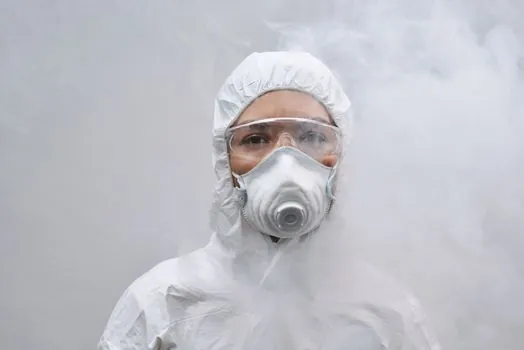
Wearing a respirator on a U.S. construction site without a 29 CFR 1910.134 program is noncompliant, and the program carries the technical requirements behind the filter choice: a written plan, a medical evaluation (OSHA mandatory appendix C), qualitative or quantitative fit testing for tight-fitting respirators, training on use and limitations, and recordkeeping. The 1910.134 Appendix D path applies only when respirator use is voluntary and the standard does not require it, which is rarely the case on silica or lead tasks [S2][S4].
Fit testing is the variable that turns a printed spec into a real protection factor: an N95 with no fit test delivers essentially no quantified protection, and OSHA treats seal leakage as a known failure mode the program must control. Qualitative fit testing (QLFT) with saccharin, Bitrex, isoamyl acetate, or irritant smoke is acceptable for half-face APF 10 respirators; quantitative fit testing (QNFT) with a PortaCount or similar is required to claim APF values on tight-fitting full-face or to document PAPR performance [S2][S4].
Selection by Trade: Putting It Together
For a typical day on a structural concrete pour, the baseline spec is a NIOSH-approved N95 disposable (APF 10) on the cutoff saw and a half-face elastomeric with P100 cartridges (APF 10) on the grinder, with the upgrade to a loose-fitting PAPR (APF 25) whenever the crew is doing extended dry sweeping or enclosed-area demolition. For a renovation on a pre-1978 wood-frame building, the lead-paint cutting task pushes selection past the N95 line into a half-face elastomeric with P100 (HE-style) filters and dedicated wash-down hygiene, and a side-load of eye and skin protection because particulate is only part of the exposure profile [S1][S2][S3].
For welding on stainless or galvanized steel, the filter class shifts again: P100 or N95 for the fume particulate, plus a separate cartridge for ozone and nitrogen oxides if the process warrants, and a welding helmet with appropriate lens shade. For spray foam or coating application, the cartridge line takes over (organic vapor with P100 prefilter), and the half-face elastomeric becomes the workhorse, with supplied-air reserved for confined-space spray where oxygen deficiency or isocyanate concentration cannot be controlled [S3].
Limits, Failure Modes, and Common Spec Mistakes
Three failure modes recur in construction PPE audits. First, choosing a respirator before measuring or estimating exposure: a N95 is correct for many Table 1 tasks but is the wrong tool for a half-face elastomeric credit where a full-face or PAPR is mandated. Second, ignoring facial hair and eyewear compatibility: a tight-fitting respirator does not seal over a beard, and a half-face frame conflicts with most prescription safety glasses, which is where PAPRs and indirect-vent goggles are often the right substitute. Third, mixing filter class and cartridge on the same respirator without verifying NIOSH approval on the combination: a P100 particulate filter clipped onto an organic vapor cartridge works only if the combination is on the NIOSH approval label [S2][S3][S4].
A second envelope of failure is comfort and compliance: a respirator that the worker removes to talk or wipe sweat is not in use, and OSHA treats intermittent use as not in use. Selecting the lowest-profile disposable that still meets the APF requirement, pairing it with a sweat-management exhalation valve where the standard permits, and keeping replacement cartridges in the gang box all raise the effective protection factor in field conditions [S1][S2].
Sourcing, Standards, and Cross-References
The federal standards anchoring every selection are 29 CFR 1926.1153 (silica in construction, with Table 1), 29 CFR 1926.103 (respirator use in construction), and 29 CFR 1910.134 (general industry respiratory protection, including the program requirements and Appendix D for voluntary use). NIOSH certifies respirators under 42 CFR Part 84 and publishes the NIOSH RELs; OSHA enforces the PELs. Outside the U.S., CSA Z94.4 in Canada and EN 529 / ISO 16975-1 in Europe drive analogous selection logic, and buyers should verify the approval mark on the specific lot, not the catalog number [S2][S3][S6].
For a structured cross-reference on adjacent PPE and air monitoring, see construction PPE selection criteria for tool-side dust controls that drive the APF math, and the construction machinery and equipment overview for tool-integrated dust collection performance. For broader PPE program context, the respirator reference page covers filter approvals, and the warehouse helmet selection guide walks the same hazard-first logic for head protection on adjacent sites.
Next trackable signals to watch on the 2026-09-14 horizon: any OSHA update to Table 1 task entries following the 2024 construction silica enforcement initiative, NIOSH revisions to the N95 fit-test panel guidance, and any new NIOSH approval activity for elastomeric half-face respirators with detachable P100 cartridges aimed at the high-turnover construction buyer. Procurement teams should also confirm the approval status of the specific lot on the NIOSH Certified Equipment List before any bulk purchase, because the lot, not the catalog number, is the legal unit of certification [S1][S2][S4].