
Contactors are the heavy-lift switching devices specified for motor starters, capacitor banks, lighting feeders, and resistive heating circuits; industrial relays handle logic-level and pilot-duty switching, with most catalog units rated below 10 A contact current and engineered for high-cycle life [S4].
The functional split shows up clearly in published catalogs: DirectIndustry lists 14 contactor-mount protection relay products from 6 manufacturers (ELFIN, Federal Elektrik, GHISALBA, IMO Precision Controls, PEOPLE Electric Appliance, TECO) [S1], while RS lists more than 1,300 contactor overload relay SKUs in the UK automation-control-gear category alone [S2]. On made-in-China.com, AC contactor model series such as CJX2-D (LC1-D pattern) 3-pole units list at US$2.00–2.31 per piece at 100-piece MOQ, with vacuum contactor and latching relay variants quoted at US$8.22–15.20 [S3].
Definition and Functional Scope
A contactor is a galvanically-separated, electromagnetically actuated switching device built to make and break line-power circuits repeatedly, with arc-quenching chamber geometry sized to interrupt inductive motor currents in the 9 A to 1600 A AC-3 band [S4].
An industrial relay performs the same galvanic-separation function but on a smaller scale: one input driving one or more output poles, with contact sets typically rated 2 A to 10 A resistive, and a mechanical life envelope that exceeds contactor endurance by an order of magnitude because the contacts never see line-voltage arcing [S4]. TE Connectivity groups both devices in its switching portfolio alongside circuit breakers, describing relays as the "galvanic separation of the primary or actuating circuit and load circuits" element with single-input/multiple-output capability [S4].
Current, Voltage, and Lifecycle Bands
Main-contact current is the first discriminator: contactors start around 9 A for small frame sizes and extend through 25 A, 40 A, 80 A, 100 A, 150 A, 250 A, 400 A, 800 A, and 1600 A frames; industrial relays top out near 10 A on the signal side, with high-power relay variants in the 30 A range for specialty loads [S3].
Mechanical and electrical life diverge sharply. Contactors are designed for 1×10⁶ to 1×10⁷ mechanical operations but only 100,000 to 1,000,000 electrical operations under AC-3 motor load, because each pole break erodes the silver-alloy contact surface; industrial relays, with arc energy limited to 24 VDC / 120 VAC pilot circuits, routinely publish 1×10⁷ to 1×10⁸ electrical-cycle ratings on the datasheet [S4]. Coil voltages for both families span 24 VDC, 24 VAC, 110 VAC, 220 VAC, 230 VAC, and 400 VAC, which is why the Schneider Tesys CAD32 control-relay family alone shows seven suffix codes (CAD32b7c, CAD32bdc, CAD32e7c, CAD32EDC, CAD32f7c, and the 24 V–400 V range) on made-in-China.com listings [S6].
Selection Criteria: When to Specify a Contactor
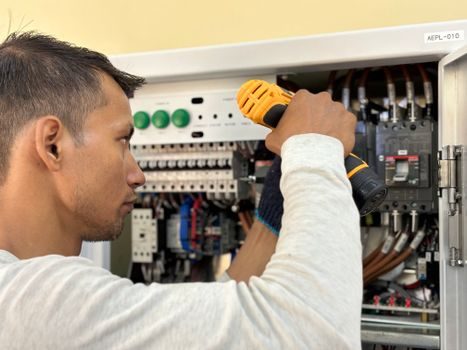
Specify a contactor when the load is a motor (AC-3 duty), a heating element (AC-1), a capacitor bank, a transformer primary, or any three-phase feeder above ~5 kW, and when the control coil will be driven by a PLC discrete output or a pilot relay contact [S4].
Match the frame to the locked-rotor current of the motor rather than the full-load current: a 5 HP / 4 kW 400 V three-phase induction motor typically draws roughly 7–8 A FLC but 40–50 A inrush, and contactor selection in this band lands on a 9 A or 12 A frame such as the CJX2-D09 or CJX2-D12 [S3]. Add a thermal overload relay (bimetallic or electronic) on the same rail to provide the inverse-time trip curve, which is why the contactor overload relay catalog exists as a combined buying category rather than two separate products [S2].
Selection Criteria: When to Specify an Industrial Relay
Specify an industrial relay when the task is signal-level switching: interlocking two PLC outputs to a single actuator, multiplying one control output into four isolated contact paths, level-shifting between 24 VDC logic and 230 VAC pilot circuits, or driving a contactor's coil from a low-current sensor [S4].
For these tasks the contactor is overkill: the inrush handling, arc chamber, and 9 A+ contact rating are unused, while the relay's higher electrical-cycle life and lower coil pull-in power (typically 0.4 W to 1.2 W for PCB-mount relays versus 8 W to 12 W for a 9 A contactor coil) keep the driver circuit cooler. RS lists a single contactor overload relay unit at £45.26 (exc. VAT) in its UK catalog, while small signal relays on the same site commonly list under £5 per unit at 1-off pricing [S2].
Criteria-Based Comparison: Contactor vs Industrial Relay

Four decision criteria frame the choice cleanly. (1) Load current: contactor ≥9 A to 1600 A AC-3, relay ≤10 A (specialty high-power relays reach ~30 A). (2) Electrical endurance: contactor ~10⁵ to 10⁶ cycles, relay ~10⁷ to 10⁸ cycles. (3) Coil power: contactor coil 6 W to 20 W typical, relay coil 0.4 W to 1.5 W typical. (4) Mounting and footprint: contactor on 35 mm DIN rail with 45 mm to 140 mm width per pole, relay on DIN rail or PCB with 6 mm to 15.5 mm width per pole [S3][S4].
The cost band follows the same shape: AC contactor pricing in China starts at roughly US$2.00 per piece for the CJX2-D series at 100-piece MOQ, while small general-purpose relays on made-in-China.com list in the US$0.10 to US$0.80 range for low-volume PCB-mount SKUs [S3][S6]. IMO Precision Controls' 6-SKU range of contactor-mount protection relays on DirectIndustry represents a different segment again — the protection-relay niche that sits between the contactor and the overload relay, handling phase-loss, phase-sequence, and under-voltage monitoring on the contactor mounting plate [S1].
Failure Modes and Sourcing Constraints
Contactor failure modes are dominated by contact welding on stalled-motor inrush, coil burn-out at the lower end of the supply-voltage tolerance band, and mechanical wear of the armature pivot; relay failure modes are typically contact contamination, coil wire breakdown at sustained over-voltage, and socket contact loss on plug-in bases [S4].
Sourcing for both families has consolidated around six functional hubs globally. On made-in-China.com, Yueqing Shendian Electrical (Zhejiang), a Diamond Member audited supplier, lists contactor relay products at US$8.52–10.61 per piece at 5-piece MOQ, and the same hub also surfaces Schneider-branded Tesys CAD32 SKUs at US$8.44–23.65 [S6]. For a fuller view of the wider low-voltage switching market, see this industrial relay catalog brief, and for a process-engineering perspective on how these devices tie into plant-wide control, the Industrial Pump Industry 2026: Pricing Bands, Distributor Coverage and Selection Levers piece covers the downstream motor loads that contactors typically switch. Standards alignment: contactor designs follow IEC 60947-4-1 for AC-3 motor starting duty, and relay designs follow IEC 61810-1 for electromechanical elementary relays; protection relays that mount on contactors additionally fall under IEC 60255 measurement-relay standards [S4].
What Each Device Is — and Is Not — For
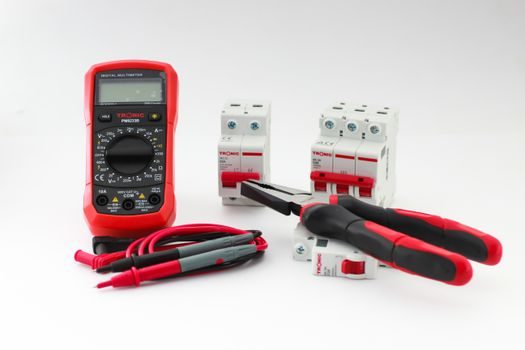
Contactors are for: motor starters in the 4 kW to 800 kW band, capacitor switching with pre-closing resistors, lighting feeders above 100 A per phase, and any inductive load that draws more than ten times running current at turn-on. Contactors are not for: low-power signal multiplexing, PLC output fan-out, or any duty cycle above ~600 operations per hour where the electrical-life curve starts to drop sharply [S4].
Industrial relays are for: logic interlocks, coil-driving of contactors from PLC outputs, multi-output fan-out from a single sensor signal, and interface between mixed-voltage systems (24 VDC logic on one side, 230 VAC pilot on the other). Industrial relays are not for: direct motor switching, capacitor banks, or any inductive DC load above 24 V / 2 A without an external arc-suppression network [S4].
The practical trackable signal from the 2026-07-03 catalog snapshot: more than 1,300 active contactor overload relay SKUs at RS-Online UK [S2], 14 contactor-mount protection relay products from 6 named suppliers on DirectIndustry [S1], and price dispersion in the CJX2-D / Tesys CAD32 bands holding in the US$2–24 / £45 corridor across audited Chinese wholesalers and EU distributors [S3][S6]. Any change in MOQ floors below 5 pieces or in the US$2 baseline at the 100-piece MOQ tier on the CJX2-D family would be the first sign of supply normalisation in the entry-level contactor segment.
For component-level specifications, see industrial adhesive.