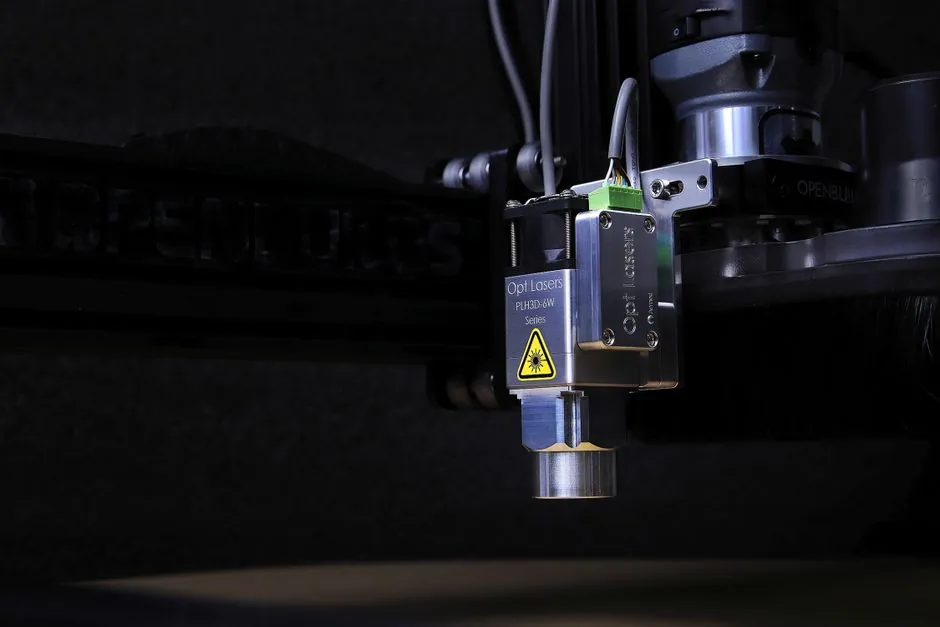
On a conveyor cell, a laser displacement sensor is specified by four knobs: stand-off distance, spot size, target surface behaviour, and output interface, with diffuse-triangulation CMOS heads covering 25-500 mm at ±0.05% linearity, and confocal heads reserved for transparent or specular parts [S5][S2].
Selection is dominated by the package being measured, not by brand: black rubber on a 0.5 m line, shiny steel at 200 mm, and clear PET tray at 120 mm each point to a different optical principle [S3][S5].
Define the measurement task before the optics
A laser displacement sensor is a non-contact device that computes position from the light returned to a receiver, with an analog or switching window set in software or via teach-in [S2]. Standard conveyor cell tasks are part height for pick-and-place, thickness for stacking, run-out for eccentricity checks, displacement for vibration monitoring, and diameter for round parts, each mapping to a different stand-off and spot [S2][S4].
For most lines, 5-10 measurements per second is enough; high-speed lines above 5 m/s need 1 kHz+ sampling, which is where CMOS-array triangulation differs from slow PSD heads, and where a confocal chromatic unit becomes a poor fit because of its low update rate [S5]. Always log target material, target colour, required accuracy in µm, and required repeatability before touching a catalog page.
Stand-off, measuring range, and spot size
Stand-off (S) and measuring range (MR) are linked by the triangulation angle: a 30 mm stand-off typically delivers a 5-8 mm range, a 100 mm head gives 20-50 mm, and a 300 mm head gives 100-200 mm, with spot size growing from roughly 30 µm to 200 µm over that span [S5]. For a conveyor cell with 50-150 mm of vertical play, a 100 mm stand-off CMOS head is the most common pick because it balances MR, spot diameter, and triangulation linearity [S5].
Spot size controls the minimum feature you can resolve: below the spot diameter the reading averages and the value drifts with vibration, so a 50 µm spot is the practical floor for detecting a 0.1 mm edge, while a 200 µm spot is acceptable for 1 mm features or bulk height [S5][S4]. The reference background, position, height, gap, or distance, should be locked in the same specification block, not added later, because background suppression changes the optical geometry and the stand-off math [S3][S4].
Target surface and reflectivity drive the principle

Triangulation CMOS heads work well on diffuse, matte surfaces, including paper, cardboard, painted steel, and most plastics, and they hold ±0.1% of MR linearity on those materials [S5]. On shiny metal, polished stainless, and mirror-finish aluminium, a specular reflection sends the spot outside the receiver window, and the read drops out unless the head is tilted 5-15° from normal [S5]. For transparent film, glass, and clear PET, neither diffuse triangulation nor retro-reflective photoelectric switching is reliable, and a confocal chromatic displacement sensor is the right call because it measures the chromatic focal shift on the target [S2].
Black or dark targets, which absorb the 660-670 nm red laser class commonly used, cut return energy to a small fraction of the white target level, so a Class 2 laser with adjustable emission power, or a blue 405 nm source, is preferred for black rubber, black anodised aluminium, and dark conveyor belts [S3][S5]. If the line mixes colours, background suppression or triangulation with auto-gain is mandatory, since colour-dependent gain shift on a fixed-power head is the most common reason for conveyor-side measurement drift [S3].
Resolution, linearity, and sample rate
Resolution and linearity scale with MR, not with stand-off: a 50 mm MR head is usually specified at 5-10 µm resolution and ±0.05% linearity, while a 200 mm MR head drops to 50-100 µm and ±0.1%, so do not buy a long-range head for a short-range task and expect µm performance [S5]. Update rate follows the same logic: 1-5 kHz is the common range for mid-class CMOS triangulation heads used on conveyor cells, dropping to 50-200 Hz on confocal heads, which is too slow for anything above roughly 0.5 m/s line speed [S5][S4].
For process control rather than pass/fail, a switching output is not enough; you need 4-20 mA or Ethernet/IP, PROFINET, or IO-Link to feed a PLC, with IO-Link increasingly used on brownfield conveyor cells because it carries both the displacement value and the diagnostic data over a 3-wire M12 link [S4]. For thickness on two opposing heads, both heads must be on the same controller channel, or the values drift by 0.5-2% if they are read independently, a frequent source of stack-height errors on palletisers.
Conveyor cell criteria-based comparison
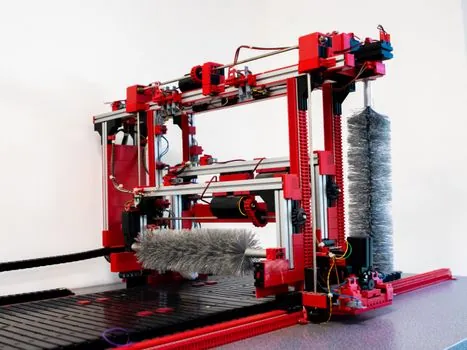
Four common families cover most conveyor cell jobs. Diffuse triangulation CMOS heads suit 25-500 mm stand-off on matte parts, 5-10 µm resolution, ±0.05% linearity, 1-5 kHz update, low cost; background-suppression triangulation variants add colour independence and reject conveyor belt reflection [S3][S5]. Confocal chromatic heads suit 5-50 mm stand-off on shiny or transparent parts, sub-µm resolution, but only 50-200 Hz update, so they fit static lab-style inspection on a stop station, not a moving belt [S2][S5]. Laser distance sensors (time-of-flight) suit 0.5-30 m stand-off, 1-5 mm resolution, and ignore colour, but are too coarse for height or thickness on small parts [S6].
Retro-reflective or through-beam photoelectric switches should be used only for presence, not displacement, because they give a 1-bit answer instead of a continuous distance; they belong on the upstream trigger, not on the gauging head [S3]. Pick the family from the stand-off and target column first, then narrow the model inside the family from resolution and update rate, not the other way round.
Mounting, environment, and integration
Mount the head on a rigid bracket with at least 4 mm steel plate behind the M5 mount, because triangulation geometry amplifies bracket flex; a 0.1 mm flex on a 100 mm stand-off head shows up as roughly 0.5% full-scale error on a 200 mm MR unit [S5]. Cable runs above 10 m on 4-20 mA loops start to pick up noise from VFDs on the conveyor, so shielded cable, separation from motor power by 200 mm, and a 24 VDC regulated supply are standard practice rather than optional [S4][S3].
Ambient light up to 50,000 lux, common in food and packaging halls, will swamp an unfiltered PSD head, while most CMOS triangulation heads in 2026 production include daylight-cut filters and pulsed lasers, so the practical rule is to avoid direct sunlight hitting the receiver rather than to overspec the head [S3]. For washdown conveyor cells, the head must be IP67 minimum, with stainless housing and a sealed M12 connector; an IP65 head will fail inside six months under daily cleaning, which is why laser displacement sensor catalog entries for food lines list IP67 or IP69K as a hard line, not a soft preference [S2][S4].
When to choose a different sensor

For long runs above 30 m, for example, scanning a 50 m log yard conveyor, a laser distance sensor (time-of-flight) is the correct tool and a triangulation head is the wrong one, with sub-mm resolution per metre traded for single-digit millimetre absolute accuracy [S6]. For dimensional metrology that must hold 1 µm across a 50 mm part, a 3D laser profile sensor or a confocal displacement sensor is the right call, and a 2D triangulation point sensor is a poor substitute [S2][S5].
Where the line already has weighing and the new requirement is part mass, a load cell on the conveyor idler or a load cell module on a divert arm is more accurate than inferring mass from thickness with a laser head, because density variation in cardboard and rubber scrapes more error than the optical resolution [S4]. For wider point-distance and gap calls, a laser distance sensor replaces a triangulation head where the required resolution drops below 1 mm and the stand-off moves beyond 500 mm; this is a frequent mix-up on bulk-material lines where engineers order a µm-class head and then ask it to read across a 2 m frame.
For broader displacement measurement on the same conveyor, including position, vibration, and diameter, fall back on a displacement sensor comparison rather than treating all laser heads as interchangeable, since eddy-current, capacitive, and laser triangulation heads overlap in spec but diverge sharply in stand-off and target behaviour. For picking up related selection logic on the same line, the CMM selection criteria for incoming part inspection article covers the lab counterpart, while the gauge block vs thickness gauge: spec map for volumetric accuracy piece covers the static calibration side that protects a conveyor laser gauge from drift.
Trackable signals: new IO-Link v1.2 displacement sensor catalog entries from major suppliers in Q3 2026 will add single-cycle event timestamps for OPC UA, which will change how conveyor cell rejection logic is wired; confirm that any shortlisted head supports the IO-Link process-data map revision in use on the line PLC, and check that the chosen head's M12 keying (A-coded 4-pin vs 5-pin) matches the existing cable harness before issuing a purchase order [S4][S5].