Conveyor chain selection is governed by five interlocking variables: pitch (the center-to-center distance between pins), roller diameter, inner width, tensile strength, and the material grade of the pins, bushings, and plates [S2]. Getting any one of those wrong by even a small margin shows up fast as accelerated wear, vibration, or unscheduled downtime on a chain conveyor line.
Unlike belt conveyors, which depend on a continuous flat surface, chain conveyors use interconnected metal links to pull attachments, slats, or trays through the system, allowing them to handle heavier loads, withstand higher temperatures, and operate in harsher environments than standard belts typically tolerate [S5]. The selection question is therefore less about "which brand" and more about which mechanical geometry and which alloy belongs in the application.
Main Chain Types and Where Each One Belongs
There are eight commonly classified conveyor chain families, each defined by its construction rather than by its manufacturer: roller, attachment, plastic, steel, slat, flat top, double pitch, and leaf chains [S2]. Roller chains use cylindrical rollers on pins to reduce friction on guide rails and sprockets, making them a default for packaging lines and bottling plants where moderate speed and load dominate [S5].
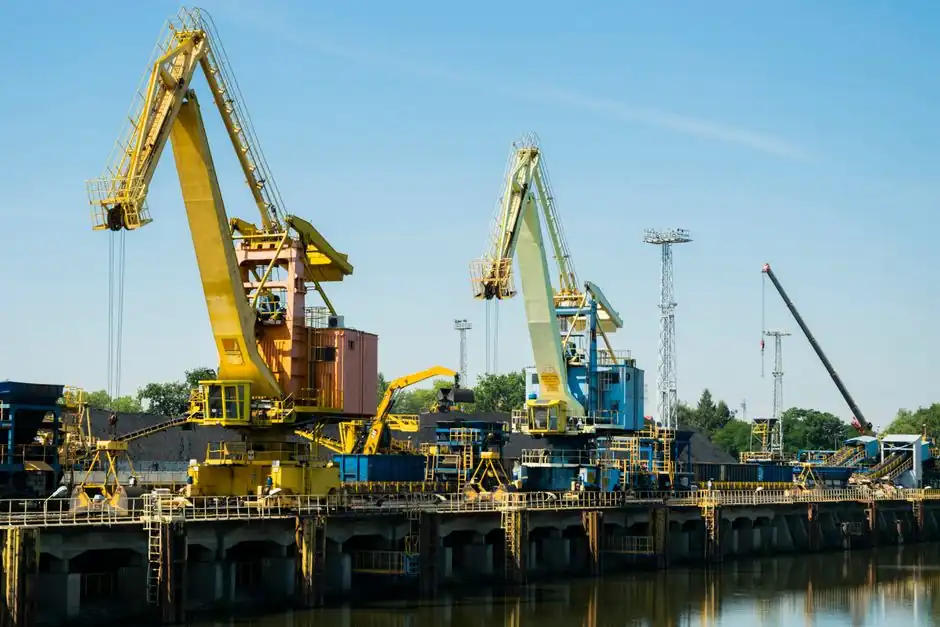
For lighter hygiene-critical duty, plastic modular chains (Span Tech's MiniLink family and equivalents) are the standard choice in food, beverage, pharmaceutical, and cosmetics lines, where they accumulate, merge, divide, incline, and vertically convey without the corrosion risk of carbon steel [S3]. Slat and apron chains use overlapping metal or polymer plates across two parallel strands to carry loose, irregular, or hot bulk material such as ore, aggregates, or scrap without spillage through the gaps [S5]. For vertical lift, bucket elevator chains carry attached buckets that scoop grain, cement, or coal in agricultural and processing plants [S5].
Decision Criteria: Load, Speed, Environment, Layout
Selection starts with four hard numbers from the conveyor datasheet: the peak load per pitch in kilograms or newtons, the linear speed in meters per minute, the ambient temperature range, and the presence of moisture, chemicals, or food contact [S5][S6]. Pitch scales inversely with smoothness: smaller pitch means more links engaged per revolution, lower vibration, and better indexing, while larger pitch cuts chain mass and cost on long, slow runs [S2]. Double-pitch roller chain variants exist specifically for those long, economical runs in agricultural machinery and distribution centers [S2].
Material choice then filters those numbers. Carbon steel is the cost-effective default for dry, standard industrial conditions; stainless steel is mandatory in food processing and washdown environments because of its corrosion resistance; nickel-plated steel sits in between for mildly corrosive or humid service [S5]. For harsh mining and bulk-handling environments, hardened alloy steel is the usual spec, and stainless-steel variants of steel mill chains are used where corrosion combines with abrasion [S2].
Material and Surface Treatment Trade-Offs
Material, structural design, and surface treatment are repeatedly identified as the three most critical factors in chain selection, ahead of brand or supplier [S6]. The structural design element covers attachment geometry, pin extension length, and the presence of K-type or G-type attachments for mounting flights, buckets, or side-flexing carriers; the surface treatment element covers zinc plating, nickel plating, black oxide, or proprietary coatings that change the corrosion and release behavior of the chain in its specific service [S6].
Lighter chains typically run on UHMW polyethylene wear strips to lower friction and cut motor power draw, while heavier chains run on hardened alloy steel tracks sized to absorb the load over a long service life [S2]. That track choice matters as much as the chain itself, because a mismatched wear strip will gall, generate noise, and accelerate pin and bushing wear long before the chain reaches its rated fatigue life.
Sprocket Pairing: Pitch, Profile, Material
Conveyor chain sprockets are typically machined from steel, stainless steel, or hardened alloys, with hardened alloy chosen for high-load or high-cycle applications and stainless steel specified for food, beverage, and pharmaceutical lines [S4]. Standard tooth profiles follow ANSI (American National Standards Institute) and ISO (International Standards Organization) configurations, and the sprocket tooth profile must match the chain pitch exactly; mixing an ANSI sprocket with an ISO-pitch chain, or even running slightly mismatched pitch dimensions, causes excessive chain wear, vibration, and noise [S4].
Common selection mistakes, drawn from operating experience rather than theory, are: picking a sprocket on cost or shelf availability without checking the actual load, ignoring ambient humidity and chemical exposure, and installing the sprocket out of alignment, which then transfers side load into the chain and shortens the life of both parts [S4]. For packaging-line conveyor chain work where the chain is paired with elastomer spiders and other flexible couplings, the same load-and-alignment logic applies across the driveline, as covered in this jaw coupling sizing guide.
Selection Comparison Across the Main Options
Across the four families most often specified, the trade space looks like this: roller chains give the lowest cost and the widest speed range, but need lubrication and tolerate washdown poorly; plastic modular chains give corrosion-free washdown performance at moderate loads, but cap out on tensile strength and high temperature; steel mill / slat chains carry the heaviest hot or abrasive loads and survive temperatures well beyond plastic limits, at the cost of weight and noise; leaf chains deliver the highest tensile strength per unit width and are reserved for lifting and hoisting service such as forklifts and stacker cranes, not horizontal conveying [S2][S5]. For packaging and bottling duty specifically, the sizing sequence is laid out step by step in a spec-first packaging-line selection guide. On the bulk-handling side, where steel mill and drag chains dominate, the same load-and-environment logic also drives chain conveyor layout and sprocket pairing decisions.
Lubrication, Wear Signs, and Replacement Triggers
Lubrication is the lowest-cost life extender in any chain system, and the choice is between manual schedules on a fixed interval and automatic lubrication systems that deliver metered oil to each pin-bushing joint [S5]. For high-cycle or hard-to-access conveyors, automatic systems are specified because they keep lubricant at the wear surface regardless of operator discipline; for low-speed, accessible lines, manual lubrication on a documented interval is acceptable as long as the lubricant is rated for the operating temperature and any food-contact requirement [S5].
Replacement triggers are mechanical, not calendar-based: measurable elongation past the manufacturer's wear limit (commonly a few percent of original pitch), stiff links that no longer articulate freely, visible pitting or corrosion on load-bearing surfaces, and any sign of the chain climbing the sprocket teeth, which indicates worn tooth profile or chain stretch [S2][S5]. Proper tensioning, verified at install and rechecked after the first duty cycle, is the single cheapest preventive action against all four of those failure modes [S2].
Spec Data to Lock In Before You Order
Before any conveyor chain is released for production, the datasheet should carry: pitch in millimeters, roller diameter, inner width between inner plates, plate thickness, ultimate tensile strength in kilonewtons, maximum allowable load, recommended lubrication type, and the matching sprocket part number with its ANSI or ISO profile confirmed [S2][S4]. Material and surface treatment need to be called out separately from chain size, because a "stainless" chain in the wrong grade will still fail in a chlorinated washdown [S5][S6].
For material handling systems more broadly, the same discipline of locking the spec before locking the supplier applies to storage handling and chain belt integrations, where a wrong chain grade or wrong sprocket profile shows up as downtime rather than as a clean test failure. A practical next step is to map each conveyor in the plant to one of the eight chain families above, then audit the sprocket-to-chain profile match and the lubrication interval against the manufacturer's wear-limit data; the second trackable signal is to record baseline pitch elongation on each new install so that the next wear measurement is a real comparison, not a guess.