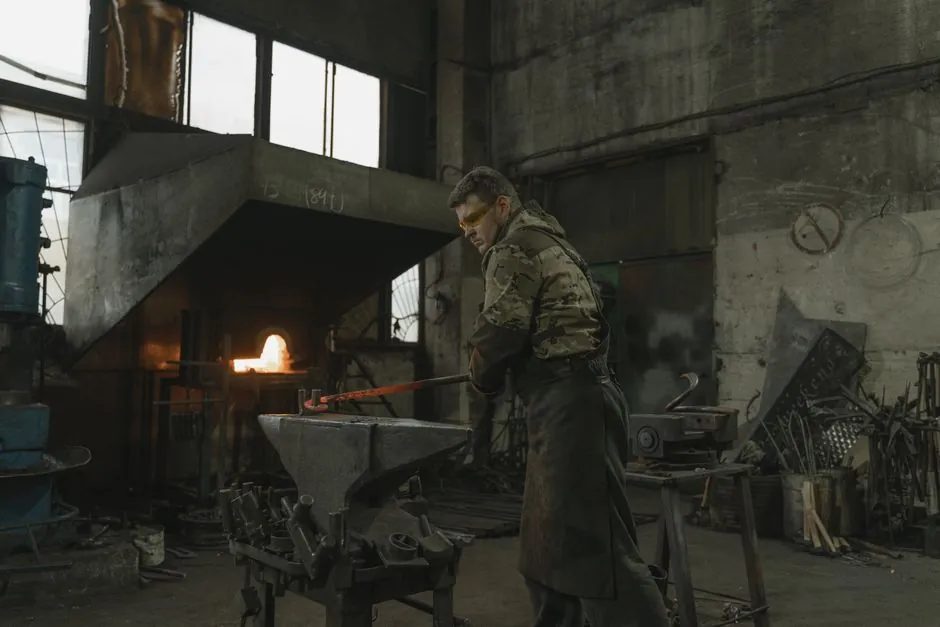
Steel mill shock absorbers live a harder life than almost any other industrial damping job: rolling stand recoil, slab transfer car impacts, coiler mandrel entry, and overhead crane bridge buffers all deliver high kinetic energy at high cyclic rates, often near hot, scale-laden, lubricated environments.
Selection is governed by per-cycle energy input, effective weight, propelling force, hourly cycle count, and the unit's ability to shed heat back to ambient, not by bore size alone. Hydraulic units dominate the steel mill envelope because elastomeric bumpers and air cushions cannot dissipate the thermal load [S2][S4].
Energy, Velocity, and Effective Weight: The Three Inputs You Cannot Skip
For linear motion, kinetic energy Ek (lb-in) is calculated as Ek = W/722 x V^2, where W is moving mass in pounds and V is impact velocity in inches per second; for an overhead crane bridge buffer, Taylor Devices' design guide specifies an effective weight factor of 1.3 times half the bridge weight plus the trolley weight, used for the kinetic energy calculation [S3].
Drive energy Ew = Fd x S (lb-in) must be added to Ek to get total energy Et per cycle, and Fd must stay below the unit's maximum rated propelling force or the calculation must be re-run on a larger bore [S4]. SMC's catalog takes the same path with E = E1 + E2 and a derived equivalent mass Me = 2E / v^2, so engineers can match a candidate unit against the calculated impactor mass before committing [S7].
For air cylinder drives the design guide uses V = 2 x average cylinder velocity (ft/sec); for hydraulic cylinder drives it uses V = 1.5 x average cylinder velocity (ft/sec), a useful shortcut when the supplier's data sheet only lists actuator speed [S3].
Cyclic Rate, Thermal Headroom, and the 240 Cycle Boundary
Hourly capacity Etc = Et x C (cycles per hour) must be less than the unit's rated hourly energy dissipation, otherwise internal oil temperature climbs past seal limits and the absorber fails prematurely, which is why Taylor Devices calls for a 30% safety factor on energy capacity once cyclic rate exceeds 240 per hour [S3][S4].
Stabilus positions its industrial mechanical/hydraulic line for heavy-duty mill and foundation-pour applications where repetitive high-energy events are the norm rather than the exception, and EFDYN markets heavy-duty hydraulic units specifically for rolling and steel mill operations with customizable stroke lengths and a wide bore range to handle the same load profile [S1][S2].
For cyclic rates below the 240/hour threshold, sizing still requires hourly heat-balance verification, but the safety factor can be relaxed; the 240/hour figure is the breakpoint, not a universal baseline, and any unit pushed past its rated Etc will cook its hydraulic oil regardless of stroke length [S3].
Hydraulic versus Elastomeric versus Pneumatic Cushions: A Criteria Comparison

Hydraulic industrial units convert kinetic energy to heat via forced oil flow through orifices, deliver controlled deceleration across a wide velocity range, and handle tens of thousands of inch-pounds per cycle; elastomeric bumpers and pneumatic cushions store energy as compressed gas or rubber strain and are cheap, but they rebound, have limited energy absorption, and degrade fast in mill heat [S2][S4].
Selection breaks down on four decision axes: per-cycle energy absorption (hydraulic wins by an order of magnitude), cyclic rate (hydraulic only, once rate climbs past tens of cycles per hour), ambient temperature tolerance (elastomer softens, hydraulic holds to roughly 80-100 C with standard seals), and unit cost (elastomer is roughly 10-20% of an equivalently rated hydraulic unit, which is why steel mills still fit elastomer bumpers on low-energy stops) [S2][S4][S8].
Viscoelastic and safety-class absorbers (for example, the ACE MAGNUM line) add a controlled-failure mode for end-of-travel stops where a missed brake or overspeed could be catastrophic, and ACE breaks the design problem into five named calculation bases: mass without propelling force, mass with propelling force, mass with motor drive, mass on driven rollers, and swinging mass [S5].
Steel Mill Application Map: Rolling Stands, Coilers, Cranes, Coil Cars
EFDYN groups its steel mill scope into rolling mill shock absorbers, coil handling buffers, pressing lines, and forging lines, all running hydraulic units with custom stroke lengths to absorb high-energy impacts without bounce-back [S2].
Enidine (now part of ITT) lists steel and aluminum rolling mills alongside its heavy-duty hydraulic product family, historically used on screw-down mechanisms, strip coiler mandrels, and runout table transfers where the moving mass is several tons and the deceleration event repeats every few seconds [S6].
For overhead crane bridge and trolley buffers, the effective-weight formulas in the Taylor Devices guide are the steel mill standard practice, because cable-slung loads produce a sling-shot overspeed that must be priced into the kinetic energy calculation before bore size is selected [S3].
Heat Dissipation, Ambient, and Mounting Constraints You Cannot Ignore
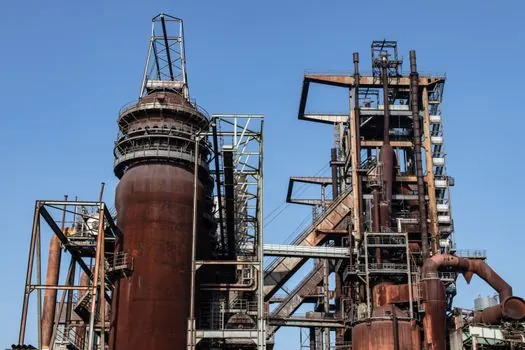
Stabilus emphasizes that its industrial units are built for the heavy-duty service seen in steel mills and construction, which implicitly accepts the elevated-ambient, scale-contaminated, high-vibration envelope; specifiers should still confirm IP rating, rod material, and seal compound against the actual mill bay, not the general-purpose catalog curve [S1].
Langch's selection checklist (2024-08) reinforces that environmental fit (temperature, contamination, wash-down, rod orientation) is a first-class constraint, not an afterthought, when narrowing a candidate list for an industrial application [S8].
85% Efficiency Baseline and the Size-Selection Trade-off
Fluid Power World puts 85% efficiency as a good baseline for typical industrial shocks, a number that any candidate unit's data sheet should meet or exceed before the rest of the energy math is trusted [S4].
Once Et is fixed, several bore/stroke combinations will fit, and Taylor Devices gives the worked example that a 400,000 in-lb input can be handled by a 4 x 10, 5 x 6, or 6 x 3 unit; the choice between them comes down to allowable deceleration, mounting envelope, available space, and unit price, not energy capacity [S3].
For steel mill work, the longer-stroke, smaller-bore option is usually favored on crane bridges (low force, long travel), while the shorter-stroke, larger-bore option wins on rolling stand recoil stops (high force, short travel) [S3].
Selection Workflow: From Calculation to Vendor Shortlist
The repeatable path is: (1) compute moving weight and impact velocity, (2) compute Ek from W and V using W/722 x V^2, (3) compute Ew from propelling force and stroke, (4) sum to Et per cycle, (5) multiply by cycles per hour to get Etc, (6) apply the 30% safety factor above 240 cycles/hour, (7) match against vendor data sheet energy and hourly capacity, and (8) verify ambient derate, seal compound, and mounting envelope [S3][S4][S5].
Vendor shortlists that come out of this workflow for steel mill duty typically include Stabilus industrial units, EFDYN heavy-duty hydraulic, ACE MAGNUM or heavy industrial, Enidine heavy-duty hydraulic, Taylor Devices Fluidicshok, and SMC's BEST-line equivalents, with the final pick driven by bore/stroke availability, lead time (EFDYN cites typically four weeks or less), and local service support [S1][S2][S3][S5][S6][S7].
Engineers specifying mill-duty dampers should also confirm whether the application calls for a standard unit, a self-adjusting unit (W-Series, Uni-Shock), or a safety-class unit, because the wrong class risks either nuisance failures (over-rated) or a hard stop event (under-rated) [S3][S5].
Limitations and Failure Modes Specific to Mill Service
The dominant failure modes in steel mill service are seal extrusion from oil over-temperature, rod scoring from scale and grit ingress, and nitrogen pre-charge loss on self-adjusting types, all of which trace back to either a missed hourly heat-balance check or an inadequate environmental seal spec [S1][S4].
Hydraulic units are also unforgiving on side-load; a misaligned mount on a coiler mandrel stop can wipe a rod seal in days, and standard industrial catalog data sheets assume axial loading only, so any rod-clevis mount near a coil car should be reviewed for side-load margin [S4][S8].
For comparison, the same hot, abrasive, high-cycle environment that punishes a shock absorber is also the reason alloy steel is the default body material for heavy industrial damper housings, and why stainless steel rod options are specified on wash-down or coastal mill sites; shock absorber selection should be paired with a material review rather than treated in isolation [S1][S2][S8].
Trackable signals to watch on the next revision cycle: bore/stroke extensions from the heavy industrial lines (ACE, EFDYN, Stabilus) targeting 500-600 kJ per cycle for next-generation rolling mill recoil, and wider use of self-adjusting units on bridge buffers to remove the sling-shot overspeed adjustment that currently has to be hand-tuned per crane.
Related analysis: Industrial Flooring Selection for High-Rise Buildings: Specs, Zones, and Resin Choices.