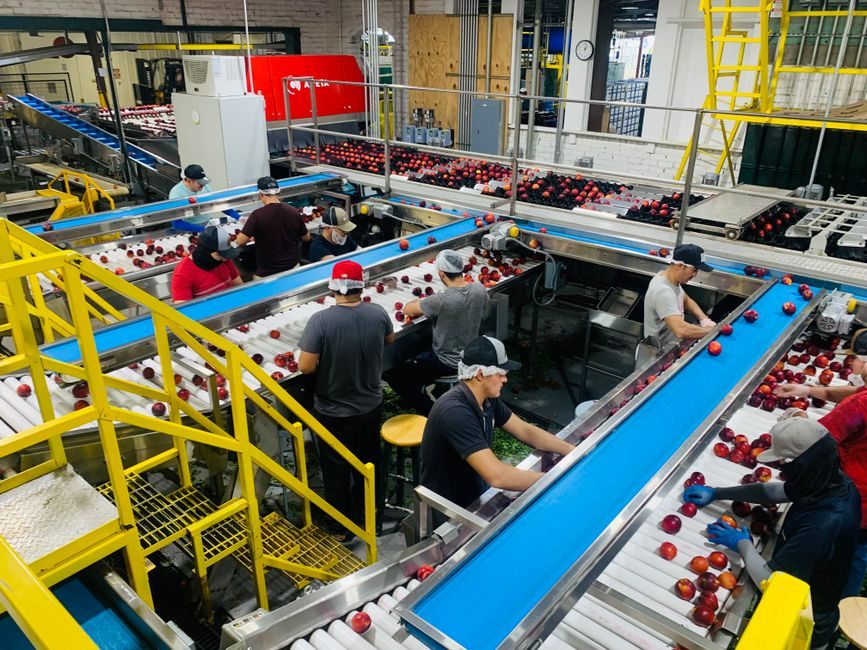
A conveyor sorting line is a powered conveyor-sorting-line assembly of belt, roller, sorter, and zone-control sections that must pass four on-site acceptance steps before the system is handed over to operations: line check, pressure test, flush, and re-installation inspection, all reconciled to a piping and instrumentation diagram, a tag list, the test record, the mechanical completion check record, and the punch list [S3].
This guide covers a typical US-spec horizontal powered installation drawing from the standard product line: slider bed belt, belt over roller, belt driven live roller, chain driven live roller, line shaft live roller, and zero- or minimum-pressure zone accumulation, with gravity sections and custom carts layered in where throughput demands it [S1]. For buyers comparing sorter topologies before they commit, the line vs loop sorter classification map is the natural prior read.
Pre-Installation: P&ID, Tag List and Mechanical Completion Records
Before any bolt is torqued, the sorting line must be reconciled against the P&ID, the equipment tag list, the loop test record, the mechanical completion check record (MCCR), and the open punch list, with on-site verification running through four discrete steps: visual line check, pressure test, line flush, and a final re-installation inspection [S3]. The P&ID defines every drive, idler, photo-eye, and reject diverter; the tag list lets the installer match each conveyor segment to the motor, gearbox, and VFD it ships with. Without this paper pass, the field crew ends up improvising wiring on a live sorter, and that is how commissioning schedules slip by weeks.
A practical pre-install checklist on a 60-meter sorting line with 4 powered zones, 1 cross-belt sorter, and 12 reject chutes typically lists 180-260 individual items — conveyor sections, leg sets, gear motors, photo-eyes, PLC I/O cards, and network drops — and each must show a closed loop on the MCCR before the next section is energized. Integrators running 24-hour component ship programs for stock conveyors [S1] rely on this tag-list discipline so a missing drive can be replaced overnight rather than holding a 4-week production slot open.
Foundation, Frame Alignment and Bolt-Down Tolerances
Frame alignment is the single largest source of chronic sorting-line failure and the easiest to verify on day one: leg-to-leg elevation should sit within ±1.5 mm across any 3-meter span, and the structure-to-floor anchor torque must match the equipment drawing before belt pull-up begins. Cross-belt sorter carriages running on linear guide rails have a parallelism budget tighter than 0.2 mm/m, so a level concrete floor and shimmed baseplates are not optional — they are the difference between a 6-month Mean Time Between Failure and a 6-week one. [S1]
For incline sections and high-speed diverters, structural deflection under load is the next concern: a 6-meter inclined leg with 2 kN/m of belt load will sag measurably if the cross-bracing is omitted, and that sag propagates into belt tracking errors that no photo-eye can compensate for. Field engineers typically pull a tension wire between head and tail pulleys and measure mid-span deviation against the OEM drawing before the belt is even laced. When the layout requires tight radius loop sections, a crossed roller guide carriage carrier should be specified at the crossover to keep angular error below the sorter controller's correction window.
Drives, Belt Tension and Tracking Adjustment
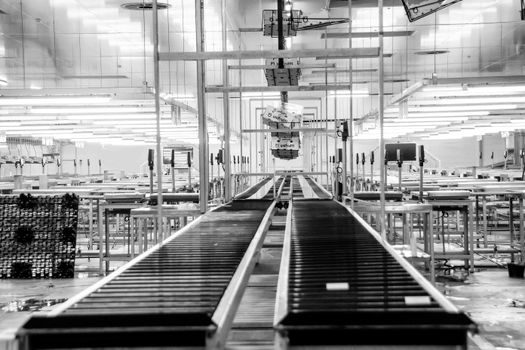
Belt tension on a horizontal powered slider bed typically lands in the 1.2-1.8% elongation window of the belt's rated working tension, measured with a sonic or mechanical tensiometer at the take-up; over-tension is the leading cause of premature motor bearing failure on VFD-driven lines, while under-tension produces slip at the head pulley that trips overload faults. Tracking is set by adjusting the take-up pulley on the tail end — the standard rule is to rotate the adjustment screw in ¼-turn increments, run the belt empty for 5 minutes, and verify the belt returns to the center of the pulley without drifting more than 12 mm per side. [S1]
For chain driven live roller and line shaft live roller zones, the corresponding belt tensioner sizing and selection workflow should be applied to the drive chain, not just the carrying belt, because the chain's stretch is what kills the line after 8-12 months of three-shift operation. A complete reference on the broader sorting system advantages and disadvantages helps sort out whether a chain or belt topology matches the throughput target in the first place.
Controls, I/O Loop Test and Zone Accumulation Setup
Zero-pressure and minimum-pressure zone accumulation depend on a discrete photo-eye and PLC-controlled zone card at every accumulating station; the loop test validates that each zone's eye, the upstream/downstream zones, the motor contactor, and the merge/diverge logic all close the right circuit on the MCCR [S3]. A common 24 V DC photo-eye paired with a zone controller typically pulls 80-150 mA per station, and voltage drop on a long 0.75 mm² trunk can be enough to cause intermittent eye-dropout at the far end of the line — verified by measuring at the last eye and confirming ≥22 V DC under full load.
Commissioning sequence: energize the control panel with all motors disconnected, run the PLC scan with simulated I/O, then bring each motor up zone-by-zone from upstream to downstream, observing direction of rotation, brake release, and current draw against the nameplate FLA. Any zone that fails the loop test or shows a contactor that does not seat cleanly must be flagged on the punch list before the next zone is powered; skipping this step is how an undetected wiring swap ends up running a sorter in reverse at full speed into a stack of totes.
On-Site Acceptance: Line Check, Pressure Test, Flush, Final Inspection
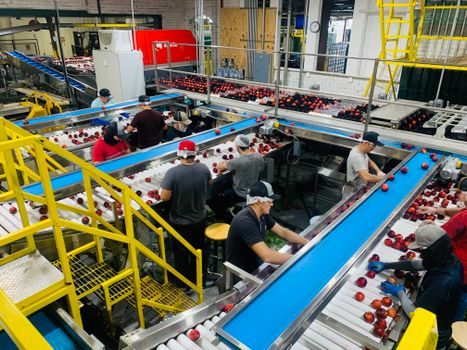
The four-step site acceptance path is non-negotiable on a conveyor sorting line, just as on a process pipe: visual line check (also called line check or walk-down), pressure test of the pneumatic supply that powers diverters, blow-down/flush of the air lines, and a final re-installation inspection before the line is signed over to production [S3]. The line check is the physical reconciliation of the installed equipment against the P&ID and tag list; a typical 60-meter multi-zone line throws 40-80 punch items on a first pass, ranging from missing leg caps to unlabeled motor leads, and these all need to clear before the pressure test begins.
The pneumatic pressure test is run at 1.5× working pressure (typically 6 bar working → 9 bar test) for 30 minutes with no measurable decay, and the flush that follows is sized to displace 3-5 line volumes of dry, oil-free air to clear debris from the diverter and cylinder bores. Only after the re-installation inspection confirms that all guards, pull-cords, e-stops, and light curtains are in place does the line release to production; any open punch item downgrades the line to "mechanically complete but not punch-free," which is a state most plant managers refuse to accept for live operation.
Common Failure Modes and When to Replace Rather Than Repair
The three chronic failure modes on installed sorting lines are belt mistracking (typically from a misaligned tail pulley or worn tracking idler), zone accumulation drift (from contaminated photo-eyes or a failing zone card), and drive chain stretch on CDLR and line-shaft sections. Belt mistracking is a repair item if caught early — adjust the take-up and replace any idler with a visibly worn crown; it is a replacement item if the belt carcass is frayed or the splice has lifted more than 5 mm. Zone accumulation drift is repair up to the I/O level — clean the eye, check 24 V DC at the terminal, swap the zone card — but a failing PLC output transistor or a VFD that has logged three or more ground faults in a month should be replaced, not repaired in place. [S1]
Drive chain stretch is the borderline case: a chain that has elongated by more than 3% over its original pitch is a replacement item, because continuing to tension it accelerates sprocket wear and ends up costing more in a single weekend of downtime than a new chain and matched sprocket set. The same replacement-over-repair rule applies to any molding line or automatic molding line feeding the sorter upstream, because a stalled upstream cell cascades into sorter over-accumulation faster than any controls can correct.
Trackable Signals for the Next Planning Window

Three signals are worth watching in the second half of 2026: the spread between standard 24-hour ship components and custom-engineered lead times, the percentage of new sorting-line builds shipping with VFD-driven zero-pressure accumulation versus fixed-speed minimum-pressure zones, and the open issue count on the punch list at mechanical completion — a metric that integrators running pre-engineered equipment consistently drive down faster than custom one-off builds [S1].