
Copper and copper-alloy production is segmented by the Unified Numbering System into seven wrought families (UNS C10000–C79999) and a parallel cast block (C80000–C82800), giving roughly 370 commercial compositions that engineers can pull from a single designation table [S2].
End-use demand is heavily skewed toward construction: building industry applications account for 47% of annual copper consumption, followed by electronic products at 23%, consumer products at 11%, transportation at 10% and industrial machinery at 9% [S2]. World consumption now exceeds 18 million tonnes per year against that mix, which is why UNS families — not generic "copper" — drive spec sheets [S2].
UNS Family Map: Wrought vs Cast
The UNS layout is a direct reading aid: C10000–C19999 covers wrought coppers and high-copper alloys, C20000–C49999 covers wrought brasses, C50000–C59999 covers wrought phosphor bronzes, C60600–C64200 covers wrought aluminium bronzes, C64700–C66100 covers wrought silicon bronzes, C66400–C69800 covers a second wrought brass block, and C70000–C79999 covers wrought copper-nickels and nickel silvers [S2]. The cast side mirrors this for foundry grades, starting with C80000–C82800 (cast coppers and high-copper alloys), C83300–C85800 (cast brasses), C86100–C86800 (cast manganese/ aluminium bronzes), and continuing through cast copper-nickels — so a C8xxxx designation immediately tells the buyer the part was poured, not wrought [S2].
For spec-driven selection, the single most common water-tube grade is C106/CW024A, which is the European designation for standard plumbing tube and dominates building-services copper [S2]. Engineers working with copper material reference pages usually cross-check the UNS code against the equivalent EN/CW symbol to avoid mismatches between ASTM and EN stock.
Composition Limits and Impurity Caps
Pure-copper stock is not 100% Cu in practice. The Markforged as-sintered copper datasheet (Rev 1.0, 2020-02-13) lists Cu ≥ 99.8%, oxygen ≤ 0.05%, iron ≤ 0.05%, balance other elements, which is the impurity envelope that additive-manufactured pure copper hits out of the printer [S3]. That same datasheet anchors the "pure Cu" mechanical baseline: 193 MPa ultimate tensile strength, 26 MPa 0.2% yield, 45% elongation, 98% relative density, 84% IACS electrical conductivity and 350 W/m·K thermal conductivity at room temperature [S3].
Reference-grade conductivity is defined against the International Annealed Copper Standard, fixed at 0.58 × 10⁸ S/m = 100% IACS at 20 °C, which is why every %IACS value on a copper datasheet can be back-converted to an absolute Siemens-per-metre figure [S3]. For thermal expansion, ASTM E831-19 measurements on as-sintered copper give 9.6 × 10⁻⁶/°F at 68–100 °F rising to 10.5 × 10⁻⁶/°F at 68–750 °F, with MIM reference values running 8.7–9.4 × 10⁻⁶/°F across the same ranges — a tight envelope that designers can use to size bimetallic joints [S3].
Property Stack: Conductivity, Ductility, Cryogenic Stability
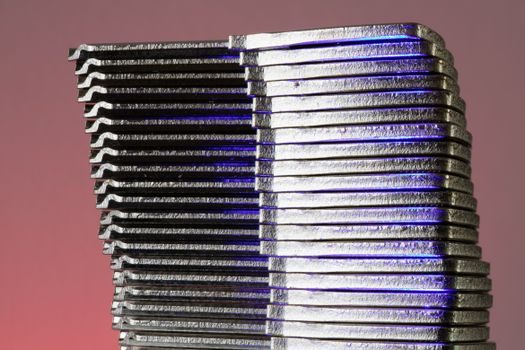
Copper is face-centred cubic, yellowish-red when polished, and combines high electrical and thermal conductivity with toughness, ductility and malleability, which is the metallurgical reason it forms cleanly into tube, wire and deep-drawn sheet [S2]. The same source flags a counter-intuitive property for low-temperature service: copper and its alloys retain mechanical and electrical properties at cryogenic temperatures, so they are routinely specified for superconducting magnet supports and LNG cold boxes rather than carbon steel [S2].
Other baseline properties relevant to selection: copper is non-magnetic, has good corrosion resistance in atmospheric and freshwater service, shows good biofouling resistance for marine heat-exchanger tubing, and is described as "tough, ductile and malleable" — the combination that allows tube forming, wire drawing, spinning and deep drawing without intermediate anneal in many tempers [S2]. For comparison context, engineers weighing non-ferrous options for instrument housings and bourdon tubes can read magnetic material trade-offs alongside the UNS table.
Wrought vs Cast Decision Criteria
Choosing between a wrought and a cast copper alloy comes down to four gates: shape complexity, mechanical-property directionality, minimum order quantity and cost-per-kg at the bought quantity. [S1]
Wrought families (C1xxxx–C7xxxx) are rolled, drawn, extruded or forged and give directional grain flow — meaning a C26000 (cartridge brass) strip has different properties along the roll direction than across it; this is the route for busbars, tubes, plates and deep-drawn enclosures [S2]. Cast families (C8xxxx) pour into sand, investment or die moulds and give isotropic properties with no grain-flow penalty, which is why foundries default to cast copper-alloy for valve bodies, pump impellers and complex plumbing fittings where the geometry cannot be wrought [S2]. The cost trade-off: cast tooling amortises only at volume, so for prototype runs below a few hundred pieces, wrought bar stock CNC-machined is usually cheaper than a one-off casting. Engineers building a process skid that mixes both — wrought copper tube for the heat exchanger plus a cast bronze body for the valve — should pin both UNS codes on the same drawing to keep procurement clean.
Alloy Sub-Family Comparison

Comparing the major sub-families against four common selection criteria (electrical conductivity, marine corrosion resistance, strength, machinability) gives a quick rule-of-thumb matrix, even where exact figures vary by temper: [S2]
Pure coppers and high-copper alloys (C1xxxx) lead on electrical and thermal conductivity — pure Cu reference sits at 100% IACS by definition [S3] — but offer the lowest strength of the group, with as-sintered yield around 26 MPa [S3]. Brasses (C2xxxx, C6xxxx block) are the workhorse for plumbing, architecture and deep drawing, with the leaded versions giving best-in-class machinability. Phosphor bronzes (C5xxxx) add tin for higher strength, better spring behaviour and improved fatigue life, which is why they show up in connectors and switch contacts. Aluminium bronzes (C60600–C64200) are the marine-and-erosion pick, with strength and corrosion resistance well above plain brass. Copper-nickels (C7xxxx) sit at 10–30% Ni for seawater and heat-exchanger service, where biofouling resistance matters [S2]. Cast aluminium bronzes (C86100–C86800) extend the same corrosion-and-strength story into foundry shapes for pumps and ship propellers [S2].
Failure Modes and Spec Pitfalls
Three failure modes dominate copper-alloy field service. First, dezincification in brasses exposed to aggressive water: zinc leaches out of the alloy, leaving a porous copper skeleton with no strength — the standard mitigation is to specify a dezincification-resistant grade (DZR brass) or move up to copper-nickel for the same service. Second, stress-corrosion cracking in ammonia-bearing environments: brasses and some bronzes crack under residual tensile stress, so any system handling ammonia, amines or nitrites should avoid high-zinc brasses. Third, galvanic corrosion when copper alloys are coupled to a more anodic metal (aluminium, zinc) in a wet service — the more noble copper drives accelerated attack on the partner, which is the same galvanic gate covered in the stainless steel installation guide but applies in reverse to copper-tubed heat exchangers bolted to aluminium end sheets. [S3]
A spec-side pitfall: %IACS values are quoted at 20 °C, and conductivity drops measurably as temperature rises, so a heat-exchanger rating computed from room-temperature %IACS will over-promise at the hot end. The Markforged datasheet reports 84% IACS for as-sintered Cu versus 100% IACS for the annealed standard — a 16-point gap that exists even before temperature derating [S3].
Manufacturing Route: Wrought, Cast and Additive
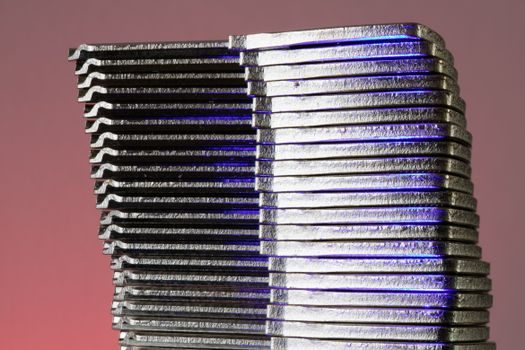
Three manufacturing routes feed copper parts: wrought (rolling, drawing, extrusion, forging), casting (sand, investment, die, continuous), and additive manufacturing. Wrought and cast are the high-volume paths and are encoded directly in the UNS C1xxxx–C7xxxx vs C8xxxx split [S2]. Additive is the newer entrant: bound-deposition metal systems such as the Markforged Metal X print pure copper at 99.8% Cu min, hit 98% theoretical density, 193 MPa UTS, 45% elongation and 350 W/m·K thermal conductivity as-sintered, enabling geometrically optimised heat sinks, induction coils and busbars that are hard to machine from billet [S3]. The same approach opens the door to lattice heat exchangers that pure wrought copper cannot deliver at sensible cost.
For context on the wider additive manufacturing envelope for engineering metals, the additive manufacturing material reference covers how the same process rules apply to copper as to other printable alloys, including sintering shrinkage allowances.
Specifying Copper: What Goes on the Drawing
A complete copper callout has six fields: UNS number (or EN/CW symbol where European), temper designation (e.g. H04 for hard, O60 for soft, as-drawn, as-rolled), product form (tube, sheet, bar, wire, casting), referenced standard (ASTM B75 for tube, B152 for sheet, B271 for castings, EN 1057 for European water tube), critical impurity limits (oxygen, phosphorus, lead), and acceptance test method (%IACS at 20 °C, tensile per ASTM E8, hardness). Without all six, procurement is gambling on one of the other five. [S1]
For instrument-side copper — bourdon tubes in pressure transmitter capsules, orifice plates in flow meter bodies — the most common callout is C36000 (free-machining brass) for the body and C11000 (ETP copper) for the sensing element, with temper pinned to the forming operation. Designers working in marine or chemical service should default to C70600 (Cu-Ni 90/10) or C71500 (Cu-Ni 70/30) over plain brass for the corrosion-resist reason flagged above.
Trackable signal: the next UNS revision cycle and the publication of updated ASTM B249/B249M scope tables will determine whether additive-manufactured pure copper at 99.8% Cu min and 98% theoretical density becomes a stockline designation rather than a custom run [S3]. Engineers specifying copper for new-build projects through 2026 should pin the manufacturing route — wrought, cast, or AM sintered — on the drawing alongside the UNS code, because the mechanical-property delta between as-sintered 193 MPa UTS and fully annealed 207 MPa MIM reference is small but real, and the conductivity delta (84% IACS vs the 100% IACS reference) is not [S3].